Intent Data Integration in Outbound Prospecting Workflows
Intent data only works when reps act on it fast enough to catch buying windows before they close.
- Written by
- Dayo Fashola
- Updated
- October 14, 2026
- Reading time
- 10 min read
- Sources cited
- 5 sources ↓
What this covers
Intent data only pays off when it's wired into a structured workflow, one that runs from signal ingestion through account scoring, rep routing, and message personalization. Most teams skip that wiring, and the numbers show it: 91% of B2B marketers now use intent data to prioritize accounts, yet only 24% report exceptional ROI Autobound. The real story here is the gap between adoption and payoff.
Forrester's April 2026 report called intent data "ubiquitous and consistently underutilized," and the reason wasn't weak signal quality. Teams simply lack a structured way to turn a stream of signals into a prioritized queue reps can act on. Signals land in a dashboard somewhere, a rep glances at it when they remember to, and by the time anyone acts, the account has moved on to a competitor's demo.
That's a workflow failure.
Defining intent data
Intent data is behavioral signal data. It shows that a specific company is actively researching a topic tied to your product category, whether that's reading comparison content, visiting a review site, or digging into a competitor's pricing page.
First-party signals come from your own properties: pricing page visits, demo requests, email clicks, product usage milestones. These carry the highest confidence because you watched them happen directly, but coverage is limited to accounts already on your site. Third-party signals get aggregated from external publisher networks and review sites, and they matter because they show an account is in-market before it has ever touched your domain B2B Intent Data: What It Is, How to Find & Use it In 2026 | Default. 68% of B2B marketers are ramping up investment in third-party intent data because of its early-warning value, per Default's 2026 guide B2B Intent Data: What It Is, How to Find & Use it In 2026 | Default. Hybrid signals stitch first- and third-party data together, and that's the highest-confidence signal, indicating late-stage activity.
First, intent data isn't the same thing as a buying signal. Intent is behavioral exhaust, the pages visited, the topics researched, and it answers "who is researching?" A buying signal is a discrete event with clear meaning, such as a funding round, a job change, or a new job posting. It answers a different question: "what just changed that shifts their priorities?" Teams getting the best reply rates blend both, using intent to narrow the account universe and a buying-signal event to time the actual outreach.
Second, intent isn't fit. Fit data, industry, headcount, tech stack, changes slowly and tells you who could plausibly buy from you. Intent tells you who's in a buying window right now, and that window closes fast. Run intent without fit and reps drown in in-market companies that will never close. Running fit without intent turns timing into a coin flip.
The account-level view matters more than any single interaction. One person downloading a whitepaper at a 500-person company is a mild curiosity. Three people across two different departments engaging with your content in the same week is a buying-committee signal, and that account should jump straight to the top of the queue. This is exactly the timing gap intent data exists to close: 67% of B2B buyers are already deep into their research before they ever talk to a sales rep. Intent data appears while buyers are still shopping, surfacing them in your pipeline before they land in a competitor's instead.
Stage 1: Signal ingestion, where intent data enters the workflow
Signals arrive from different sources, in different formats, on different schedules. Unifying that mess is the first job, and it's a prerequisite for every stage that follows.
First-party signals flow from the CRM, marketing automation, website analytics, and product telemetry you already own; latency here is lowest, and this stream should run continuously. Buying signals, like funding events, job postings, and leadership changes, typically come from separate enrichment tools entirely and need their own ingestion logic layered in.
The operational question that decides whether any of this works: where does the unified signal record actually live? It needs to sit on the CRM account record itself, not inside a standalone intent dashboard that reps open twice a month if that. The direction the whole category is moving is away from dashboards and toward activation, meaning signals that automatically spin up tasks, drop contacts into sequences, and hand reps context without anyone having to interpret a chart.
Tool choice shapes how this ingestion gets built. Bombora runs Company Surge® across a large publisher network and is widely used for third-party topic intent, integrating into CRM and ABM platforms directly. ZoomInfo combines real-time intent with deep contact enrichment and can resolve intent down to the person level, which suits enterprise outbound teams. 6sense predicts buying stage across the funnel and fits mature ABM organizations best. Default isn't a data provider at all; it's the activation layer sitting on top of providers like ZoomInfo, Clearbit, and Apollo, automating routing, enrichment, and CRM sync without engineering work, with its Growth plan starting at $500 a month.
None of this is a one-time setup. Intent data needs to run as a standing monitor with same-day alerts, not a quarterly enrichment pass, because signal value decays on a timeline measured in hours, not weeks. Apollo.io integrates prospecting, enrichment, and sequencing in one workspace suited to SDR/BDR-led GTM teams, surfacing 275M+ contacts filterable by intent and firmographic fit MarketsandMarkets. Dealfront performs IP-to-firmographic matching for anonymous website visitors, offering lower lift suited to SMB/mid-market teams.
Stage 2: Account scoring, turning raw signals into a prioritized queue
Once signals are flowing in one place, they need weighting.
Volume isn't the same as value here. An eBook download often reflects curiosity more than purchase intent, while a competitor comparison or a pricing-topic search carries far more predictive weight for near-term buying activity, even if it happens less often.
Stacking signals across sources beats reading any one in isolation. An account visiting your pricing page directly (first-party) while simultaneously showing a Bombora topic surge on your category (third-party) is a materially stronger target than either signal alone, and platforms like 6sense, Demandbase, and HubSpot's intent integrations already support this kind of multi-signal scoring inside the CRM. Aggregation should happen at the account level before scoring runs at all, since a buying-committee pattern, multiple contacts, multiple departments, same week, should always outrank a single contact clicking one email.
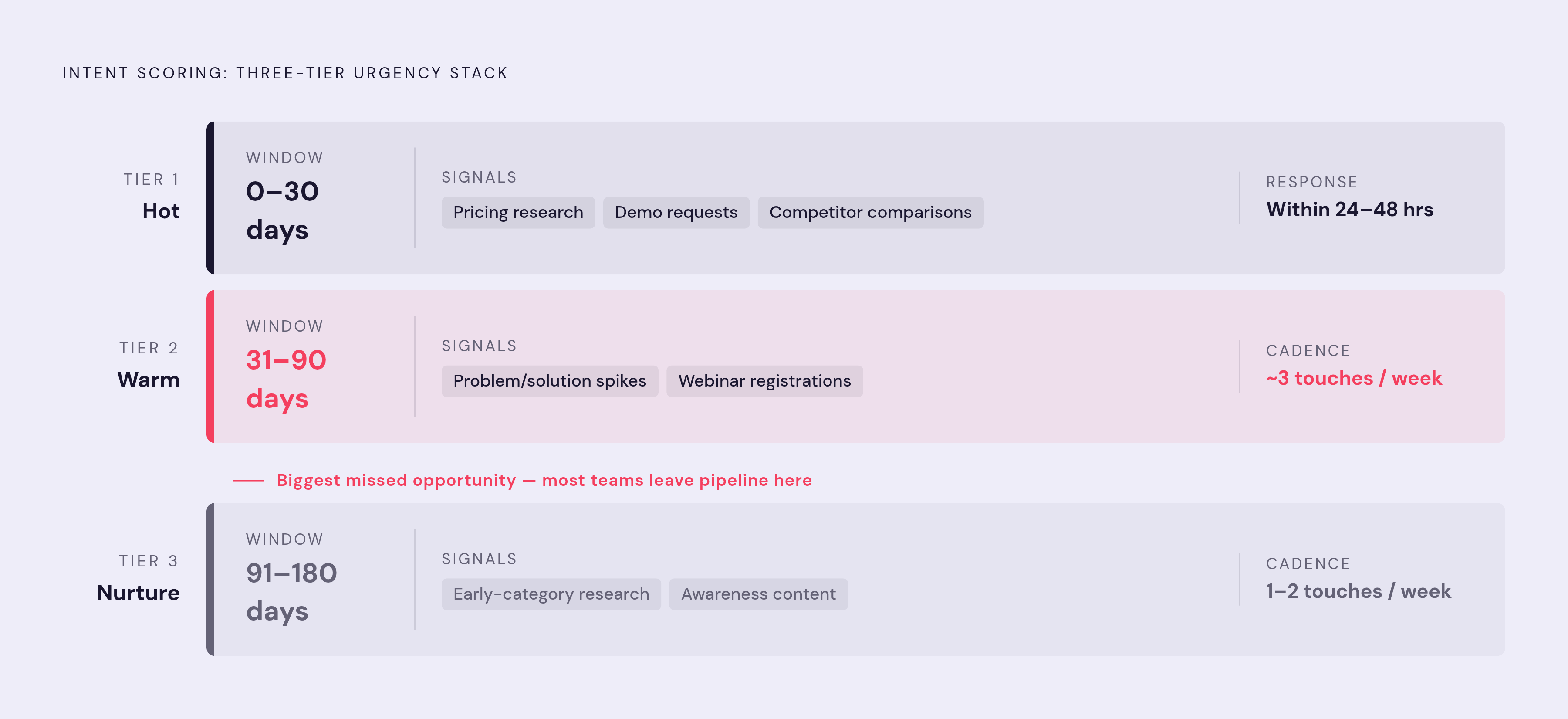
Urgency breaks into three time-horizon tiers. Spanning 0 to 30 days, Tier 1, hot, includes pricing research, demo requests, and competitor comparisons MarketsandMarkets. Tier 2, warm, spans 31 to 90 days and covers problem/solution topic spikes and webinar registrations. Tier 3, nurture, runs 91 to 180 days and covers early-stage category research and general awareness content.
Mid-term intent signals are increasing in volume as buyers extend their self-education phase before engaging sellers, and Tier 2 is where most teams leave pipeline on the table (per Apollo). The score itself needs to live on the CRM account record and update continuously; a number recalculated once a week defeats the entire point of ingesting signals in real time. A survey found organizations using intent data see 2 to 4x ROI in the first year, with 25 to 35% higher conversion rates and 30 to 40% shorter sales cycles, but only when scoring feeds directly into activation rather than sitting in a report. The composite scoring framework follows Apollo's intent prioritization guide. Third-party intent, including topic research spikes, competitor keyword searches, and pricing-page visits on external sites, carries a suggested weight of 40% Data Partners. First-party engagement, including website visits, webinar attendance, demo requests, and content downloads, carries a suggested weight of 35%. Fit, including ICP industry, headcount, tech stack match, and hiring signals, carries a suggested weight of 25% MarketsandMarkets.
Stage 3: Rep routing, getting the right account to the right rep at the right moment
Scoring an account correctly doesn't matter if nobody acts on it fast. Optifai's 2026 benchmark of 939 B2B companies found an average response time of 47 hours, with only 23% of companies responding within five minutes. That's the gap between having a score and having a workflow.
Software alone doesn't close that gap either. Workato's 2026 study of 114 B2B companies found that even organizations using lead-routing tools still averaged 3 hours and 32 minutes to respond. The bottleneck is classification and SLA discipline, not the absence of a tool. The rule of thumb taking hold across the industry in 2026 is 24 to 48 hours from signal detection to first touch for Tier 1 accounts.
There's a real tension underneath that number, though. Most intent signals reflect research mode, not evaluation mode, and reaching out the moment a signal fires risks looking premature to a buyer who's still forming the question. Waiting 7 to 14 days can actually be the better entry point for some signal types, letting the buyer move from "I should look into this" to "I need to find someone who does this well," which is a far more receptive moment for a rep to show up. The resolution isn't picking one SLA and forcing every signal through it: tier-based routing aligns response speed to the signal type itself rather than applying one SLA universally.
In practice, automated routing means the intent score updates the account record, triggers a sequence for the assigned rep, and updates an ad audience simultaneously, so the account gets treated consistently no matter which channel it shows up in next. The routing logic underneath needs to account for territory and existing ownership so it doesn't override current CRM assignments, rep capacity so signals don't pile up on one person while others sit idle, signal tier so Tier 1 goes to a senior SDR or AE while Tier 3 drops into nurture, and firmographic fit so enterprise accounts route differently than SMB ones.
Default's routing engine handles this without code, respecting current CRM ownership rules, which matters because the single most common routing failure is overwriting an existing owner and generating duplicate outreach on the same account. Before adopting Default, leads at OpenPhone sat in queue for roughly 2.5 days on average; after layering in third-party intent and automating the workflow, OpenPhone cut speed-to-lead by 67%.
Stage 4: Message personalization, using signal type to determine what the rep says
The signal should change what the rep actually says, not just who they say it to. A signal type becomes revenue rather than dashboard trivia the moment it maps to a specific play.
A G2 competitor-comparison view calls for a switch-focused message that leads with differentiation instead of a slow education sequence. A Bombora surge on an early-stage category topic calls for the opposite: an insight-led message, not a demo ask, because the buyer hasn't decided what they need yet. A first-party pricing-page visit means the prospect is already weighing cost, so the message should address that directly instead of dancing around it. A leadership change or a relevant new hire calls for a message tied to the priorities that role typically inherits on day one.
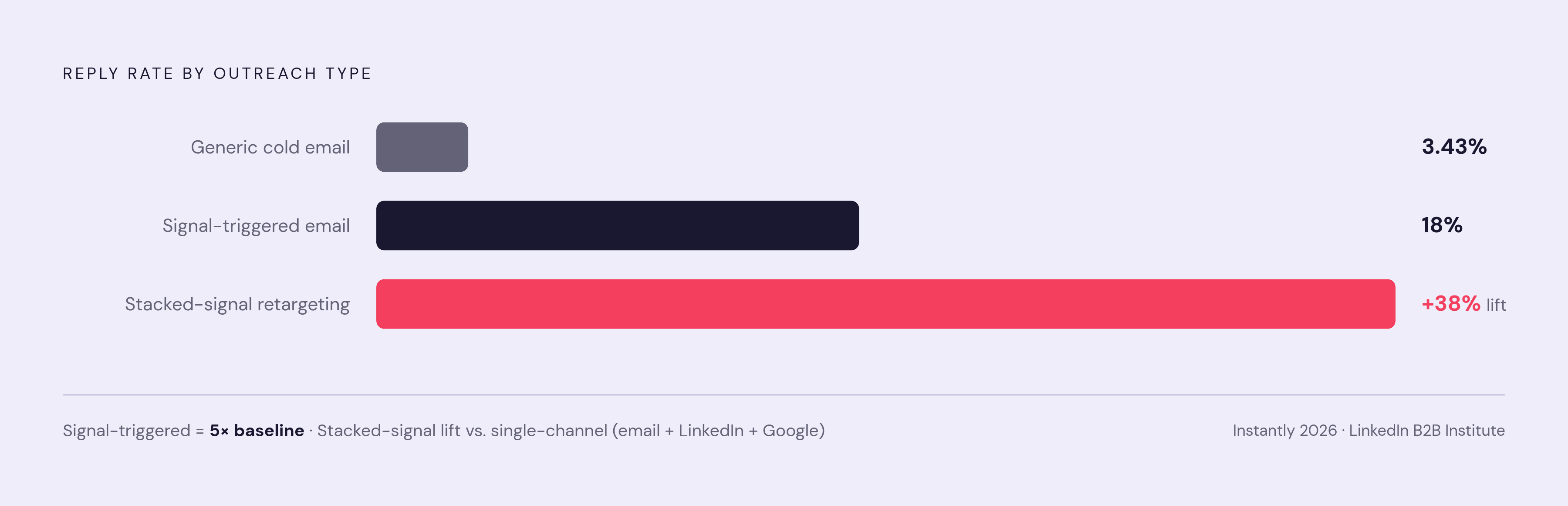
The performance difference this produces is substantial. Hunter's State of Email Outreach 2026 and Lemlist's provider guide both independently put average cold outreach reply rates around 3%, which is the baseline signal-based personalization is beating by that margin.
Stacking channels multiplies the effect further. When a prospect gets a signal-triggered email and also sees retargeting ads on LinkedIn and Google around the same time, LinkedIn's B2B Institute research puts the conversion lift at up to 38% compared to single-channel outreach. Retargeting built on stacked signals is simply a more efficient use of a rep's time than cold prospecting into accounts with no signal at all.
None of this means dropping a company name and industry into a template and calling it personalized. Real personalization gives the rep a specific behavioral fact, "you've been researching X", that changes what the message actually says, not just its salutation. Cadence should shift by tier too. Tier 1 gets high-touch treatment, a call, an email, and a social touch inside 24 hours; Tier 2 gets a value-first cadence of roughly three insight-led touches a week; Tier 3 gets one to two educational touches a week at most. The Instantly 2026 Cold Email Benchmark Report, published in January 2026, found the overall average reply rate is 3.43%, while emails referencing specific trigger events achieve 18% response rates, more than 5x the generic average.
Signal decay and the urgency calculus at each stage
Every stage above assumes the signal is still worth acting on by the time a rep sees it, and that assumption has an expiration date. Different signal types decay on different clocks, and the entire scoring and routing structure only works if that decay curve gets built into it rather than ignored.
A pricing-page visit or a demo request is worth far more on day one than on day five. That's why the industry rule of thumb of 24–48 hours from signal detection to first touch for Tier 1 signals exists in the first place. A topic-research surge from a third-party provider decays more slowly, since it reflects a broader research phase rather than a single transactional action, which is part of why Tier 2 tolerates a slower, more patient cadence. Ingestion has to be a standing, same-day process rather than a periodic batch job precisely because the value inside these signals erodes on a timeline measured in hours, not weeks.
The workflow is the product. The data was never the hard part. Signal freshness windows by type are defined per Clay's intent framework.
Methodology & sources
- 7 Best B2B intent data providers to consider in 2026 for your outbound
Cited alongside Hunter's report to establish the ~3% baseline cold outreach reply rate.
- How Do I Use Intent Data to Prioritize Outbound Targets? | Apollo
Provided the composite scoring framework weights and the observation that Tier 2 is where most teams leave pipeline on the table.
- B2B Intent Data: What It Is, How to Find & Use it In 2026 | Default
Provided the 68% statistic on B2B marketers increasing investment in third-party intent data and explained its early-warning value.
- Intent Data for B2B Sales: The Ultimate Guide to Predictive Sales Intelligence in 2026
Supplied the conversion rate improvements (25–35% higher) and shorter sales cycles (30–40%) figures, plus the Tier 1 signal examples and scoring weight for fit.
- 15 Best Intent Data Providers (2026), Pricing & Reviews
Provided the statistics that 91% of B2B marketers use intent data to prioritize accounts yet only 24% report exceptional ROI.