AI-Generated Personalization at Scale in Outbound Emails
AI personalization beats merge tags when signals stack and data stays fresh.
A bare merge tag now reads as a tell to most buyers. It signals that nobody bothered to look them up, and the email is headed for the trash before the subject line finishes rendering. This piece breaks down how AI-generated personalization works, the signals it pulls, the emails it produces, and why the teams who've rebuilt their workflow around it are pulling reply rates that treat the industry average as a floor.
Volume is the reason the old trick stopped working. Global daily email volume hit 418 billion messages in 2026, up from 380 billion the year before, and the average B2B buyer now receives more than 120 emails a day. AI writing tools made cheap outreach even cheaper, so inboxes filled up faster than buyer patience could keep up with.
The reply-rate data shows how much ground merge tags have lost. Instantly's 2026 Cold Email Benchmark Report, built from an analysis of billions of sent emails, puts the platform-wide average reply rate at 3.43%, down from 5.1% the prior year, a 33% drop in twelve months. That's a 33% drop in twelve months. Basic name-and-company personalization still lifts reply rates into the 5 to 9% range, a real gain over a generic template, but it doesn't come close to what signal-based AI personalization produces. Closing that gap is the entire subject of this piece.
The Scope of AI Personalization
AI email personalization means using machine learning and unified prospect data to build a one-to-one email at scale. It does not mean smarter template automation with a wider set of fields to swap in, and a lot of tools marketed as "AI personalization" are just merge-tag systems with a chatbot bolted on the side. Check that distinction before spending money on either.
Two different kinds of AI do two different jobs here, and mixing them up is where most of the confusion starts. Generative AI writes the subject line, the body copy, and the call to action, pulled from enriched context about the prospect. Predictive AI handles targeting and timing: who should get a message at all, what content fits where they sit in the buying journey, and when sending it is most likely to produce a reply instead of an unsubscribe.
Neither function happens at the push of a button. The pipeline runs in four steps: data collection, then enrichment and signal detection, then content generation, then send-time optimization paired with ongoing A/B testing. Skipping a step, or doing it badly, degrades the output no matter how good the underlying model is. Bad data in means irrelevant email out, full stop. The teams winning at this are the ones with the cleanest data and the tightest feedback loop between what gets sent and what gets learned from the response. They're the ones with the cleanest data and the tightest feedback loop between what gets sent and what gets learned from the response.
The signal stack: what data feeds the AI
One thing decides the quality of a personalized email above everything else: how rich and how recent the signals feeding the model are. Stale data produces stale personalization, no matter how sharp the language model drafting the copy happens to be.
The strongest engines combine six categories of data. CRM data covers past interactions, deal history, and lifecycle stage. Firmographic data covers company size, industry, and revenue. Technographic data tracks the prospect's current tech stack and anything recently added or dropped. Intent data captures content consumption: third-party providers like Bombora, G2 Buyer Intent, Demandbase, and 6sense aggregate browsing behavior across B2B publications to score accounts by topic interest. Public signals cover job postings, funding announcements, leadership changes, and general company news. Relationship data covers mutual connections and shared history.
Some of the most useful signals are also the smallest. Hovering over a pricing page, zooming into a feature comparison, repeat visits to the same product page: these microbehaviors show intent before a prospect ever fills out a form or books a demo. Acting on those early means reaching someone before a competitor even notices they're in-market. A job listing for a Director of Demand Gen is a signal the company is about to buy demand gen tools. A Series A announcement works the same way: it signals budget that's about to move.
Layering signals compounds the effect rather than just adding to it. A funding round on its own might nudge reply rates up modestly. Stacking that funding round with a LinkedIn post from the same executive and a recent job change on the buying team pushes reply rates into the 25 to 40% range. The goal is to collect data that corroborates other data, so one signal confirms what another already suggested.
The four-step workflow: how the AI turns raw signals into a sent email
Step one is data collection. The system pulls from LinkedIn profiles, CRM records, company websites, news feeds, job boards, and technographic databases. Richer input produces better output, and there's no shortcut around that.
Step two is enrichment and signal detection, where platforms actually separate from one another. Raw data doesn't mean much by itself. A job posting for "Head of Revenue Operations" isn't just sitting on a job board, it's a signal that the company is actively building out its go-to-market infrastructure, and turning the raw fact into that interpretation is the hard part. That judgment call is what separates a genuinely useful platform from one that just scrapes and dumps.
Step three is content generation. An LLM takes the enriched signals, combines them with a prompt template encoding the messaging framework, the value proposition, and the tone, and drafts the personalized elements of the email. The better practice is to generate chunks, not full emails: the AI writes the opener and the line referencing the specific signal driving relevance, while the sequence structure and the call to action stay fixed and human-approved. Length matters too. Shorter emails tend to outperform longer ones. Brevity here isn't a limitation forced by the format, it's a feature that respects how little time a buyer actually has.
Step four is send-time optimization paired with a feedback loop. The AI analyzes engagement patterns to predict which send windows are most likely to land a reply, while parallel A/B tests on subject lines, openers, and calls to action feed results back into the model to sharpen future output. Timing isn't a footnote here. Triggered behavioral emails, sent within 60 minutes of a prospect's action, land transaction rates many times higher than non-personalized campaigns sent on a generic schedule.
Matching personalization depth to prospect value: the three-tier framework
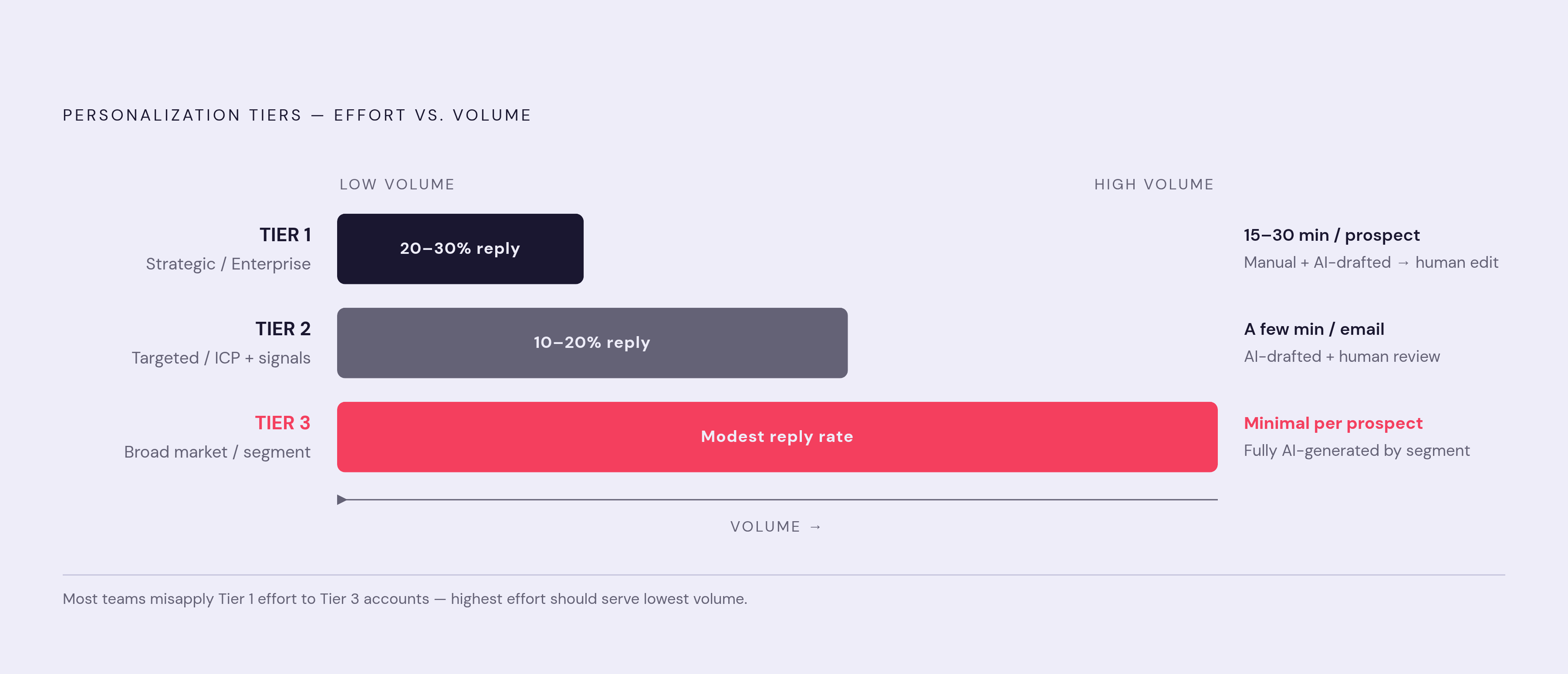
Practitioners have largely converged on a three-tier system for deciding how much personalization effort a given prospect deserves, and treated as an operating framework rather than a loose principle, the math behind it holds up.
Tier one covers strategic accounts: dream accounts, enterprise logos, C-suite contacts. The method is manual research combined with an AI-drafted email that a human edits by hand, pulling from deep prospect research including public signals, LinkedIn activity, and mutual connections. Research alone can run 15 to 30 minutes per prospect, expected reply rates are between 20 and 30%, and volume stays small by design. AI earns its place here by finding the detail buried in an SEC filing, or the pattern across several data points that a rep under time pressure would never get to manually.
Tier two covers targeted accounts: companies that fit the ideal customer profile and are already showing active buying signals. The method shifts to AI-drafted with a human review pass, pulling from job postings, funding rounds, tech stack changes, and company news. Time drops to a few minutes per email, expected reply rates run 10 to 20%, and volume moves up substantially.
Tier three covers the broad market: accounts that fit the profile but aren't showing any active signal right now. The method here is fully AI-generated, but at the segment level rather than the individual level. Group prospects by shared traits, same industry paired with the same hiring trend, or same tech stack paired with the same pain point, and generate messaging variants per segment. Expected reply rates are modest next to the other tiers, but still meaningfully better than a generic template blasted to the same list. Volume here scales well beyond the other tiers.
Most teams get this backwards. They pour tier-one effort into tier-three accounts because manual research feels like the safe choice, and they end up covering a fraction of the pipeline they should be working.
The performance gap in numbers: what AI personalization delivers
AI-personalized emails average an 18% reply rate against 3.4% for generic templates. That average hides more than it reveals, though. Most teams cluster well below 18%, while a smaller group pulls the number up sharply, and that distribution is the real story.
Teams using AI with intent-based targeting consistently reach the 10 to 15% range. Teams stacking multiple signals, the funding-plus-LinkedIn-plus-job-change combination from earlier, reach 25 to 40%. Read against that spread, 18% represents a benchmark that well-built programs can meet or exceed.
The revenue evidence backs up the reply-rate evidence. McKinsey's research shows companies that excel at personalization generate 40% more revenue from those activities than average performers do. The Campaign Monitor 2026 Benchmark Report, drawn from 30 billion sends across 200,000 brand accounts in 48 countries, found that AI-powered hyper-personalized emails reached transaction rates up to 9 times higher than batch-and-blast campaigns sent to an undifferentiated list.
Why scaling volume without data hygiene backfires on deliverability
AI drops the cost of a personalized email from what manual research used to demand down to somewhere around $0.03 to $0.15. Cutting volume up simply because each email suddenly costs almost nothing tempts teams into the wrong move, even though that's the same shift that makes AI personalization worth adopting. That instinct is the fastest way to waste the advantage AI just handed you.
Email providers don't measure quality the way a marketer might expect. They measure engagement, and low open rates paired with high spam complaints from over-sending damage a domain's sender reputation for every future email that domain tries to send, not just the batch that triggered the problem. Volume without hygiene is how a team torches its own sending infrastructure in a matter of weeks, and there's no fast way to earn that reputation back once it's gone.
Consumer behavior already reflects the fatigue. Consumer fatigue with over-sending is well documented, driven by too-frequent sends, sales-heavy content, and repetitive or generic copy. Buyer skepticism about unsolicited email is significant and growing. That's the skepticism every AI-personalized email has to cut through before the personalization even gets a chance to land.
The efficiency case: what AI does for the SDR's working day
The manual math on personalization was never sustainable. Research alone takes 15 to 30 minutes per prospect. An SDR trying to send 50 personalized emails in a day would burn the entire shift on research and never write a single word.
AI collapses that math. Sellers using AI tools dramatically cut research and personalization time while holding reply rates steady or improving them, and tasks that used to take 15 minutes now take 15 to 60 seconds. Output capacity jumps accordingly, from roughly 30 emails a day up toward much higher volumes. But the three-tier framework from earlier should stop a team from scaling recklessly just because the tooling now allows it. Volume was never the win condition here. Matching effort to account value is, and any team that treats speed as the whole story will end up back where merge tags left them.
Only 5% of sales teams currently personalize every email they send, even with all of this available. That gap isn't a knowledge problem, and it isn't a lack of intent either. Most teams simply haven't rebuilt their workflow around the pipeline that actually produces the reply rates laid out above. Until they do, the merge tag stays their ceiling instead of their floor.