Multichannel Outbound Sequencing for Mid-Market B2B SaaS
Coordinated multichannel sequences beat parallel outreach by 4 to 7 times.
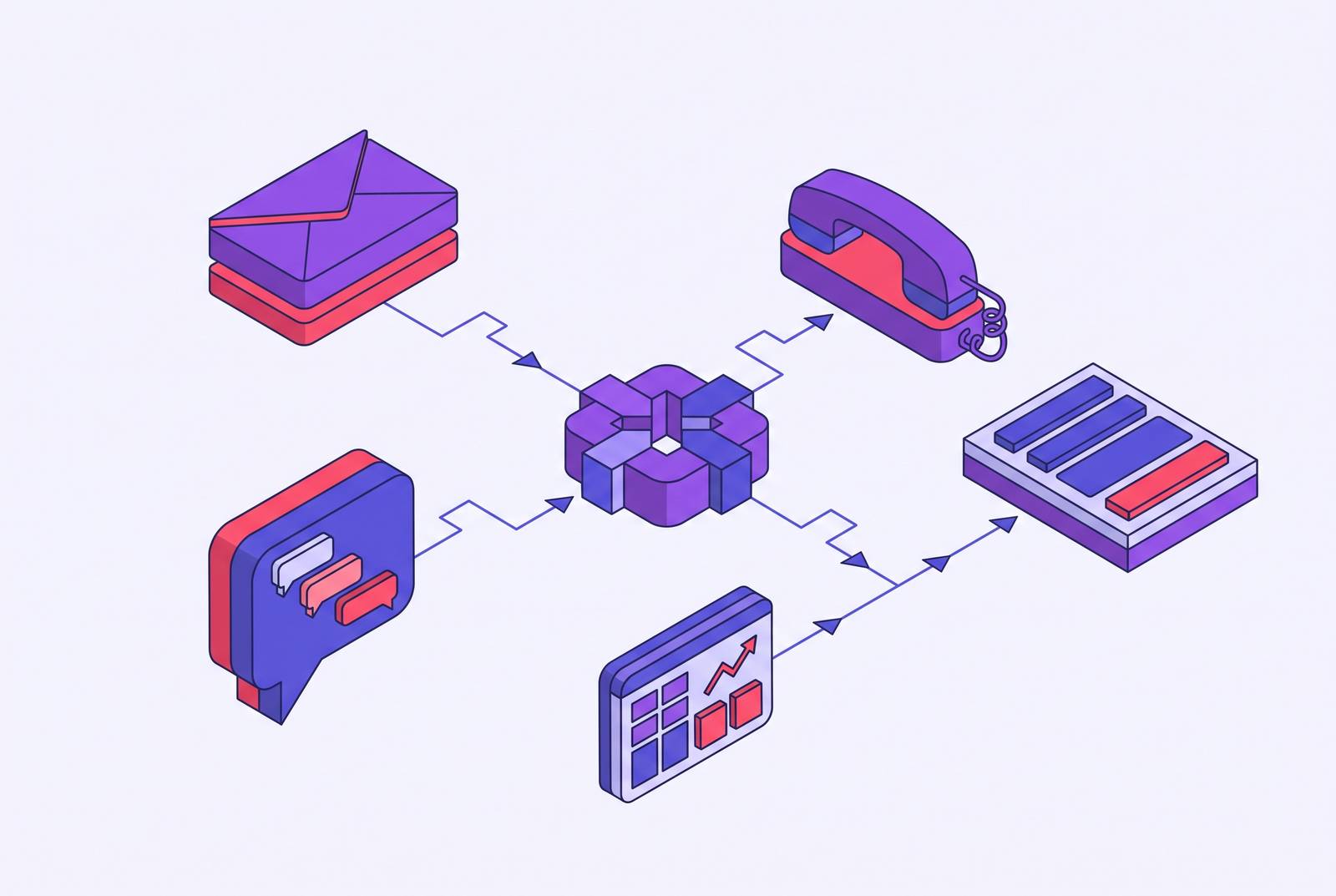
Multichannel outbound sequencing is the baseline for mid-market B2B SaaS teams now, and the gap between teams pulling 15 to 25% reply rates and teams stuck at 1 to 3% has nothing to do with send volume. The sequence's construction determines the outcome: timing, channel order, and how precisely the team picked who gets contacted. Most teams still get this backwards. They pour their energy into targeting when the real gap is timing, or they chase volume when the real gap is coordination.
Cold email as a standalone channel has hit a wall it can't get past. Email providers now weigh opens, replies, and deletions to decide where a message lands, so blasting low-engagement volume doesn't just underperform, it damages the sending domain for every campaign that follows it. Average B2B cold email reply rates run between 1 and 5%, and the average decision-maker now gets a high volume of sales emails. Volume stopped being an edge a while ago. Targeting and timing are what's left, and most teams are still spending their energy on the wrong one of the two.
What the mid-market buying window looks like
Mid-market, for sequencing purposes, means organizations with 100 to 999 employees and deals in the $5,000 to $75,000 ACV range, averaging around $40,000. That band justifies a real two-stage sales process, but it doesn't need the drawn-out cadence built for enterprise. Treating it like a smaller version of enterprise is the single most common design mistake in how these sequences get built.
The median sales cycle now runs 84 days, with the productive window between 46 and 75 days. That window is the actual constraint that should set sequence length: long enough that it takes 8 to 12 coordinated touches to earn a response, short enough that borrowing a sprawling 12-week enterprise cadence misreads the buying motion.
Win rates aren't making any of this easier. The Ebsta x Pavilion 2025 GTM Benchmarks report shows win rates falling to 19%, down from 29% in 2024, driven by warier procurement, larger buying committees, and more crowded competition across nearly every SaaS category. Fewer deals close, and the ones that do close take longer to get there. A sequence built for the wrong window doesn't just underperform. It runs past the point where the deal was ever winnable.
The lift that comes from coordinating channels rather than running them in parallel
Single-channel email converts at 1 to 3%. Adding LinkedIn and phone into a coordinated sequence lifts reply rates to 8 to 15%, and layering in personalized video pushes mid-market prospects past 20%. The lift doesn't come from more channels giving a message more chances to land. It comes from what coordination does to how the prospect reads the outreach.
A coordinated sequence has each touch reference the one before it: the LinkedIn note mentions the email that just went out, the call opens by referencing the message left on Tuesday. A parallel sequence fires email, LinkedIn, and calls independently on a schedule, with no touch aware the others exist. That distinction is the whole game. Properly orchestrated omnichannel sequences have been shown to produce 4 to 7 times higher response rates than parallel multi-channel outreach, because the prospect experiences the outreach as one thread instead of three strangers showing up in three different places the same week.
Coordination, not a vague sense of consistency, produces that gap: when a prospect gets a cold email, plenty check the sender's LinkedIn before they reply." When a prospect gets a cold email, plenty check the sender's LinkedIn before they reply. A thin or dormant profile raises the bar for a response even when the email copy is good. Coordination means making sure the prospect finds something real when they go looking, because they will look, and a sequence that skips this step is betting the copy alone can carry the whole interaction.
How each channel performs and what its role in the sequence is
Cold email still carries the sequence, but its numbers have softened. Platform-wide average reply rate is 3.43%, down from roughly 5.1% in 2024 and around 7% approximately two years prior. Top quartile senders hit 5.5% or better, and top performers clear 10.7%, a gap that comes down to sequence quality and signal targeting, not send volume. SaaS and Software is the worst-performing vertical, landing at 1.9 to 3.5%, because those inboxes are the most saturated in B2B. Mid-market SaaS teams should benchmark against that floor, not the platform average, or they'll walk away thinking they're underperforming when they're actually average for the category.
Format changes results more than most senders assume. Emails between 50 and 125 words, with subject lines under seven words, beat longer formats by a wide margin. One clear call to action beats a menu of options, and manufactured urgency reads as what it is. Timing follows a pattern too: Send timing patterns do exist across the industry, though the specifics vary by source and audience. Friday consistently draws the weakest engagement across most reported data. Apple Mail Privacy Protection, now used by more than 95% of Apple Mail users, inflates open rates by an estimated 18 percentage points. Open rate has turned into a vanity number. Reply rate is the only one still worth trusting.
LinkedIn does a different job entirely, and treating it as a second inbox for the same cold pitch wastes the channel. Salesmate data shows cold message reply rates run 5 to 15% with proper targeting, and InMail response rates range from 18 to 25%, well above what cold email pulls for senior buyers. Email still wins on raw volume, benchmarks put cold email average reply rates above LinkedIn InMail's average, and on daily send capacity, by something like a 10x margin. LinkedIn earns its place in warm follow-up and social proof through a profile view ahead of the first email so a real person shows up when the prospect checks, plus a connection request on day two and a DM after a missed call. Senior buyers respond disproportionately to LinkedIn over cold email, so persona targeting should weight the channel harder the higher up the org chart the contact sits.
Cold calling carries a reputation it hasn't fully earned. Average dial-to-meeting conversion runs around 2 to 3%, while top-performing teams hit 5 to 8%, a gap driven by data quality, call timing, and coaching, not anything wrong with the channel itself. That spread between average and top-performing teams is a useful benchmark for what a well-run call motion looks like in practice. Phone works best from touchpoint four onward, after two or three prior email and LinkedIn exposures, so the caller can reference prior outreach and take the cold edge off the call. Mid-week calling tends to outperform Monday and Friday, and avoiding midday blocks generally improves connect rates.
Personalized video is the newest layer and the hardest to standardize. A short video recorded for one specific prospect stands out in an inbox full of templated text, and tools like Vidyard and Loom have cut production time down considerably. Some platform-level data has pointed to higher open and reply rates on video-containing emails, though those figures come from individual vendors and should be treated as a hypothesis to test rather than a guaranteed lift. Video earns its place on high-tier accounts where the personalization investment pays off, layered mid-sequence to re-engage prospects who've gone quiet.
ICP precision and prospect tiering before the sequence runs
Most teams define their ICP at the company level and stop there. Defining the ICP only at the company level and stopping there is the mistake. Knowing the target is a Series B SaaS company with 50 to 200 employees tells the team who to target, not who to actually reach or what to say to them. The decision-maker persona, meaning their functional role, the outcome they're accountable for, and the language they use to describe that outcome, is what determines the real contact and the real message.
A three-layer framework separates fit from priority. Layer one is firmographic: industry, company size, revenue, geography, tech stack, growth stage. This is table stakes, since every competitor filters on the same fields, and it should never be mistaken for a differentiator. Layer two is behavioral: website visits, competitor content engagement, intent data, job postings for roles the product supports, champion movement between companies. Layer three is contextual triggers: funding rounds, executive hires, M&A activity, product launches, conference attendance.
Teams that layer multiple signal sources together report 47% better conversion than teams relying on one source alone. Website visitors convert to meetings at roughly 7 times the rate of cold prospects, and that gap alone should push most teams to invest in behavioral tracking before they buy another sequencing tool.
Tiering decides where the personalization budget actually goes. Roughly the top 10% of accounts sit in Tier 1, matching every ICP criterion and showing active buying signals, which warrants full personalization, manual review, and priority routing. Tier 2, around 30% of the pipeline, has strong firmographic fit with fewer signals, and gets moderate personalization with automated sequencing and human spot-checks. Tier 3 has firmographic fit only, and it's the group most teams overinvest in. A lighter touch, a longer cycle, or outright deprioritization beats burning rep time on accounts showing no signal.
Signal-based timing: why the same message sent at the right moment outperforms a better message sent cold
Templated sequences with no signal behind them have collapsed to below a 1% response rate. Top-performing teams anchor every message to something real happening at the account, and signal timing is widely regarded as among the most consequential variables separating top performers from the rest.
Funding announcements, particularly Series A through C rounds, tend to precede a buying cycle for infrastructure and go-to-market tooling, making them a trigger worth building actual workflows around. A new VP of Sales, CRO, or CMO signals a likely evaluation of... Funding announcements, particularly Series A through C rounds, tend to precede a buying cycle for infrastructure and go-to-market tooling. A new VP of Sales, CRO, or CMO signals a likely evaluation of CRM, enablement, or prospecting tools within their first few months on the job. An SDR hiring surge tells you an outbound motion is scaling and will need supporting tooling, which matters a great deal for SaaS teams selling into sales orgs specifically. Tech stack changes, like a prospect adopting a competitor's product or dropping one, show up in intent data platforms. Champion movement, where a former customer moves to a new company, is often the highest-converting trigger of the group, and it's the one most teams forget to track. Website behavior, especially repeat visits to pricing or solution pages, is one of the only observable footprints left of a buyer's research process.
That last point changes how buyers actually get to a purchase decision. B2B buying research shows buyers spend only about 17% of their total buying time actually talking to suppliers, and a large share of B2B buyers now use LLMs to research vendors before they ever pick up the phone. Most of the evaluation happens somewhere sales can't see it, in what's sometimes called the dark funnel. Behavioral signals are the few footprints that process leaves behind, and that is why they carry so much weight in a well-timed sequence.
Signals compound when stacked, and they should be read that way rather than one at a time. One signal on its own is a maybe. Firmographic fit plus a behavioral signal plus a contextual trigger, all pointing at the same account the same week, is a task for today.
Building the sequence: architecture, channel weighting, and touch logic for mid-market
Mid-market sequences run 8 to 12 touches across 3 to 4 weeks. Enterprise sequences stretch considerably longer in both touches and weeks, and mid-market teams borrowing that extended cadence are misreading their own buying window. A 46 to 75 day cycle doesn't leave room for a sequence built for a six-month enterprise deal, and running one anyway just means the sequence outlives the window it was supposed to serve.
Channel weighting for mid-market should keep all three channels meaningfully represented, with no single channel dominating the way email does in high-volume SMB motions. No single channel dominates this segment the way email dominates a high-volume motion aimed at smaller customers, so the weighting stays balanced across all three instead of tilting hard toward one.
Front-loading matters as much as the weighting itself. Email and LinkedIn should dominate the first two weeks, giving the prospect passive exposure to a name and a value proposition before the phone ever rings. Phone enters from touchpoint four onward, once that groundwork is laid, so the call doesn't land as a cold interruption out of nowhere.
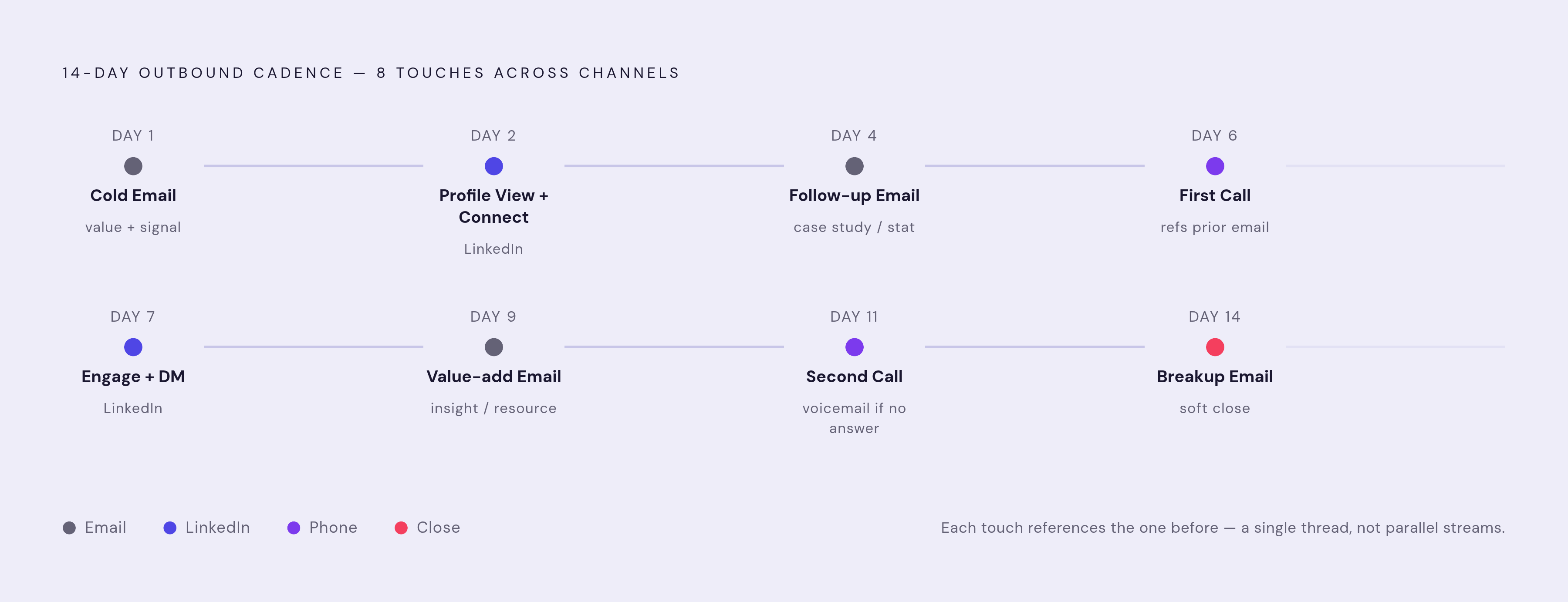
A 14-day cadence built from SyncGTM benchmarks lays this out in concrete terms. The 14-day cadence opens on day one with a value-focused cold email referencing a specific signal or pain point tied to the account. Day two brings a LinkedIn profile view and connection request with a short note referencing the email. Day four is a follow-up email carrying a case study or a stat relevant to the prospect's industry or role. Day six is the first call attempt, referencing the prior email directly. Day seven is a LinkedIn engagement, a like or comment on the prospect's content, followed by a DM if the call went unanswered. Day nine is another email, a value-add touch offering a relevant insight, a data point, or a short resource. Day eleven is a second call attempt at a different time window, with a voicemail left if there's no answer. Day fourteen closes the sequence with a breakup email, a soft close that leaves the door open without a hard sell.
Every touch in that cadence knows what came before it, and that's the entire point of building it this way. It reads as one conversation the prospect can follow, delivered across three channels over two weeks, timed to the buying window mid-market deals actually run on rather than one borrowed from a different segment.