Outbound Prospecting Benchmarks for SMB Sales Teams
Performance targets that actually match how SMBs sell today.
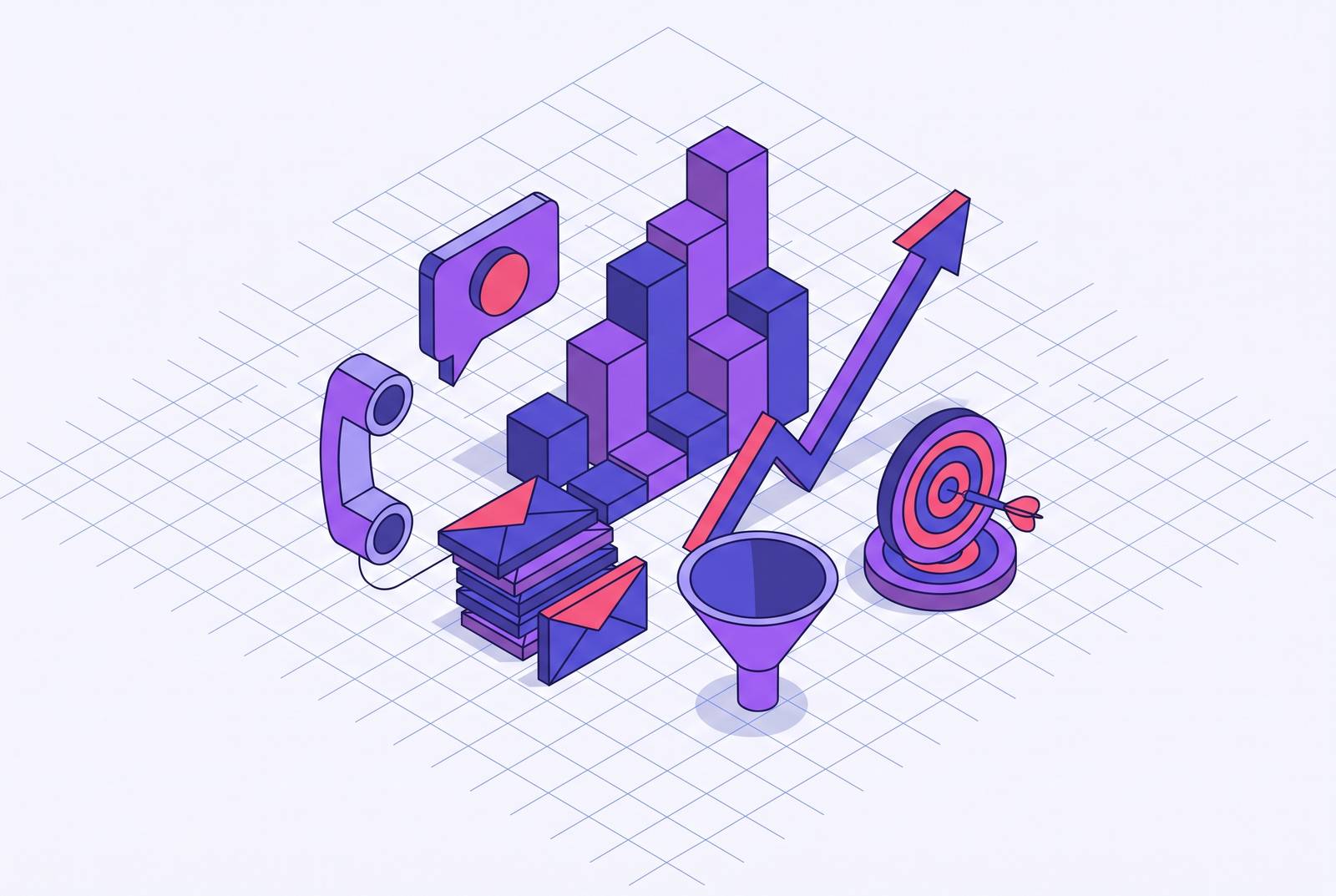
Outbound Prospecting Benchmarks for SMB Sales Teams. This piece gives SMB sales teams a channel-by-channel reference for what average, good, and elite performance actually looks like in 2026, so they can diagnose gaps and set realistic targets.
SMB outbound benchmarks versus B2B norms
Most published outbound benchmarks pool enterprise, mid-market, and SMB data into one number, and that number ends up describing nobody's actual pipeline. That habit is the first thing an SMB sales leader needs to unlearn, because it produces targets that are wrong in both directions at once: too soft for the reps working warm, well-staffed segments, too harsh for the reps cold-calling into companies with a single gatekeeper and no dedicated ops function.
Even inside "SMB outbound," the number moves depending on who's picking up the phone, a variance too large to average away. That's not a small variance to average away. A team benchmarking itself against a single blended connect rate has no way of knowing whether it's underperforming or simply calling higher up the org chart than its comps.
Layer on top of that a macro environment that has gotten harder for everyone. Cold email reply rates have fallen from 8.5% in 2019 to 5% in 2025 to 3.43% in 2026, a straight decline with no sign of reversing https://www.autobound.ai/blog/10-outbound-sales-benchmarks-crushing-it-for-100-saas-companies-and-how-to-steal-their-playbook. Bridge Group's research on SDR activity found quality conversations per rep dropped 55%, from 8 a day down to 3.6, since 2014 https://martal.ca/outbound-prospecting/. Gartner has separately found that 67% of B2B buyers now say they'd rather avoid a rep altogether, and 45% used an AI tool somewhere in their last purchase process https://martal.ca/outbound-prospecting/. None of that excuses underperformance, but it does mean the floor for what counts as working outbound has dropped, and the floor for SMB-targeted outreach was never going to sit at the same depth as the floor for enterprise outreach in the first place. That's the honest tradeoff: smaller deals and thinner org charts mean more raw activity has to fill the gap that account-based selling covers on the enterprise side.
Cold email benchmarks: what average, good, and elite look like in 2026
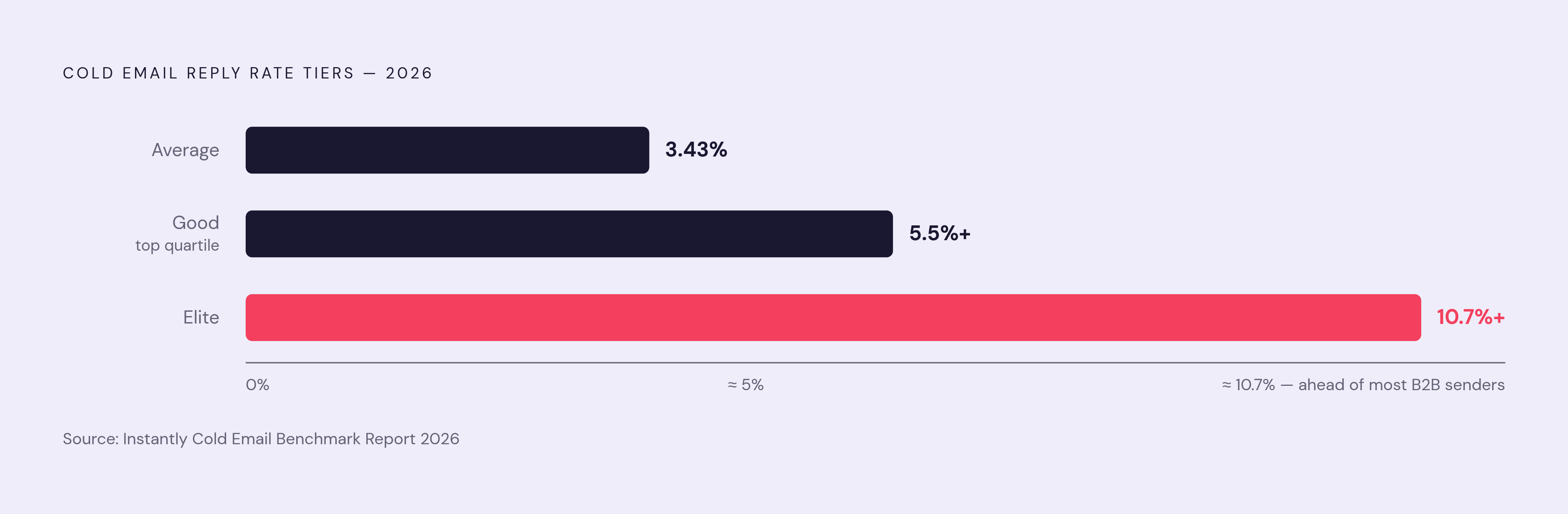
Instantly's Cold Email Benchmark Report puts the platform-wide average reply rate at 3.43%. Above that, the top quartile, what the report calls Tier 2, clears 5.5% or better, and elite senders in Tier 1 exceed 10.7% https://www.autobound.ai/blog/10-outbound-sales-benchmarks-crushing-it-for-100-saas-companies-and-how-to-steal-their-playbook. Clearing 10% puts a sender ahead of most of the B2B field outright https://www.autobound.ai/blog/10-outbound-sales-benchmarks-crushing-it-for-100-saas-companies-and-how-to-steal-their-playbook.
Before benchmarking against those figures, a team needs to know what's actually being counted, because the methodology changes the number more than the underlying performance does. Instantly's 3.43% average counts every email sent through active workspaces on its platform. Belkins, by contrast, tracked only net-new cold contacts across more than 7.5 million emails sent in 2025 and landed at an average reply rate of 0.45%, with the first half of the year at 0.50% and the second half slipping to 0.40% https://martal.ca/sales-statistics-lb/. The gap between 3.43% and 0.45% looks enormous on paper, but it's a measurement artifact, not a real performance gap: one number includes engaged, previously-contacted recipients, the other doesn't. Get this wrong and a team either panics over numbers that are actually fine or celebrates numbers that are actually weak. Know which definition the reporting tool uses before deciding whether the result is good or bad.
Reply rates also split hard by industry. Legal Services tops the list at around 10%, the highest tracked vertical. Healthcare and MedTech run 4 to 6%, Manufacturing is 4 to 5%, and Financial Services is 3.4% https://www.autobound.ai/blog/10-outbound-sales-benchmarks-crushing-it-for-100-saas-companies-and-how-to-steal-their-playbook. SaaS and software sits lowest, at 1.9 to 3.5%, because those inboxes take more cold outreach than almost any other buyer category, and the filters, human and automated both, have adjusted accordingly https://www.autobound.ai/blog/10-outbound-sales-benchmarks-crushing-it-for-100-saas-companies-and-how-to-steal-their-playbook. Open rates tell a smaller but related story: personalized subject lines pull 20.79% versus 14.96% for generic ones, and the average cold email open rate across the board in 2026 is 27.7%, with Apple Mail responsible for 49.29% of recorded opens, a figure that matters given how Apple's privacy features distort what "open" even means https://martal.ca/sales-statistics-lb/ https://www.autobound.ai/blog/10-outbound-sales-benchmarks-crushing-it-for-100-saas-companies-and-how-to-steal-their-playbook. Meeting booked rates run 0.5 to 2.5% per 100 emails sent, depending heavily on deal type and how disciplined the follow-up sequence is https://martal.ca/sales-statistics-lb/. The trend line, roughly 7% in 2023 down to 5.1% in 2024, points one direction only, and nothing in the current data suggests it bends back up.
Cold email timing and deliverability: the infrastructure constraints that now cap performance
Send timing has flipped from what worked a few years back. Belkins' 2025 dataset shows emails sent between 8 AM and noon pulling the highest reply rate, at 0.54%, with early morning sends from 5 to 8 AM close behind at 0.52% https://martal.ca/sales-statistics-lb/. Any team still running that old schedule is optimizing for a version of the inbox that no longer exists.
Deliverability has stopped being a best practice and become an infrastructure gate that either lets an email through or doesn't. Google started issuing hard 550 rejection codes to non-compliant senders in November 2025. Microsoft has required SPF, DKIM, and DMARC authentication for any sender above its volume threshold since May 2025. Cross a 2% bounce rate or a 0.3% spam complaint rate and the campaign doesn't just underperform, it gets shut down.
Lean SMB teams are the ones most likely to skip domain warm-up and skip full authentication, because those steps take time and don't show up on a dashboard the way open rates do, even though skipping them works exactly backwards. That's exactly backwards. Skipping authentication used to cost a few points of deliverability. Now it's binary: the email doesn't arrive at all, no matter how sharp the copy is. SPF, DKIM, and DMARC, alongside active complaint-rate monitoring and a disciplined ramp-up in sending volume, aren't advanced configuration anymore. They're the entry fee for running any cold email motion at all. Late evenings (8–11 PM) now rank last alongside night sends at 0.40%, a reversal from previous years when late-evening sends topped the charts. The implication is that sender behavior that worked in 2022–2023 now actively underperforms. Microsoft inboxes show a 22% inbox placement decline for cold senders, while Gmail's decline is smaller at 5%, a material risk for SMB teams whose prospect lists skew toward Microsoft domains.
Cold calling benchmarks: connect rates, conversion, and the dial volume question for SMB
Connect rate benchmarks vary as much by data source as by team performance, and the denominator matters as much as the number itself. Belkins' 2025 dataset, built on more than 175,000 dials, found a 9.9% per-dial connect rate, but a 24.5% per-prospect connect rate once repeated attempts on the same contact are counted together https://saleshive.com/blog/b2b-sales-cold-calling-benchmarks-teams-2025. A team quoting one of those numbers without the other is quoting half a fact.
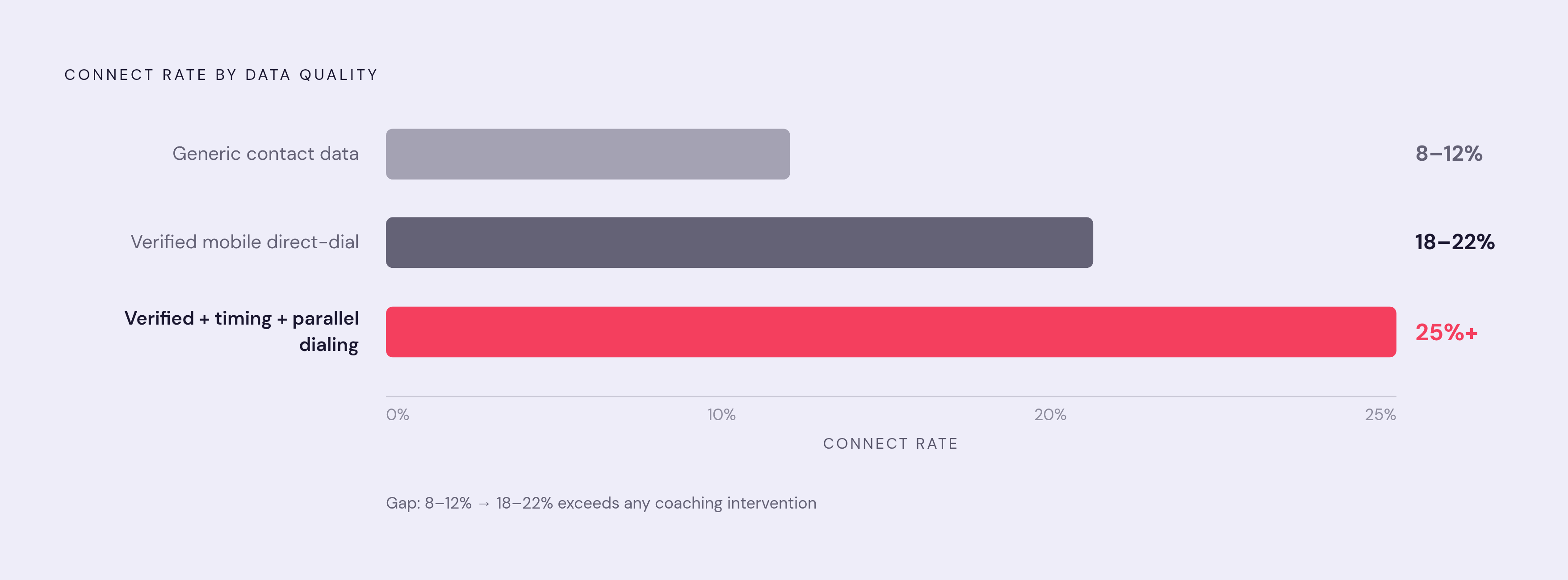
Data quality moves the number more than almost anything else, more than coaching, more than script, more than tenure. Generic contact data produces connect rates of 8 to 12%, while verified mobile direct-dial numbers push that up to 18 to 22% https://saleshive.com/blog/b2b-sales-cold-calling-benchmarks-teams-2025. Teams that stack verified data with disciplined call timing, clean caller-ID practices, and parallel dialing infrastructure hit 25% or higher https://saleshive.com/blog/b2b-sales-cold-calling-benchmarks-teams-2025. That spread, 8 to 12% on generic data against 18 to 22% on verified mobile direct-dial data, is bigger than almost any coaching intervention could produce on its own. A sales leader chasing connect rate through call-script training while running the team on stale data is solving the wrong problem.
Dial-to-meeting conversion averages roughly 2 to 3%, while top-performing teams convert at 5 to 8% or better. Set rate, meetings actually booked, averages 4.6%. The distance between average and elite here traces back to data quality, coaching, and cadence discipline, not to raw dial volume or individual talent.
That last point matters directly for SMB dial strategy. Bridge Group's survey found the median SDR logs 44 phone activities a day, with phone-centric teams running closer to 56 https://martal.ca/sales-statistics-lb/. But pushing dial volume past a high daily ceiling on already-good data starts compressing conversion instead of improving it: rushed calls worked off a padded list produce worse outcomes than fewer, sharper attempts. Volume by itself isn't the lever, and treating it as one is the most common mistake in SMB phone strategy. RAIN Group's research across 489 sellers found the average B2B seller needs 8 touchpoints to land a first meeting with a cold prospect, and top performers get there in fewer touches, because sharper targeting means fewer wasted attempts along the way. Gong Labs' analysis of 300M+ calls found an average connect rate of 5.4%, with top-quartile reps reaching 13.3%. SMB-focused reps run 80–100 dials, roughly double the enterprise benchmark of 30–50.
LinkedIn outbound benchmarks: connection rates, message reply rates, and channel erosion
Expandi's 2026 benchmark dataset, drawn from 13.2 million connection requests, 6.7 million outbound messages, and 3.7 million accepted connections sent between May 2025 and April 2026, sets the baseline for this channel. The platform-wide average connection acceptance rate across that dataset is 28.5%. Warm outreach, where the prospect already engaged with the sender's content before the request went out, pushes acceptance well above that average, while pure cold outreach is at the lower end of the range. The reason acceptance is compressing overall isn't mysterious: most prospects get hit with a high volume of connection requests every week in 2026, and the bar for any single request to stand out keeps climbing.
The connection note itself is the part of this channel that's genuinely breaking down, and any team still leaning on it as a primary reply generator is fighting a losing trend. Reply rates on connection notes fell from 3.5% in May 2025 to 2.2% in April 2026, a 37% relative decline in about a year. Drivers behind that slide include increasingly generic connection-note templates, changes in how LinkedIn surfaces notes, and audience fatigue from volume-based outreach tools. Whatever the exact mix of causes, the practical result holds regardless: the connection note can't be treated as a reliable first-touch channel for generating a reply anymore.
What hasn't eroded is the message sent after the connection is accepted. Post-connection reply rates average 10.4% across industries, holding steady in the 10 to 11% range rather than sliding the way connection-note replies have. Staffing and Recruiting leads all industries at 18.9%, while Computer Software sits lower, at 8.8%. The strategy that still works in 2026 is winning the connection through genuine relevance, then putting real effort into the first message that follows, rather than trying to close or pitch inside the connection note itself.
Cadence structure: touch count, sequence order, and the sequence data
The general 2026 benchmark for a multi-channel cadence, spanning email, LinkedIn, and phone together, is 8 to 12 touchpoints spread across 14 to 21 days. Fall short of 8 steps and a team is leaving real pipeline on the table. Pushing past 12, though, causes the return on each additional touch to thin out fast while the risk of tripping spam complaint thresholds climbs, and that risk threatens the sending domain's reputation for every campaign that follows it, not just the one in progress.
SMB sequences shouldn't be shrunk-down copies of that enterprise range. Shorter sales cycles and faster decision-making at small companies mean a prospect either engages early or doesn't, and padding the sequence to match enterprise timing only delays that outcome.
Within any given sequence, the first touch does most of the work. Roughly 58% of all replies in a cold email campaign come from step one alone, though that is no license to skip the follow-up steps https://www.autobound.ai/blog/10-outbound-sales-benchmarks-crushing-it-for-100-saas-companies-and-how-to-steal-their-playbook. That's not license to skip the follow-up steps. RAIN Group research of 489 sellers found the average is 8 touchpoints to secure a first meeting with a cold B2B prospect, with top performers averaging fewer touches, enabled by better targeting rather than giving up earlier. The practical takeaway is to put the sharpest personalization and the clearest offer into that first message, rather than treating it as a placeholder ahead of the real sequence that follows. Optifai's 2025–2026 benchmark found SMB often needs 5–7 touches, mid-market 8–10, and enterprise 12–15, indicating that SMB sequences should be tighter and faster versions of enterprise cadences. SMB-focused sales reps may run 80–100 dials compared to 30–50 for enterprise reps https://martal.ca/outbound-prospecting/. The connect rate for SMB managers is 18–25% https://martal.ca/outbound-prospecting/. The connect rate for C-suite prospects is 4–6% https://martal.ca/outbound-prospecting/. The average cold email reply rate in 2024 was 5.1% https://www.autobound.ai/blog/10-outbound-sales-benchmarks-crushing-it-for-100-saas-companies-and-how-to-steal-their-playbook. The average cold email reply rate in 2023 was 7% https://www.autobound.ai/blog/10-outbound-sales-benchmarks-crushing-it-for-100-saas-companies-and-how-to-steal-their-playbook. Inbox placement for cold senders on Microsoft inboxes declined by 22% https://martal.ca/sales-statistics-lb/. Inbox placement for cold senders on Gmail declined by 5% https://martal.ca/sales-statistics-lb/. Gong Labs' analysis of 300M+ calls found an average connect rate of 5.4% https://saleshive.com/blog/b2b-sales-cold-calling-benchmarks-teams-2025. Gong Labs' analysis of 300M+ calls found a top-quartile rep connect rate of 13.3% https://saleshive.com/blog/b2b-sales-cold-calling-benchmarks-teams-2025.