ICP Signal Scoring for Outbound Prioritization
Three-layer scoring separates ready accounts from those wasting rep time.

What an ICP scoring model measures: the three signal layers
Every Monday, the same scene plays out in CRMs across B2B sales teams: a freshly bought list sits in the system, half the fields are blank, nobody knows the tech stack behind a single account, and the contacts pulled in have zero purchase influence. Nobody asked, before that list hit the sequence tool, which of these accounts actually deserved a rep's time. Pipecorn.com's 2026 ICP guide points to poor account selection as a core driver of outbound underperformance, not weak email copy, not bad sequencing.
The math is unforgiving. Reps can't call every company in a market, so an hour spent on a low-fit account is an hour stolen from a high-fit one. Sales capacity is finite. When it goes to companies that were never going to buy, the pipeline shortfall gets blamed on messaging, when the real failure happened upstream, in the list-building step nobody scored.
An ICP is not a persona, and it is not a description of a target market. It's a scored model built at the account level, made of three layers that each answer a different question about fit.
The first layer is firmographic: industry and sub-industry, revenue band, headcount, geography, funding stage, business model, growth stage. These fields answer one question: could this company plausibly be a customer, able to feel the problem, afford the fix, and support a real sales process. The limit appears quickly once you look at what firmographic fields alone can predict. Two companies can carry the exact same label, "mid-market SaaS" or "healthcare 500+," and behave nothing alike when it comes to buying speed or win rate. Firmographics narrow the field. They don't tell you who's ready.
The second layer is technographic: what CRM the account runs, what sales engagement tools sit installed, whether there's a data warehouse, what integrations the account already depends on, how mature the whole stack looks. This layer answers a different question: can this company actually deploy what's being sold. A company can match on size and industry and still lack the systems to adopt the product without a costly rip-and-replace. A legacy stack or a missing tool is not a neutral fact to shrug at; it should pull the score down. Friction earns a negative weight.
The third layer is behavioral and intent, covering hiring spikes in relevant departments, repeat visits to a pricing page, a funding round that just closed, an executive change, a technology getting ripped out, and activity on review sites. This layer separates a company that fits the profile in theory from one with an active, present-tense problem right now. It's what makes a score alive instead of static. Cold Email Best Practices 2026 from autobound.ai found outreach that references a specific buying trigger outperforms firmographic-only personalization by 3 to 5 times in reply rate. That gap is the entire argument for why behavioral signal can't sit bolted onto a firmographic score as an afterthought.
The ICP describes the company. A persona describes the person inside it. Blend the two into one number and the qualification logic breaks, because that logic only works if company fit and person fit stay separate checks.
Separating account readiness from contact readiness before building any score
Before any weighting happens, split the score in two: is the account in a buying window, and is this particular contact worth reaching right now. Blend those into one number and the model breaks in a predictable way. A junior manager opens one email, the blended score spikes, and the system fires outreach at an account with no real buying signal behind it.
Account readiness confirms ICP fit, confirms a behavioral trigger has actually fired, confirms the tech stack is compatible. Contact readiness checks something else entirely: does this person carry decision influence, is their seniority right for the size of the deal, does engagement appear at the account level rather than from one isolated click.
Keep the two sub-scores apart in routing. An account can be fully ready with no reachable person inside it yet, and a highly engaged contact sitting inside a low-fit account still shouldn't trigger a priority sequence. The most common mistake in scoring is scoring the person who clicked instead of the buying context around them. Account-level signal, repeated evaluation behavior, a relevant new hire, confirmed ICP fit, should always beat any single action from one individual.
How to weight signals into a working score
Importing someone else's weighting model wholesale ignores that weights reflect how a specific product actually converts. They should reflect how a specific product actually converts. An enterprise security vendor probably weights tech stack and revenue band heavily, because deployment complexity and budget size are the real gating factors there. A product-led startup probably weights growth signals and hiring velocity instead, because those track closer to when a team actually feels the pain the product solves.
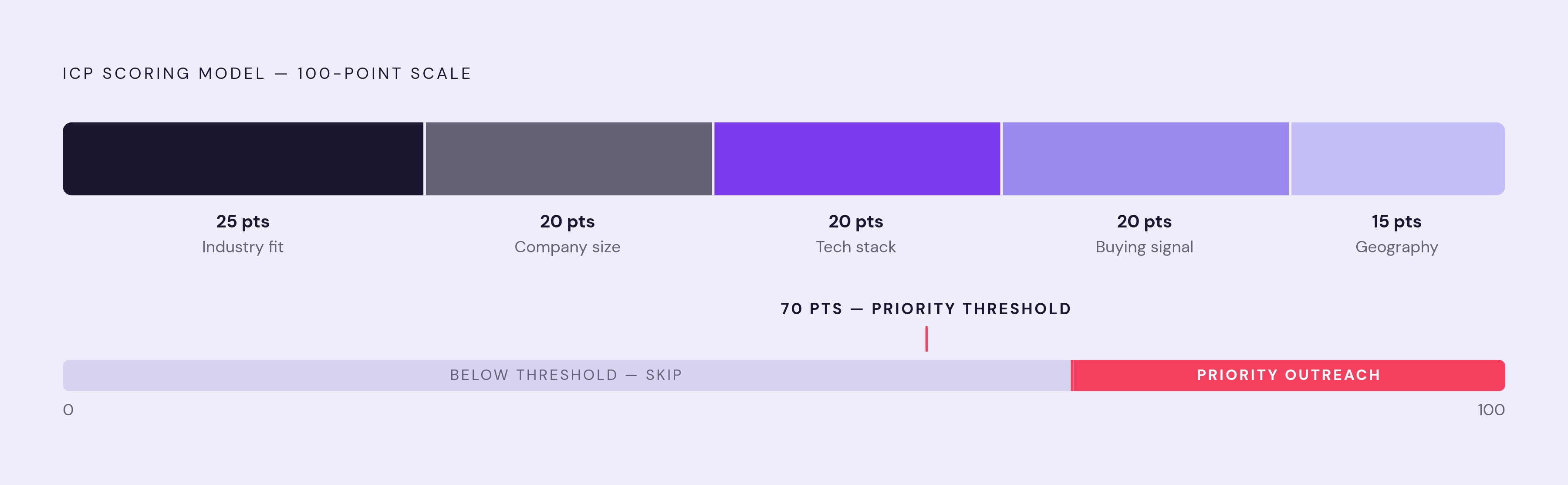
Factors.ai's 2026 ICP marketing guide lays out a workable starting distribution on a 100-point scale: industry fit at 25 points, company size at 20, tech stack match at 20, geography at 15, buying signal or behavioral intent at 20, with 70 or above marking the high-fit threshold. None of this needs a data science team on day one. A weighted spreadsheet gets the job started; the value sits in the order of the logic, not in how polished the tooling looks.
Getting this order wrong causes reps to chase activity instead of readiness, wasting outreach on accounts with no real signal behind them. A strong score checks the trigger first, meaning what actually changed at the account, then checks ICP fit, then confirms whether a reachable contact with influence exists, and only then adds engagement as a supporting layer. Flipping that order causes the score to reward activity instead of readiness, which is exactly the failure mode described above with the junior manager and the single email open.
Negative weights need a place in the model too. A legacy stack that doesn't integrate, a business model that doesn't match, a geography outside the sales team's coverage: these should actively subtract points, not sit absent from the calculation like they don't count. Static, human-set weights also drift over time. Diggrowth.com (updated July 2026) and hginsights.com (March 2026) both point to the same pattern: AI-driven scoring that learns from closed-won versus closed-lost outcomes adjusts weights toward what actually predicts conversion, while manually set weights slowly fall out of step with the market. What AI adds on top of that is timing. The score updates the moment intent spikes, an evaluation starts, or a technographic condition shifts, so sales works off a current picture instead of a snapshot from three weeks back.
Translating score ranges into three concrete outbound tiers
Once the score exists, it needs to sort into tiers a rep can act on without re-deciding fit every single time.
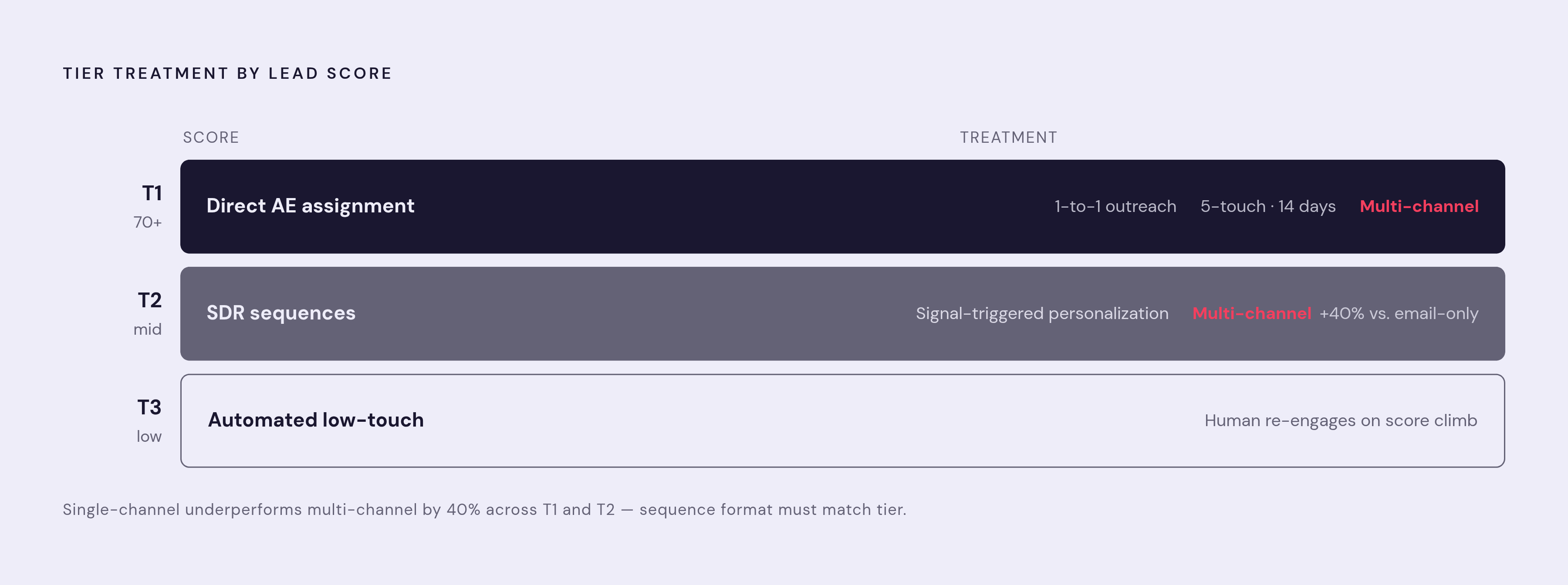
Tier 1, the top-scoring accounts, gets full one-to-one account-based treatment: direct AE assignment, immediate outreach, heavy research per account. This is usually a short list, and it earns that treatment because these accounts behave like the ones that already closed. Founder or senior AE time, where there's room for it, belongs here.
Tier 2, mid-range scoring accounts, gets segmented sequences with SDR follow-up and precision nurture. These are accounts that haven't crossed the urgency threshold that justifies AE time yet. They're accounts that haven't crossed the urgency threshold that justifies AE time yet. A working list here might run a few hundred accounts, watched continuously for score movement, with multi-channel sequences that pull in signal-triggered personalization the moment a trigger fires.
Tier 3, lower-scoring accounts that don't meet the mid-range threshold, gets deprioritized into automated low-touch sequences. Not excluded forever, just not worth spending expensive human hours on today. Humans step back in only when the score climbs and the account earns a promotion.
The exact line between tiers depends on sales capacity, not some fixed industry number. A team with fewer AEs should raise the Tier 1 bar so the list stays short enough to actually work. A team with SDR headroom to spare can lower the Tier 2 floor and catch more accounts earlier.
Best practice for signal-based outbound recommends running campaigns against small, tightly filtered lists built around specific live signals. A list like that is relevant this week and stale by next month, and static, evergreen lists underperform against this micro-campaign approach for exactly that reason. A 5-touch, 14-day multi-channel sequence is widely cited as the standard for Tier 1 and Tier 2 work, with single-channel email-only campaigns underperforming that by 40%. For gating performance by tier, the 2026 benchmarks from autobound.ai run: 45 to 65% open rate is good, 5 to 15% reply rate is good, 1 to 3% meeting-booked rate is good. Fall short of those numbers and the problem is almost never the copy; it's deliverability, or it's targeting. It's deliverability, or it's targeting.
Why data quality determines whether the score means anything
The scoring logic above produces wrong results the moment the data underneath it goes wrong. Cleanlist.ai research put contact data decay at roughly 2.1% per month, which works out to close to a quarter of records going stale or wrong within a year without continuous refresh. A model scoring decayed records routes reps toward wrong titles, dead inboxes, and companies that no longer match the ICP at all, and the score still looks perfectly valid on screen while the action it triggers goes to waste.
Unifygtm.com notes a hard deliverability floor that governs this directly: hard bounce rates above 2% start tripping spam filters at Google and Microsoft, and once domain reputation takes that hit, the damage spreads to every piece of organizational email, customer replies, partner communication, transactional messages included, with recovery running months, not days. Validity's 2025 Email Deliverability Benchmark Report, cited by unifygtm.com, puts the global average inbox placement rate at 83.5%, and senders who actively manage list hygiene achieve inbox placement rates 8 to 12 percentage points higher than those that do not.
This work carries a time cost too. Cleanlist.ai's survey of 47 customers found a median of 28% of SDR time going to manual data work instead of actual selling, inside a broader range of 20 to 40% estimated waste without enrichment. Enrichment has stopped being a CRM housekeeping task. It's the input layer feeding every AI tool downstream of it, and when AI drafts the outreach itself, what actually separates one email from another is the depth of context fed into the model, not the model. Job title, company size, industry, tech stack, buying signal: these are the exact fields the scoring model runs on, and they're only as good as the last time someone bothered to refresh them.
Building a live enrichment layer that keeps scores current
Coverage gaps from single-provider enrichment are a real, measurable problem, not a theoretical one. Cleanlist.ai's February 2026 test of Apollo against a batch of fintech contacts returned usable emails for 71.3% of them, meaning roughly 28% of prospects were simply unreachable from that one source. No single provider covers everything, which is the whole argument for waterfall enrichment: query one provider, and when it comes back empty, fall through to the next rather than leaving the field blank and letting the score run on a hole in the data.
Apollo's own database, with a very large number of contacts and accounts, combined with waterfall enrichment layered on top from additional sources, closes a meaningful chunk of the gap that single-provider lookups leave open. That matters directly for any team building the enrichment layer its scoring model depends on.
Enrichment shouldn't run on a batch schedule alone. It should fire on triggers. A pricing-page visit should refresh that account's intent fields immediately. A relevant new hire should update the contact list and force a rescore. A bounced email should kick off real-time re-enrichment through an API or webhook, a pattern increasingly treated as standard practice. The real unit of work in signal-based outbound is the signal itself, not the static account record sitting in the CRM. The signal itself includes a hiring spike, a stack change, a funding event, a competitor swap, or a repeat visit. Operationalizing that means CRM rules that auto-update score-relevant fields the moment enrichment returns something new, and an alert to the right SDR the moment a Tier 2 account crosses into Tier 1 territory.
Operationalizing the scoring system inside the outbound workflow
A scoring model only earns its keep once it becomes the single number sales, marketing, and RevOps all look at. Hginsights.com research flags separate scoring systems across departments as a direct source of handoff friction and internal argument over what actually counts as a qualified lead. One shared model removes that argument by removing the second system.
From there, the score needs to live inside the CRM in a way that routes work on its own: Tier 1 to an AE without anyone deciding, Tier 2 into SDR-managed sequences, Tier 3 into automated low-touch outreach, with no manual triage sitting between the score and the action. Marketing automation and ABM tools should trigger off score changes directly, not off a calendar.
This changes what the SDR role actually is. Less sequence execution, more system operation: watching for score movement, reviewing what an AI drafted the moment a trigger fired, stepping in when an account crosses a tier line. This hybrid model describes a mix of deterministic steps, fixed routing rules tied to score, and agentic steps, AI research and personalization and follow-up, rather than a system that's either fully automated or fully manual. The agent's job in that setup is to watch signals continuously, pull research from the CRM and the open web, and draft outreach that actually references what the account's signal indicated, pulling a human in only at the moment that decision matters. Apollo's AI agents and sequencing layer build around exactly this motion: prospecting, enriching, scoring, sequencing, and following up from one connected system instead of five point tools stitched together by hand.
None of this is a fringe bet. Thesignal.club ranks intent-based outbound as the second most-invested GTM channel among B2B companies in 2026, which puts a score-driven operating model squarely in line with where budget and team attention already sit.
When to recalibrate the model
The test is simple to state and hard to fake: pull conversion rates by tier and compare them. If Tier 1 accounts aren't winning at a meaningfully higher rate than Tier 3, the weighting is wrong somewhere, and no amount of sequencing polish downstream fixes a score that isn't actually predicting anything. Pipecorn.com's 2026 figures give a sense of what a working model should produce: documented ICP-based segmentation tied to substantially higher marketing-sourced pipeline conversion, with Tier 1 segments running a 36% higher win rate and several times the three-year customer lifetime value of the lower tiers.
Recalibration isn't a one-time setup task. It runs ongoing, because the signals that predicted a win last quarter can stop mattering once the market, the product, and the buyer shift, and when they shift, what the model should be measuring shifts with them. The plainest way to tell an ICP hasn't actually been operationalized: a rep still has to decide, from scratch, whether each account on the list is worth pursuing. When the score is doing its job, that decision happens before it ever reaches the rep's desk.