CRM Data Hygiene Workflows for Outbound Sales Teams
Repeatable workflows prevent data decay better than one-time cleanups.
- Written by
- Dayo Fashola
- Published
- October 21, 2026
- Reading time
- 8 min read
What this covers
CRM data hygiene for outbound sales teams is an operating system. Reliable routing, deliverability, forecasting, and AI depend on repeatable workflows that govern intake, standardize records, resolve duplicates, and monitor decay. Those workflows must run as part of daily operations, with clear definitions and named ownership, rather than begin only when a campaign exposes bad data.
Why outbound teams have a structural data problem, not a discipline problem
An outbound rep working through dozens of prospects a day has no natural stopping point for field formatting. The immediate task is to build pipeline, so hitting send takes precedence over updating the record. Traditional CRM systems assume that a lead has arrived, been qualified, and sits waiting for action. Outbound teams instead import lists, sequence immediately, and update records retroactively, if at all. That mismatch creates a data problem even when reps are working as expected.
Integration sprawl adds another source of inconsistency. Enrichment tools, marketing platforms, and billing software can each add data that repeats or clashes with what is already there when field-mapping rules are loose. Meanwhile, the people and companies represented in the database keep changing. Decay compounds rather than accumulating at a steady rate, so an unmanaged database loses reliability faster than a simple count of stale records suggests. The cause is structural, and the remedy must change how data moves through the system.
What bad CRM data actually breaks downstream
Bad data propagates into every workflow that depends on it. When company, territory, or seniority fields are wrong, the right prospect goes to the wrong rep or gets no assignment at all. Duplicate pipeline records then inflate the forecast beyond what the business can realistically support.
Stale email addresses create a wider exposure because hard bounces damage sender reputation and affect future sends. Findymail's 2026 guide names email deliverability as a main reason hygiene matters, because contacts with bounce-prone emails put the sending domain at risk when they are in active sequences. Google and Yahoo bulk sender requirements, which are now enforced at scale, also bring consequences for complaint-rate and spam-activity issues.
An AI-powered outbound sequence works through every record in the queue without the judgment a rep might use. Bad firmographic data produces misfired personalization, while weak identity resolution can cause the same person to receive outreach twice. AI lead scores also drift when the tags for job title, industry, and ICP drift. Each failure is fixable, but only through workflows that protect the data before downstream systems act on it.
Why one-time cleanups fail and what a hygiene system requires instead
A cleanup before a campaign or after a migration removes existing errors without changing how the next ones enter. Findymail's cleansing guide distinguishes reactive cleansing from proactive hygiene. Cleansing fixes problems that are already there, while hygiene stops new ones from forming. Neither works alone, because prevention leaves an inherited dirty baseline untouched, and repair without prevention allows it to deteriorate again.
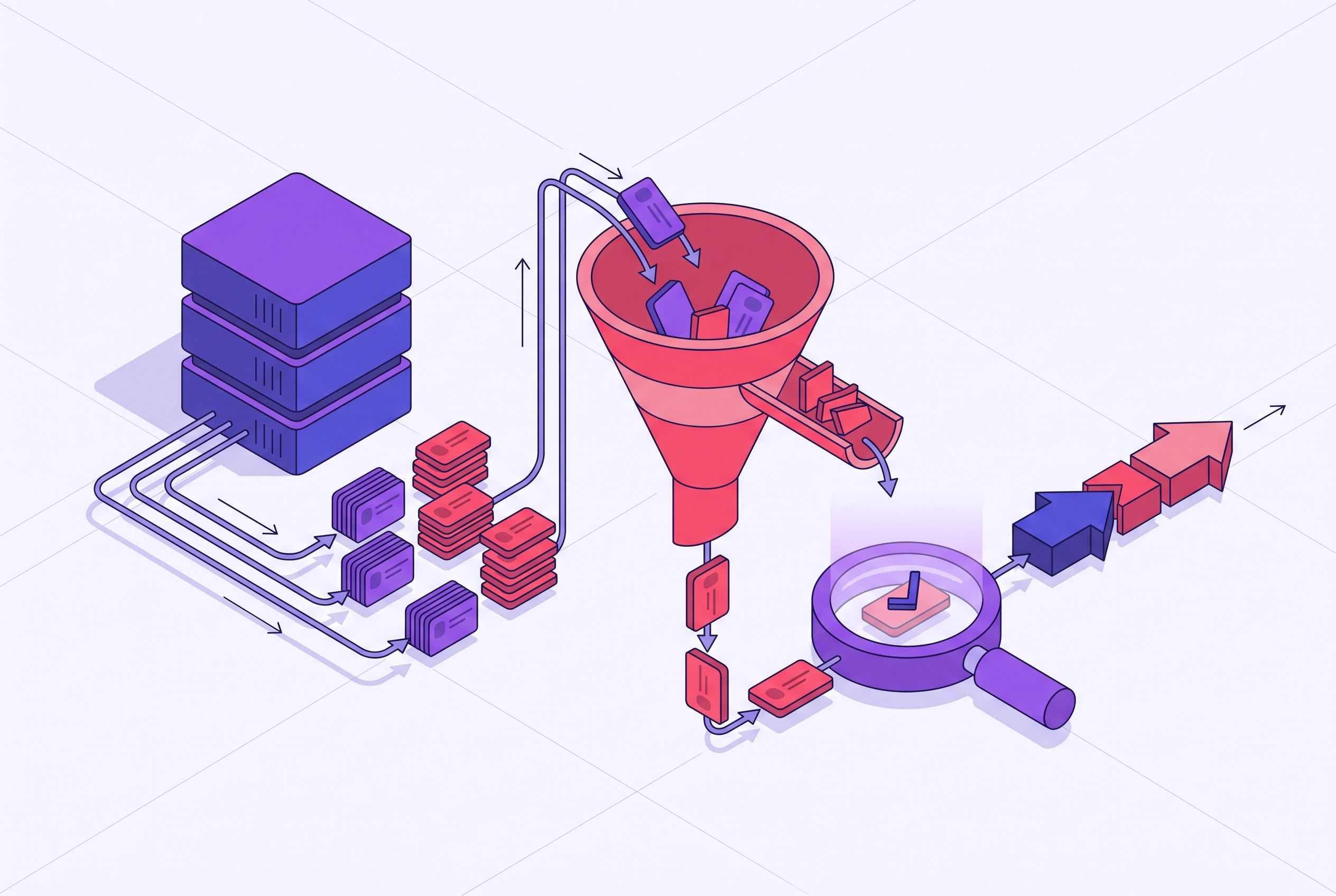
A durable system has four layers, namely intake governance, standardization, deduplication, and enrichment and decay monitoring. Intake controls entry, standardization makes records comparable, deduplication establishes authoritative identities, and enrichment keeps records accurate over time. Together, these layers address both the existing database and the flow of changes through it. The workflow sections that follow fill in this operating model.
The important objection is that automation solves capture while leaving definition unresolved. High field-completion rates do not make a forecast sound if the enforced fields do not support routing, scoring, or reporting. Too many mandatory fields can also push reps to enter placeholders just to move on. Only fields that guide operational decisions should be enforced.
Intake governance: stopping bad data at the point of entry
The cheapest point to correct a data problem is before the record enters the CRM. Contacts from inbound forms, outbound lists, and external sources should all go through the same intake sequence. Email syntax checks, phone-format checks, and domain-structure rules should stop malformed records from being saved. A duplicate check should match incoming data against existing records, while missing required fields should trigger enrichment before the record enters use.
For outbound B2B, the minimum actionable record includes a verified business email, a job title matching target seniority, an associated company with domain confirmed, and a last-activity timestamp. A record missing any of these should be enriched, quarantined, or excluded from sequences. Required-field rules should apply only to fields that affect routing, scoring, and sequence eligibility.
Imports need a close look because the source may follow different rules from the CRM. A Clay export or Apollo list can carry formats that need correction before records are saved. Standardization must therefore run during import. Findymail's hygiene guide identifies data validation as a foundational practice, together with eliminating data silos and implementing governance.
Standardization: making records consistent enough to be usable
Accurate information can still be unusable when equivalent values have different formats. Job titles such as "VP Sales", "VP of Sales", "Vice President, Sales", and "vp sales" describe the same role but will not match in a filter or scoring rule. Company names such as "Acme Corp", "Acme Corporation", "ACME", and "acme" similarly disrupt account deduplication and rollup reporting. Inconsistent country codes, spacing, and punctuation make dialer integrations unreliable, while free-text geography fields produce variants for the same place.
Standardization gives each decision-driving field a canonical format. Document that format, enforce it through dropdowns or constrained fields where possible, and apply periodic normalization rules to existing records. Scheduled normalization also brings legacy data into conformance with rules introduced after it arrived. Findymail's cleansing guide names standardizing data entry as the first best practice for ongoing CRM hygiene. The purpose is functional comparability, with proof that the information is current belonging to enrichment.
Deduplication: defining one authoritative record per entity
Once records can be compared, deduplication can find which ones refer to the same entity. Set a rule for each CRM object so that duplicates are handled by object type. Contact and Lead uniqueness should use normalized email as the primary key, with LinkedIn URL as a secondary key when email is missing or role-based. Account uniqueness should use the normalized root domain, stripping subdomains, "www", and protocol, with legal entity name matching as a secondary check.
Matching must be paired with an explicit rule for which record wins a merge. The older record with more activity history is a typical choice, and a consistent rule makes merge winners predictable. Fuzzy matching can catch records that have different email formats but the same name and company. FullContact extends identity resolution across email, phone, social profiles, and device IDs, which is relevant when contacts come from multiple sources. Run deduplication at import and on a schedule to catch duplicates introduced through integration sync or manual entry.
Suppression history needs to be kept safe because duplicate records may have different unsubscribe or bounce status. Bounce and unsubscribe suppression must live in both the CRM and the email service provider. If an unsubscribe in one sequence tool does not write back, another tool can contact the person again. An authoritative record must therefore consolidate identifying fields and preserve the controls that permit or block outreach.
Enrichment and decay monitoring: keeping records accurate over time
Even a clean database becomes stale as contacts change jobs, companies rebrand or are acquired, and email addresses expire. Those events do not announce themselves to the CRM. Findymail's hygiene guide recommends email hygiene before every campaign, CRM hygiene at least quarterly, and monthly prospecting-data reviews for active outbound teams. These different cadences reflect the different uses of the data rather than imposing one review schedule on everything.
Calendar reviews should be supplemented by signals that a record needs attention. A hard bounce, a job-change alert, or a last-activity timestamp beyond the team's staleness threshold should trigger review or enrichment. A response-rate decline across a segment can also indicate that its underlying data is drifting. Job-change alerts are particularly useful because they can trigger re-enrichment and re-routing before a bounce exposes the change.
Waterfall enrichment queries multiple sources in sequence and writes the best available value for each field. This fills gaps without replacing verified data with lower-confidence values. For high-velocity outbound teams, monthly light-touch cleanups should remove hard bounces, flag stale records, and check for new duplicates between quarterly deep cleans. A targeted hygiene pass before activating a campaign segment adds a practical checkpoint to the calendar and event-driven workflows.
Tools that automate the four workflows
Tools can partially automate these workflows, but their value depends on which layer they address and how deeply they connect to the CRM. Findymail CRM Datacare provides always-on CRM cleansing and enrichment. It takes care of outdated contacts, missing fields, duplicates, and bounce-prone emails automatically. It also includes a free CRM health check with every demo to assess the current state before changes are made. Findymail's cleansing and hygiene guides both list Datacare as a primary tool for ongoing CRM health.
Clay combines AI agents, enrichment, intent data, and workflow automation in a GTM platform. It suits RevOps, growth, and outbound teams that need flexible prospect enrichment across CRMs, data warehouses, and sales tools. Its enrichment draws on more than one source, so it serves a different part of the workflow from a tool built just for deduplication. Findymail's hygiene guide lists Clay as one of the tools to choose from.
Findymail's cleansing guide lists Breeze Intelligence, formerly Clearbit, as an enrichment tool among its top CRM data cleansing tools for 2026. The same guide includes LeadAngel, Dedupely, and Truelist, with Dedupely focused on deduplication. Findymail's cleansing and hygiene guides both include WinPure as a cleansing and hygiene tool. Findymail's hygiene guide also lists DemandTools. These listings provide options for evaluation.
Selection should turn on integration depth and the controls the team needs. Native CRM integration and connector-based sync differ in maintenance demands, with connectors creating ongoing work and leaving sync gaps. Evaluate whether enrichment is multi-source and per-field, whether deduplication runs at import and on schedule, and whether suppression writes back to the CRM. Include setup effort in total cost of ownership because a long implementation delays the hygiene benefit.
Governance and ownership: who is responsible when data quality is everyone's problem
Technical workflows will be skipped, overridden, or abandoned without ownership and team buy-in. Governance commonly fails when CRM customization displaces consistency, an effective governance model is absent, or governance is treated as a costly blocker. Assign a named owner for CRM data health. In a smaller team, that may be a sales operations generalist or RevOps lead, while a larger team may need a dedicated data steward or ops manager.
The owner's remit should cover field definitions, cadenced cleanup workflows, integration sync-log reviews, and escalation when quality metrics fall below threshold. Rep training should explain the fields that affect routing and sequence eligibility. A missing company domain delaying sequence entry gives a rep a concrete reason to complete it. Findymail's hygiene guide treats training and automation as complementary practices. Accessible documentation keeps those rules from drifting as team members change.
Governance must also keep field definitions aligned with how the business operates. Treat bounce-rate trends, deduplication volume, enrichment coverage, and completion rates for important fields as a standing item in RevOps reviews. Visible metrics create accountability without relying on manual policing. This discipline gives outbound teams more than a cleaner CRM, because it establishes the data foundation that AI tools need to score, personalize, and sequence reliably.