Real-Time Data Enrichment vs Batch Enrichment for Sales Workflows
The right mode depends on your workflow's urgency, not just speed preferences.
- Written by
- Dayo Fashola
- Published
- October 26, 2026
- Reading time
- 8 min read
What this covers
- Why the real-time vs. batch question is actually a question about workflow triggers
- What downstream actions actually need from enriched data before they can run
- Which triggers belong to real-time enrichment and why latency is the deciding factor
- Which workflows are better served by batch enrichment and why scheduling is an advantage, not a compromise
Real-time and batch enrichment serve different jobs in sales workflows. The right architecture follows the trigger event, the action waiting on the data, and how long that action can wait. Most teams need both modes, with field-level rules that keep urgent updates and scheduled refreshes from overwriting one another.
Why the real-time vs. batch question is actually a question about workflow triggers
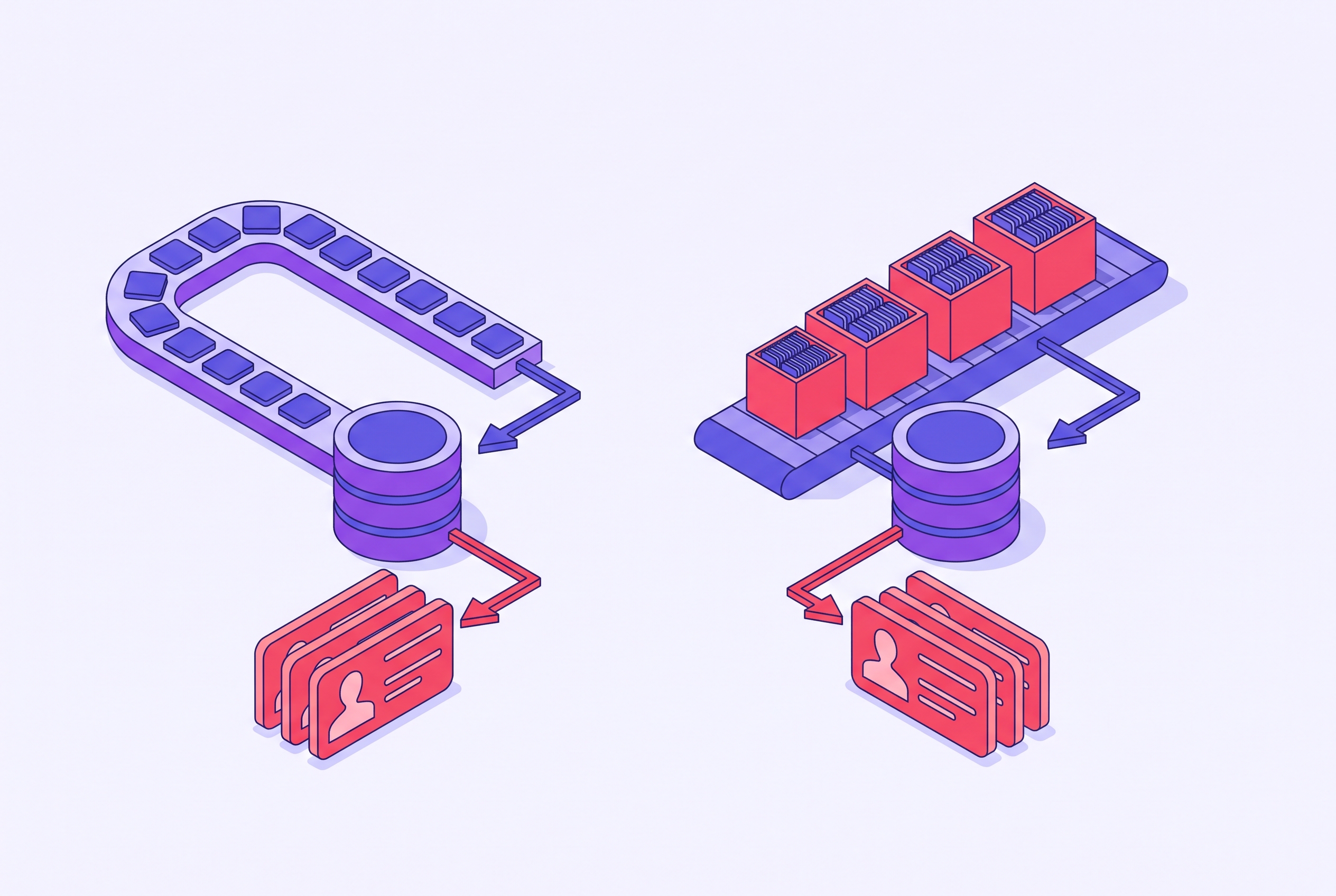
A form submission and a database refresh do not create the same dependency. The form may require an immediate routing decision, while the refresh prepares existing records for later use. Their clocks differ because their jobs differ. Real-time enrichment fires at contact creation or another live event and returns data in seconds. Batch enrichment processes records asynchronously over minutes to hours on a scheduled cadence.
Choosing by preference creates two predictable failures. A time-sensitive lead waits for a batch run, or a large static list consumes real-time API spend without gaining anything from the speed. Neither failure is primarily a provider problem. Both begin with the wrong assignment between an event and its enrichment mode. The organizing question is therefore specific. Which triggers belong to which mode, and what does your downstream action actually need?
What downstream actions actually need from enriched data before they can run
Lead scoring depends on complete inputs, including title, seniority, department, company size, and industry. When inputs are missing, the score can be wrong or scoring can fail, leaving a lead mis-routed or unrouted. Routing has its own required fields, including geography, employee count, industry, and tech stack. Missing routing keys can leave leads untouched or send them to the wrong owner.
Outreach personalization depends on a different set of inputs. Role, company stage, and specific business signals give a rep something more useful than a name and company to reference. A hiring pattern or tech addition gives a rep a specific way to open the message, while a lack of context leads to generic wording and fewer replies. Speed alone cannot supply that context. The relevant fields must be available before the message is written or the sequence launches.
ABM targeting depends on account-level firmographic and technographic coverage across a defined list. Because the motion is planned rather than reactive, the data can arrive well before anyone acts on it. Its latency tolerance is therefore higher. Across these workflows, what matters is the gap between when data arrives and when someone acts on it. As that gap narrows, enrichment latency becomes a direct constraint on the workflow.
Which triggers belong to real-time enrichment and why latency is the deciding factor
An inbound form submission belongs to real-time enrichment when scoring or routing must follow immediately. Enrichment supplies the fields the form did not capture before the lead reaches its next step. The contact window is already open. Faster contact after a qualified lead expresses intent raises the probability of conversion, while a scheduled run can introduce hours or days of delay into a window that closes in minutes. Here, waiting changes the outcome.
Product signups create a similar dependency in a PLG motion. The user’s first in-product action can trigger enrichment so that routing to a sales rep or a nurture sequence uses the relevant context. A manual CRM add creates a more direct human dependency, because a rep needs the missing details before first outreach. An intent signal also warrants a live update when a high-value account visits a pricing page or a relevant hire appears. The account is enriched while the signal is warm.
These triggers justify a premium. Synchronous API calls and dedicated infrastructure cost more per record, but the gain in conversions on high-value inbound leads can make that cost worthwhile. The operational requirement is explicit. Real-time enrichment needs webhook triggers, API orchestration, and monitoring for failures and rate limits. Those costs become waste when applied to records whose next action has no urgency.
Which workflows are better served by batch enrichment and why scheduling is an advantage, not a compromise
Batch enrichment is the right architecture when volume and cost efficiency constrain the workflow. A prospect list needs completeness and accuracy at campaign start. The same applies to a planned ABM play whose target list is static at launch.
Bulk processing also works well for large lists of outbound prospects. Individual real-time calls add cost and operational complexity without a proportionate conversion benefit when there is no inbound urgency. Historical database cleanup and large-scale CRM refreshes also operate across a population. Quarterly ICP re-scoring takes place after a planned change to the scoring criteria. No individual record requires an immediate response merely because the account database is being reassessed.
Scheduling also simplifies operations once the job is established. A consolidated error report covers the run, rather than requiring attention to individual API failures throughout a live pipeline. A list can be enriched before a campaign, and an existing database can be refreshed on a known cadence. That cadence still needs to be assessed for suitability for every field the job updates.
How data decay makes the choice between modes a function of field type, not just timing
A record’s creation date alone cannot tell how long the data in it will stay accurate. People change jobs, companies restructure, and some fields go out of date faster than others. Enrichment at creation is not permanent coverage. Some fields can become stale within weeks, so periodic refresh remains a structural requirement even when the original record entered through a real-time pipeline.
Job title, direct phone, tech stack signals, and funding status can change so fast that a scheduled cycle misses a change before the next attempt at outreach. A job-change signal or bounce event can thus be a reason to refresh that record right away. Stable fields have a different tolerance. Industry, company size, and headquarters location can generally use a weekly or monthly batch cadence without introducing meaningful error. Applying one refresh rule to the whole record ignores this difference.
Batch processing can update a record’s stable firmographic fields while a live trigger refreshes the fields that change faster. Each field’s decay rate needs to be connected to the action that uses it. The trigger establishes when an update is needed, while scheduled data’s fitness for that decision depends on the field type.
Why waterfall enrichment has become the standard architecture inside both modes
Within either mode, enrichment now typically queries multiple providers in sequence. Waterfall enrichment begins with a primary provider and passes the identifier to a secondary provider when the first returns no match or an incomplete record. Further providers can fill remaining gaps. Using more than one vendor helps the run find matches for more of the records. It has moved from advanced practice to standard architecture.
The same pattern serves both processing modes. In batch, the waterfall runs across the list before it enters a campaign. In real time, it runs inside the pipeline fired by the inbound event. The mode decision determines when enrichment runs, while provider selection determines which sources can supply the required fields.
A match is not proof of accuracy. Waterfall enrichment inherits the quality of its providers, so thin or unverified source data can introduce fresh errors. Choosing the architecture must include choosing the providers and setting standards for how their data is checked. Adding sources without checking how reliable they are can fill more records yet leave the inputs for scoring, routing, or outreach no better than before. Coverage and confidence must be evaluated separately.
How a hybrid stack routes between both modes without creating field-level conflicts
A hybrid stack assigns real-time enrichment to inbound forms, product signups, manual CRM adds, and intent signals on high-value accounts. Batch handles database hygiene, preparation before a campaign, quarterly ICP re-scoring, and new contact lists acquired before a product launch. An existing record can appear in both pipelines. The stack therefore needs explicit field-level priority rules before deployment.
Without those rules, a later batch run can overwrite a real-time update with a different provider’s value. The CRM then keeps whichever value arrived last. For fast-decaying fields, recency wins, while stable fields use the higher-confidence provider’s value.
CRM-native tools fit teams using HubSpot or Salesforce when record-creation enrichment and low integration friction are priorities. Broad database tools fit teams that need wide ICP coverage, with options including ZoomInfo, Cognism, Apollo, and Zeliq. Workflow-composable tools suit technical RevOps teams that want fine-grained control over enrichment steps and can support custom pipelines. More control brings a steeper learning curve.
Unify is a first-class option for orchestrating real-time plays at scale. Navattic used an automated play with real-time enrichment through Unify and generated pipeline within the first 10 days of launch, with strong email open rates on enriched sequences and meetings booked. The sequence depended on enrichment arriving before launch. Abacum shows how batch-plus-waterfall works alongside real-time, with manual contact research down to near zero on enriched records and prospecting said to be much faster. Its benefit came from enriching lists before SDRs worked them.
The economic distinction follows this division of labor. Real-time pays for synchronous calls when speed helps an action that is waiting, while batch saves by processing records that can wait in bulk. AI-driven enrichment gives teams more ways to get data by pulling from live sources such as LinkedIn, company press releases, and funding databases. Some fields can now remain fresh enough through AI-augmented batch processing. Teams should assess that freshness against the next action before allocating real-time API budget.
A decision framework for assigning enrichment modes before building the stack
Start with three questions in sequence. What event triggers enrichment, what downstream action needs the result, and how long can that action wait before its outcome degrades? Assign the mode only after those answers are explicit. The waiting action defines the latency budget.
If a form fill, signup, or CRM add feeds immediate scoring, routing, or a time-sensitive sequence, use real-time enrichment with waterfall providers inside the live pipeline. If a pricing-page visit, relevant hire, tech stack change, or email bounce triggers personalized outreach, use real-time or near-real-time enrichment on the specific account record. A full-database run is the wrong scope for that event.
If a campaign launch, monthly refresh, or database audit allows hours or days before action, use batch enrichment. Run the waterfall across the full list before campaign entry. If the GTM motion is primarily outbound with large static prospect lists, favor batch for cost efficiency and operational simplicity.
Before deploying both modes, identify every field each pipeline will write and define priority for every overlap. Assign refresh cadence by field decay rate, with recency governing fast-changing fields and provider confidence governing stable ones. Set monitoring for real-time API failures and rate limits, and add an accuracy validation step before batch import. Defined triggers determine the architecture before tools are chosen.