Waterfall Enrichment Setup for B2B Contact Data Gaps
Three-to-four vendors in sequence beat any single provider's match rate ceiling.
- Written by
- Dayo Fashola
- Published
- October 16, 2026
- Reading time
- 10 min read
What this covers
A single enrichment vendor cannot close B2B contact data gaps, not because the vendor is weak but because no provider covers every contact, field type, and geography at acceptable accuracy. Any team relying on one source therefore accepts a fixed, non-negotiable ceiling on match rate. The alternative is waterfall enrichment, an architecture that queries providers in sequence so each layer fills only what the previous one missed. Getting that architecture right demands deliberate decisions about provider independence, ordering, fallback logic, and stopping conditions.
Why a single enrichment provider structurally cannot solve B2B contact data gaps
The problem is database fragmentation. Providers win on different dimensions: some lead on verified phone numbers in specific regions, others on email match rates for particular company sizes or industries. No one wins on all dimensions simultaneously. In 2026, Amplemarket evaluated eight platforms across a 231-point framework and found that every major enrichment vendor claims very high accuracy, but accuracy varies significantly by data type, geography, and company size. The claim and the performance are different things.
The gap between what vendors advertise and what a list actually resolves is consistent. Apollo's own 'Verified Emails' accuracy filter reduces its 275M-contact database to 96M usable contacts, a 65% reduction. The database exists, but most of it doesn't meet the vendor's own bar. That is the structural ceiling in one number.
Data decay compounds the problem. Datamagnet's 2026 benchmark report documents that a single job change simultaneously invalidates multiple fields: title, email, and direct-dial. The list built in January is measurably wrong by December. A single provider was already incomplete on day one.
What waterfall enrichment actually is and how the coverage mechanics work
Waterfall enrichment is not a product but an architecture. It queries providers in a defined sequence so that each layer fills only what the previous layer missed, stopping as soon as a field resolves. Provider A is queried first. On a miss, Provider B is queried. On another miss, Provider C. The system stops querying once the target field is filled, so credits are not burned on redundant lookups.
This logic operates at the field level, not the record level. A single record's email can come from Provider A while its phone number comes from Provider B and its firmographic data from Provider C. Each field has its own resolution path, which is what makes the architecture flexible in practice.
Cleanlist AI's 2026 enrichment guide distinguishes three approaches: single-source, sequential waterfall, and parallel multi-provider. Parallel queries are fastest and most complete but pay every vendor for every record. The choice between them is an operational decision, not a coverage decision.
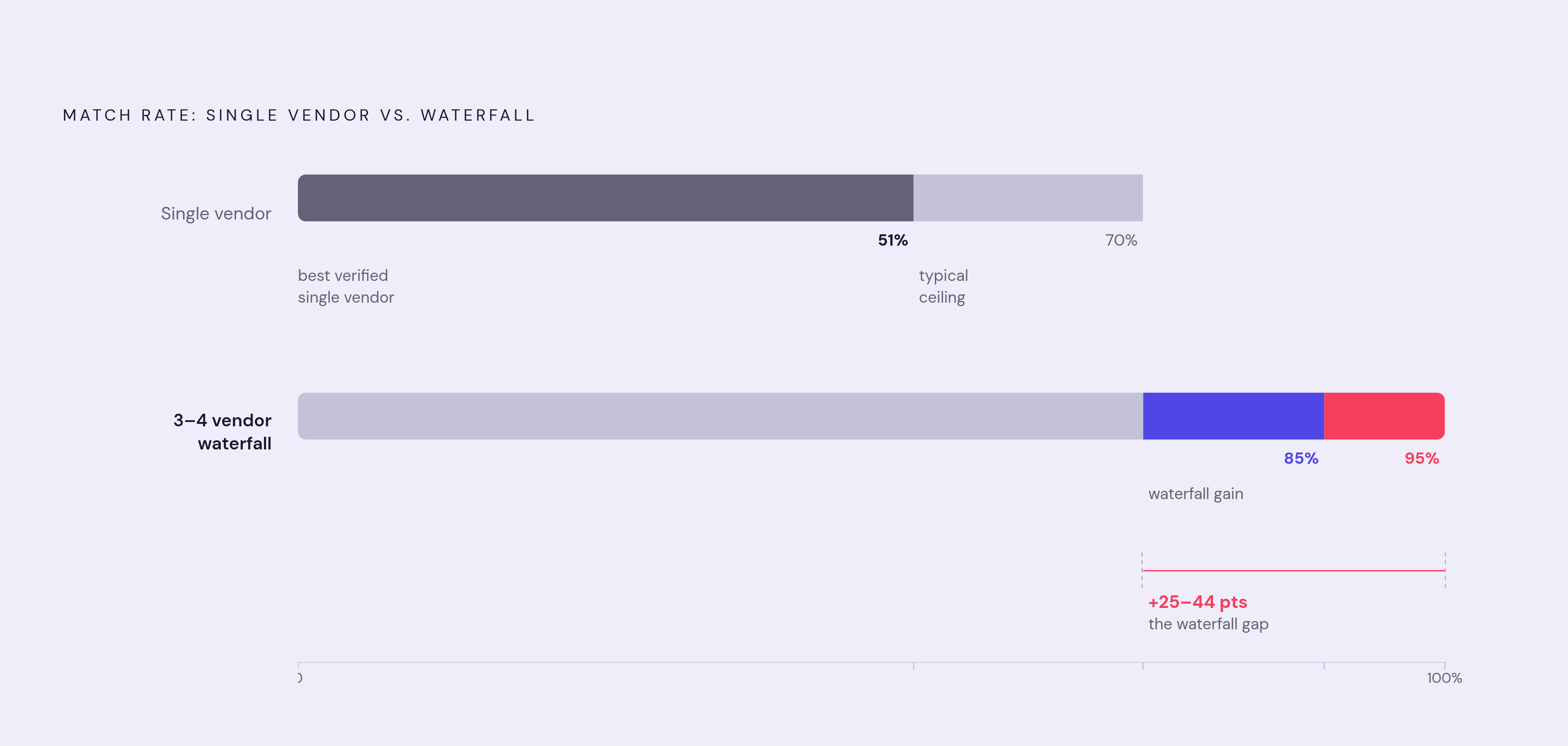
The match rate lift is real but follows a diminishing-returns curve. Datamagnet's 2026 benchmark cites the independent Outbound Kitchen benchmark of 1,400 US B2B contacts: the best single vendor hit a high raw coverage rate but only a 51% verified right-person match rate. Zeliq's 2026 enrichment workflow guide puts the aggregate range plainly: single-vendor match rates of 55 to 70% rise to 85 to 95% with a three-to-four vendor waterfall. The email-to-phone gap is structural across the B2B data market in 2026.
Why provider independence determines whether the waterfall actually works
A waterfall built from providers that share underlying data sources adds cost and complexity without proportional coverage lift. Provider independence is the prerequisite the architecture depends on but rarely advertises. Many data vendors in the B2B space resell or license data from the same upstream sources. Stacking them produces overlapping rather than complementary coverage, and the incremental match rate gain drops toward zero while cost compounds.
Cleanlist AI's provider ranking distinguishes between providers that own their data and those that aggregate or resell. This is the architecture question that predicts coverage better than any feature list, and it must be answered before building a stack. If they miss the same records, they are likely sharing a source.
There is a related risk. Providers that aggregate from many sources may blend verified and unverified records, so a match from a secondary provider carries lower confidence than a primary-source match. Independence matters, but so does provenance. Both are selection criteria, examined in the next section.
How to select and order providers in a waterfall stack
Provider selection and ordering are not interchangeable decisions. Which providers to include is determined by coverage independence and ICP fit. Ordering is determined by cost, confidence, and the hit-rate distribution across a specific list.
Selection starts with coverage independence: does this provider fill gaps the anchor provider misses, or does it overlap? Test on a sample of your own records before committing. Data type strength matters next. Geographic fit is equally consequential. EU coverage, APAC coverage, and US coverage are not interchangeable. ZoomInfo's waterfall tools guide notes that conditional logic can route records to geography-appropriate providers, skipping irrelevant ones.
Compliance posture is a selection criterion, not an afterthought. ZoomInfo's guide describes Cognism as the leading choice for EMEA coverage and GDPR compliance. Some providers take a different architectural approach entirely: rather than storing contact data, they generate and verify it in real time, eliminating retention-related compliance exposure.
Once providers are selected, ordering begins. The anchor provider in Position 1 should be the one with the highest match rate on your ICP. It handles the majority of records and sets the baseline. Subsequent positions should be ordered by cost-per-successful-match on the residual records the anchor missed, not by overall list price. Expensive or high-latency providers belong later in the sequence, where they run only against the records cheaper providers could not resolve.
Three to four providers covers the practical range where incremental gains justify incremental cost. The Outbound Kitchen 2026 B2B mobile data benchmark shows the match-rate curve bending steeply after the first source. Past three or four, economics favor better-targeted providers over more providers. Beyond four, the complexity of managing vendor contracts, credit balances, and API reliability compounds while the coverage gain narrows.
The tools available for orchestrating waterfall enrichment in 2026
Waterfall enrichment requires orchestration infrastructure, and the right tool category depends on how much custom control a team needs versus how much operational complexity it can absorb. ZoomInfo's waterfall tools guide organizes the market into three categories: parallel waterfall platforms that evaluate multiple vendors simultaneously with intelligent scoring, sequential orchestration layers that let teams build custom multi-provider workflows, and specialized single-dimension sources that serve as secondary or tertiary layers in a broader stack. Parallel waterfall platforms consolidate multiple providers into a single engine, so you no longer need to manage sequential vendor queues and credit balances separately. ZoomInfo GTM Studio runs a parallel waterfall across more than 25 vendors with intelligent scoring for highest-confidence match selection. Pricing requires a ZoomInfo subscription, and the waterfall enrichment within GTM Studio is included at no additional per-lookup cost or credit consumption for subscribers. It suits teams wanting maximum coverage without managing vendor logic. Its own 500-lead benchmark returned 98% verified work email and 85% phone on stratified B2B leads, and it opens on Pro for 14 days with 250 credits and three seats. Amplemarket scored highest overall in its own 231-point platform evaluation, at 221 of 231 overall and 29 of 30 in Data and Lead Generation. Unify's B2B Buyer Data product runs a native waterfall across more than 30 verified sources, triggered at the moment a signal fires inside a Play, with automatic CRM sync. It is signal-triggered rather than batch.
Sequential orchestration layers let RevOps teams build custom multi-provider workflows with full control over fallback logic and conditional routing. Clay offers a visual workflow builder for sequential, multi-provider waterfalls across more than 100 data sources, priced per enrichment lookup on credits. It suits RevOps teams building custom enrichment logic, though the operational complexity is real: credit consumption is unpredictable across complex workflows.
Specialized single-dimension sources serve as secondary or tertiary layers rather than primary platforms. Cognism provides phone-verified mobile numbers with Diamond Data on subscription pricing, serving as the European-market layer in a geographically conditional stack. People Data Labs offers an API-first provider with a very large person-record database, priced per matched record on credit-based subscription, best used as a layer inside a waterfall built in Clay or a similar orchestration tool. CRM-native enrichment occupies a fourth category. Clearbit, now HubSpot Breeze Intelligence, functions as a HubSpot-native enrichment feature with the lowest integration friction and real-time enrichment at form submission, but limited coverage depth for waterfall purposes.
Building the fallback logic and stopping conditions into the workflow
A waterfall without deliberate stopping conditions becomes a cost problem. The system will keep querying providers for records it will never resolve, burning credits on the stubborn fraction that no database covers. Fallback logic determines when the cascade moves to the next layer. Stopping conditions determine when it ceases entirely.
Conditional routing rules reduce wasted lookups before the cascade starts. Company-size-based routing acknowledges that enterprise contacts may resolve better through providers with deep firmographic data, while SMB contacts benefit from broader coverage databases. ZoomInfo's waterfall guide identifies conditional logic as a core capability, the ability to skip providers based on geography, company size, or the specific missing field.
Confidence thresholds determine when a result is good enough to stop. A match is not automatically a good match. The waterfall should stop when a field resolves with a confidence level above a defined threshold, not simply when any value is returned. Cross-source validation raises confidence: when two independent providers agree on a value, that field carries higher reliability than a value from a single source.
Hard stopping rules prevent runaway credit consumption. Set a maximum provider depth per field. If a phone number has not resolved after three providers, stop querying for that field on that record. Credit consumption in orchestration tools compounds quickly across multi-step workflows. Tag unresolvable records explicitly so they do not re-enter the waterfall on the next enrichment cycle.
Timing affects where fallback logic fires. Zeliq's 2026 workflow guide describes mature setups as running both real-time and batch enrichment: real-time at contact creation, at form submission, product signup, or manual CRM add, for immediate routing, and batch on a scheduled cadence for CRM refresh. Signal-triggered enrichment fires at the moment a signal such as a funding event, job change, or site visit is detected rather than on a nightly schedule, keeping records current at the moment of highest relevance. This is the model Unify's Play-triggered waterfall uses.
The compliance decisions that belong in the architecture, not the legal review
Compliance with GDPR and CCPA is not a review step that follows waterfall design. It constrains which providers can appear in which positions for which record types, and ignoring it exposes the team to liability at the data-collection layer. Zeliq's 2026 guide frames GDPR, CAN-SPAM, and CCPA compliance as explicit criteria in the enrichment workflow, alongside match rate and cost. They are parallel constraints, not sequential ones.
The risk is not abstract. Passing prospect identifiers through unverified third-party APIs to maximize find rates creates provenance liability. The team may not be able to establish lawful basis for the data returned by secondary and tertiary providers. For EU-targeted contacts, the questions to answer at the provider selection stage are: does this provider source data from publicly available information, professional networks, or consented databases? Can it document lawful basis for the personal data it returns? These are architecture questions, not legal ones to ask later.
Providers differ structurally on compliance posture. ZoomInfo's waterfall guide places it as the benchmark for GDPR compliance in the tool comparison. Some providers eliminate retention-related exposure by generating and verifying contact data in real time rather than storing personal data, a different architectural tradeoff that may suit teams operating under strict retention rules.
Conditional routing logic is also the compliance enforcement mechanism. Route EU contacts to GDPR-documented providers as a mandatory first layer, not as an optional fallback. A waterfall that maximizes match rate by routing EU contacts through US-centric scrapers is not a high-performing waterfall. It is a compliance liability dressed as a coverage win.
What a correctly built waterfall delivers versus what it costs
The case for waterfall enrichment is not that it is cheap. It costs more per record than single-source enrichment. But the correct unit is not cost per enriched record. It is cost per usable conversation or cost per pipeline dollar. At that unit, higher per-record cost with significantly higher match rates and lower bounce rates produces better economics. The cost of not building the waterfall has a real floor: unenriched and decaying contact data produces bounced emails, dead dials, missed routing, and reps spending time on manual research. Those costs compound against a team's pipeline capacity.
The waterfall underdelivers where its constraints are ignored. Credit consumption on orchestration platforms is unpredictable without hard stopping rules. The architecture's value depends on the fallback logic and stopping conditions being set deliberately, not left to default behavior.
The value of enrichment scales with the maturity of the downstream workflows it feeds. Zeliq's 2026 workflow guide notes that a team without lead scoring, routing, and personalization gains modestly. What separates a waterfall that delivers the lift from one that delivers the cost without it are the decisions this piece has covered: provider independence, ordering, fallback logic, stopping conditions, and compliance routing. The architecture works when those decisions are made.