Managing Bounce Rates and Spam Complaints in Outbound Sequences
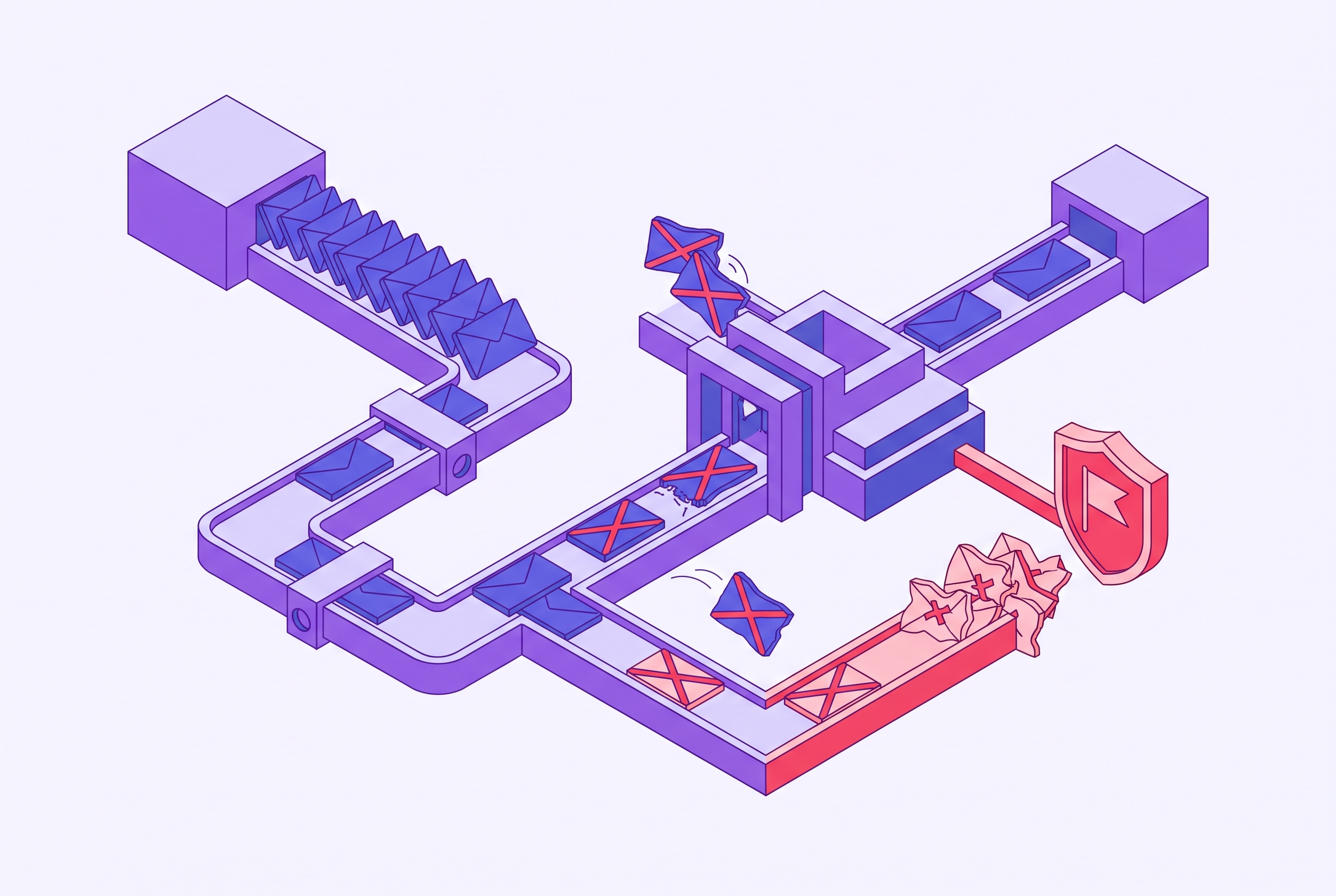
Provider enforcement now rejects non-compliant mail immediately instead of routing it to spam.
- Written by
- Dayo Fashola
- Published
- October 7, 2026
- Reading time
- 11 min read
- Sources cited
- 2 sources ↓
What this covers
Bounce rates and spam complaints are rising in outbound sequences this year, and the cause is not sloppier writing or lazier targeting. Provider enforcement changed the consequences of practices that have been common for years, and that change is what's driving the numbers. As of November 2025, Gmail actively rejects non-compliant email outright, and temporary and permanent rejections now replace what used to be quiet placement in the spam folder. Microsoft moved first: in May 2025, it began routing non-compliant mail from Outlook.com into junk folders, before full rejection enforcement arrived later in November 2025.
The old buffer senders relied on is gone. A message used to land somewhere, even if that somewhere was the spam folder, and a team could watch open rates sag, check Postmaster Tools, and fix the problem before it became permanent. Rejection does not give you that runway. A domain can now take on damage within days, because the failure shows up immediately as a hard bounce rather than building up through a slow decline in engagement as it did under the old system. That compression is the reason early detection and a sequential approach to fixing the underlying causes are no longer optional steps for a careful team. They are the only way to catch a problem before the domain's reputation absorbs permanent harm.
The three root causes that almost every bounce and complaint problem traces back to
Bounce rates and spam complaints present as two different metrics, but they trace back to the same small set of causes, and treating them as unrelated problems is why so many fixes fail to hold. Apollo's 2026 triage framework identifies three tracks that have to be worked together: list hygiene, authentication alignment, and reputation monitoring. Fix one while ignoring the other two, and the damage from the untouched tracks keeps compounding and erases whatever progress you think you're making.
Bad data is the first cause. B2B contact records decay constantly, because people change jobs and companies move offices, so a list you verified last quarter can already be generating bounces today. Broken authentication is the second. Missing, misconfigured, or misaligned SPF, DKIM, or DMARC records give receiving servers a clean reason to reject mail outright, and this failure mode is especially common in stacks that run multiple sending tools, where the visible From domain often doesn't match the DKIM signing domain or the Return-Path. Poor reputation management is the third. Complaints that run high, volume that spikes suddenly, and a cold domain sent from without a warming period all suppress deliverability and raise the odds of rejection.
A fourth factor deserves its own mention even though it isn't a root cause in the same sense: catch-all and role-based addresses, like info@ or support@, often accept mail at the SMTP level without ever reaching a human being, and that silent acceptance can mask a real data quality problem.
These three causes also sit in a dependency chain, and that chain determines the order the rest of this piece follows. Authentication has to be clean first, because if you're only watching the bounce rate, rejections from broken authentication look identical to rejections from bad data, and that means credit for improved data hygiene can't register against your domain. Reputation cannot recover if bad data keeps producing hard bounces, no matter how carefully you warm a domain. Fix authentication first, data second, reputation third. That order is the sequence enforcement actually checks.
Reading your own thresholds
Before applying any fix, a team needs to know which threshold its numbers are actually close to crossing, and most teams can't answer that because they're looking at a single blended rate that hides the real risk inside it. Hard bounces and soft bounces need separate tracking. If you treat a soft, temporary deferral as a permanent failure, you remove good addresses from a list for no reason, but if you ignore repeated soft failures, dead addresses sit in the sendable pool and quietly drag down future sends. A total bounce rate that looks healthy can still be hiding a hard bounce rate sitting in a caution or urgent band, so any report worth trusting splits the two.
Complaint rate has its own wrinkle, and it depends on which mailbox provider you're sending to. Yahoo only counts inbox-delivered emails in its denominator and excludes anything that landed in spam, so Yahoo's calculation is stricter than Google's. A sender with meaningful spam placement is closer to Yahoo's complaint ceiling than the raw number suggests, since a chunk of sent mail never counted toward the denominator. Bounce rate and spam complaint rate move on their own, independent of each other. A campaign can show fine open rates while it quietly damages sender trust through bounces and complaints at the same time, so watching opens alone won't catch either one.
The stakes for crossing the complaint threshold are specific. Once a bulk sender domain's spam rate exceeds the upper limit, it loses access to Google's delivery mitigation program until the rate stays below the threshold for seven consecutive days. That seven-day rule governs regaining eligibility after a domain has already crossed the line. It is not a grace period for a rate that's merely approaching the limit. The practical response before that point is to set an internal alert well below the healthy threshold, so there's room to act before a crossing happens. If the reported spam rate starts climbing toward that line, the response is to review recent campaigns and acquisition sources, pause the riskiest segments, and keep monitoring until the rate drops back into healthy territory. Reading the numbers this way, split by bounce type and benchmarked against provider-specific thresholds, is what tells a team which of the three root causes to work on first.
Fixing broken authentication before anything else
Authentication comes first in the fix sequence because a misconfigured record converts directly into a permanent rejection under current provider policy, regardless of how clean the recipient list is or how well the domain has been warmed. In 2026, that direct conversion is what makes authentication failures the fastest route to a hard bounce. A domain can have a perfectly verified list and a carefully managed sending cadence and still get rejected wholesale if its SPF, DKIM, or DMARC setup doesn't check out.
The most common version of this failure appears in stacks that run more than one outbound tool at once. The From field a recipient sees doesn't always match the domain that signed the DKIM header, and neither one may match the Return-Path the server uses to handle bounces. Any one of those three mismatches is enough to trigger rejection under DMARC alignment rules, so all three need auditing before volume scales up: confirm the SPF record covers every server currently sending on the domain's behalf, confirm DKIM is signed with a key that's published and valid, and confirm a DMARC policy exists with DKIM and SPF properly aligned to the From domain.
Mailbox providers treat authentication as the first signal they check, ahead of engagement, content, and list quality. When authentication fails, none of those downstream signals get evaluated, because the provider already has a clean, mechanical reason to reject the message. That ordering is also why authentication has to be fixed before any data hygiene work can be trusted. If a domain gets rejected for authentication failures, you can't trust its bounce diagnostics, because the bounces it generates are infrastructure errors wearing the same label as list-quality problems. Sort out authentication first, and the bounce numbers that remain actually mean something about the data.
Fixing bad data: list hygiene before the send, and continuously through the sequence
Once authentication is solid, decayed data becomes the next visible source of hard bounces, and one pre-send verification pass won't be enough to stop it. Contact data in B2B keeps decaying as people change roles and move between companies, so a list that passed verification last quarter can already contain addresses generating bounces now. The decay is continuous. The protection against it has to be continuous too.
Practitioners split on how to handle this. One camp argues that sourcing contact data in real time from clean providers removes the need for a separate verification step. But the other camp holds that you need a dedicated hygiene pass before every send, even with the best data sources, because B2B contact records churn so fast. The evidence favors running the dedicated pass: a low bounce rate comes from data quality, not from better copy, and checking addresses against a large, current database before they enter a sequence catches decay that even clean sourcing misses. Sending a follow-up to an address that was valid when the sequence started but has since been deactivated produces a hard bounce that damages sender score just as surely as a cold list would. The fix is continuous verification: a tool that checks address validity at every step of a running sequence, not only before the first send.
Catch-all and role-based addresses, like info@ or support@, need separate handling, because they are a distinct data problem. These addresses frequently accept mail at the SMTP level without a human ever reading it, and they should be filtered out before a send goes out, not identified afterward once they've already counted against deliverability. Verification tools in active use today cover different parts of this workflow: ZeroBounce works as an all-in-one suite with enrichment built in, NeverBounce handles bulk list cleaning and API-based verification, MillionVerifier focuses on bulk list cleaning, and Bouncer emphasizes accuracy and GDPR compliance along with real-time form protection. What you pick should come down to which part of the workflow needs coverage, not brand familiarity. Outbound platforms with verification built directly into the sequence tool, including Overloop, Amplemarket, and Apollo, cover both ends of this problem at once: they verify addresses before a sequence launches and flag bad addresses as they turn up mid-sequence.
Every hard bounce needs to go into permanent suppression the moment it happens, recorded with the reason, the timestamp, the source it came from, and whatever consent evidence exists for that contact. Suppressing rather than simply deleting a bounced address matters because a deleted record can get re-imported into a future campaign from an old list export, while a properly suppressed one can't.
Why spam complaints require tighter ICP targeting
List hygiene fixes bounces, but it does very little for spam complaints, because a complaint comes from a valid, correctly delivered address attached to a human who found the message irrelevant enough to report. Complaint rate depends on recipient behavior rather than sender configuration, which sets it apart from every other factor in provider enforcement. A message can pass every authentication check and land in a perfectly verified inbox and still generate a complaint if the person reading it has no reason to want it.
Complaints spike for predictable reasons: the email reaches someone outside the intended audience, it arrives too often, or it gives the recipient no obvious way to opt out. The most direct lever against all three is tighter targeting of the ideal customer profile before a sequence ever goes out. The best campaigns lean on micro-segmentation, messaging built around a specific problem rather than a generic pitch, and frequent A/B testing, and all of that pushes down the odds that any single recipient feels enough friction to hit the spam button. Signal-based personalization extends that logic further: using real-time triggers like funding announcements, leadership changes, or hiring surges demonstrates timing and relevance in a way that generic personalization, built only from a name and a company field, cannot match.
Tracking complaints also carries a blind spot that many teams don't know they have. Gmail does not forward individual complaint data to email service providers at all, so tracking Gmail complaints is operationally harder than tracking complaints on other providers. Yahoo does provide individual complaint feedback loop data, and Microsoft offers SNDS and JMRP, but both are IP-based tools, so they have limited use for senders on shared ESP infrastructure. If a program sends heavily to Gmail addresses, it has to monitor Google Postmaster Tools directly to see its actual complaint signal, because the sending platform's reports exclude Gmail's individual complaints.
One-click unsubscribe, now required at scale by major providers, also does double duty here. It satisfies a compliance requirement, and it also gives a frustrated recipient an easy exit that doesn't involve marking the message as spam. A recipient who can leave a list in one click has less reason to reach for the complaint button instead, which makes unsubscribe placement a complaint-reduction mechanism in its own right, not just a box to check for compliance.
Reputation management: domain warming, suppression architecture, and recovery sequencing
Reputation absorbs the consequences of the first two fixes, and it recovers slowly even after authentication and data hygiene are both in order. If a cold domain sends at volume without a warming period, it signals exactly the kind of pattern that trips reputation-based filtering, no matter how clean the list behind that volume is. Warming works by ramping volume gradually, so mailbox providers see a pattern of consistent, expected behavior to measure against, rather than a sudden spike that looks identical to a compromised account or a purchased list.
Suppression architecture, introduced earlier as part of fixing bad data, is also what protects reputation over time. Every hard bounce and every complaint needs to go into a permanent suppression list, recorded with enough detail, including the reason, the timestamp, and the source, that the same address can never be accidentally reintroduced through a future list import. Reputation damage compounds specifically when the same bad addresses keep cycling back into new campaigns because no suppression record stopped them the first time.
Recovery, once reputation has already taken damage, follows the same order as the original fix sequence: confirm authentication is clean, confirm the list driving the current send has been verified and suppressed correctly, and only then expect the complaint rate and bounce rate to start moving back toward healthy thresholds. Google's rule that a domain must hold its spam rate below the critical threshold for seven consecutive days before regaining mitigation eligibility is a useful model for how recovery actually works across every provider: reputation rebuilds over a sustained run of clean sends, not from a single corrected setting. Treating authentication, data, and reputation as three tracks that have to hold steady at once, in that order, is what keeps a domain out of the enforcement regime this piece opened with.
Methodology & sources
- to authenticate outbound email with these protocols, you need to set up SPF, DKIM, and DMARC for your domain. - Microsoft Q&A
Provided technical background on SPF, DKIM, and DMARC configuration requirements referenced in the authentication sections.
- How email authentication works in Microsoft 365 - Microsoft Defender for Office 365
Supported the explanation of how email authentication works and why providers treat it as the first signal checked before engagement or content.