Contact Database Decay Rates and Refresh Cadences
Job changes decay contact data faster than company facts, so refresh schedules must vary by field.
- Written by
- Soo-Jin Pak
- Published
- October 20, 2026
- Reading time
- 8 min read
What this covers
Fields tied to a person’s current role go stale faster than stable company facts, so using one refresh schedule wastes work and leaves important fields unchecked. Verification frequency and depth should match each field’s decay risk, with event triggers covering the changes that happen between scheduled reviews.
Why contact databases decay continuously rather than occasionally
A contact database looks fine until a campaign reaches the portion that is no longer correct. A stale cell looks identical to an accurate one in a spreadsheet or CRM view, so the problem can remain hidden until someone uses it. This makes decay different from an obvious technical failure or a data-entry error. The record may have been correct when it entered the system. What changed was the person or company it described.
Job mobility is the main driver of that change. The Bureau of Labor Statistics recorded millions of quits in a single month, illustrating the labor-market movement behind apparently static records. A single departure can invalidate a job title, work email, direct-dial number, and company name together.
Company events compound those person-level changes. Mergers, acquisitions, rebrands, relocations, and team restructures can invalidate whole groups of firmographic details at once. None requires anyone maintaining the database to make a mistake. Decay is therefore a structural, ongoing problem that reaches the CRM after the underlying change has happened.
The blended annual decay rate and why it understates the real problem
HubSpot/MarketingSherpa’s Database Decay Simulation is the source of the annual baseline often cited for contact database decay. That benchmark is a useful starting point because it establishes that deterioration is normal. A large database losing roughly 2% of its usable records each month loses thousands over a year without any failure in data entry. The annual view makes that accumulated loss visible. It does not show where the loss is concentrated.
The first limitation is that a blended rate combines fields with different failure patterns. A record can retain the correct personal name and company founding year while its email address and title become unusable. Counting that record as a single unit obscures the distinction between descriptive accuracy and outreach readiness.
Sector differences further limit the average’s value as a planning tool. SaaS and tech lose accuracy faster than comparatively stable sectors such as manufacturing and healthcare. Annual snapshots also miss contacts that churned in and out within the same year, leaving some movement outside the measurement. Meanwhile, a higher estimate often credited to Gartner cannot be traced to a Gartner report, so it should not take the place of a baseline with a known source. The aggregate rate is a planning floor.
How fast each field type actually decays, and why
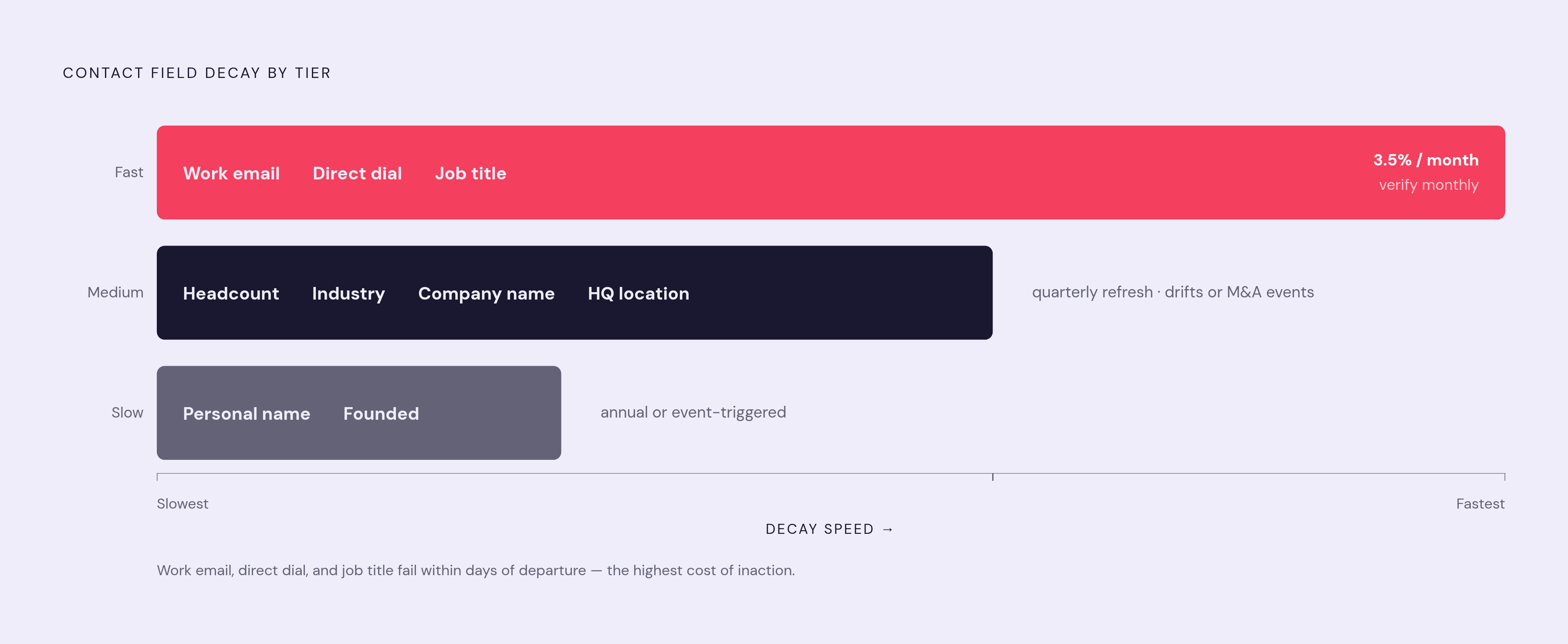
The fields that decay fastest are those tied to the job a person has now, including work email, direct-dial phone, and job title. A work email can be deactivated within days of departure, before that departure appears in a CRM. A direct line can stop reaching the intended person even when that person remains reachable on mobile. A title can become wrong through a promotion or internal move without any employer change. These fields share a dependence on current employment, but they do not always fail together.
Email may be the first field to break after a departure, while direct dials and titles generally become stale faster than company names. The address may still work even though the title no longer says what the person does.
The middle tier contains firmographic fields such as headcount and industry classification. Headcount drifts as a company grows or restructures, while industry classification can become less useful as the business pivots or is reclassified. Company name is generally more durable than a role-linked field, but a rebrand or acquisition can change it abruptly. Those events can also change email domains, titles, and firmographic classification at the same time. This is a cluster failure that a single-field check cannot resolve.
The slow tier includes personal name and founding year, which are essentially permanent or close to it. The city where a company has its physical headquarters can also stay the same for years, though it changes when the headquarters moves. The important distinction is between details that drift through ordinary activity and those that usually change only after an identifiable event.
What decayed fields actually cost a GTM team in practice
Deliverability is the most immediate consequence of stale contact fields. Hard bounces above a 2% threshold harm sender reputation, so outdated addresses cause trouble beyond the one message that failed. The cost is no longer simply that one contact cannot be reached. Poor list quality puts the sender’s ability to reach the rest of the audience at risk.
Revenue loss extends beyond bounced messages. Validity’s 2025 State of CRM Data Management found that a sizable share of CRM users said poor data quality had directly cost them revenue, and companies also said they lost sales opportunities each quarter. Gartner’s estimate, first published in 2020, puts the average annual organizational cost of poor data quality in the tens of millions of dollars. That broader estimate establishes the magnitude of the wider poor-data-quality problem. Stale contact fields add to these costs when outreach fails, reps waste time, and targeting no longer fits the buyer the team meant to reach.
CRM trust suffers because many of those errors remain technically invisible. A segment of senior technology decision-makers can continue to pass its filters even as contacts change roles, departments, or companies. The filters still operate correctly, but the records no longer describe the intended audience. AI personalization amplifies the same weakness by turning decayed inputs into thousands of tailored mistakes.
Matching refresh cadence to each field's actual decay speed
The cadence decision has three parts, namely which field matters, how often it needs review, and what event should bring that review forward. Fast-decay fields warrant frequent re-verification, with shorter intervals for high-velocity outbound teams. The strongest control is verification at the point of use, when an outdated value is about to affect a decision or message. Any contact that has not been emailed recently and has not been re-verified should be checked before outreach. This concentrates effort where stale data is about to create a consequence.
For email, a calendar alone leaves too much room between checks. The cited monthly email decay rate of 3.5% shows why an address that once worked may become unsafe to use. Event-driven checks complement the calendar. Useful triggers include a hard bounce, a pricing-page visit, a LinkedIn job-change signal, or a new hire announcement.
For middle-speed firmographic fields, quarterly refresh is a reasonable floor. Headcount, industry classification, and headquarters location need to be checked sooner in high-M&A sectors or during known periods of consolidation. A known relocation or acquisition makes the next scheduled review of headquarters location too late.
Slow-decay fields such as personal name and founding year usually need a check only once a year or when an event triggers one. Legal entity details can follow that lighter schedule unless a known acquisition creates a reason to check sooner. Industry context then adjusts the framework, with SaaS and tech contacts warranting more aggressive schedules than manufacturing or government contacts. The schedule follows both the field’s behavior and the population’s mobility, rather than forcing every record into one maintenance cycle.
Verification methods and tooling that can sustain field-level cadences at scale
Field-level cadences require layered verification because no single method covers every kind of uncertainty. SMTP-only email verification has a specific blind spot in catch-all domains, which return a positive response to any address. In that case, a positive response does not establish that the intended mailbox is valid. Vendors should explain what happens when SMTP is inconclusive. Layered validation, including SMTP, carrier lookup, and human review, addresses more of the problem than a single-method check.
Coverage also needs to be separated from correctness. A provider may return a phone number without establishing that it reaches the intended person. Waterfall enrichment addresses gaps by passing a miss from one provider to the next, improving match rates beyond a single source. However, gains shrink past three or four providers, when the additional per-lookup cost rarely justifies the incremental coverage.
A well-filtered target list makes that process more efficient. ICP qualification before enrichment directs lookups toward contacts that already fit the intended audience, rather than spending them across an unfiltered import. Landbase offers verified emails and verified phone numbers as a targeted add-on for contacts a team plans to call through its enrichment layer. Its targeting workflow includes ICP qualification, tying enrichment to audience definition rather than making it solely a downstream cleanup step. That workflow option still requires choosing the right verification depth.
Request-time API lookups check how things stand now, avoiding the risk of relying on an aging batch snapshot. They can support point-of-use verification where scheduled refresh leaves a gap, although the underlying verification method still matters. Manual research is still useful for high-stakes strategic accounts but is too slow to be the main way to keep data clean. A list assembled over a full researcher-week can already be stale when it is finished.
Building a maintenance routine that matches effort to decay risk without over-engineering it
A sustainable routine starts with a field-level audit that identifies the fields outreach actually depends on, ranks them by decay speed, and assigns each a calendar, event, or bounce-triggered review. That connects maintenance effort to a decision the database supports. It also distinguishes records that are merely complete from records that are ready to use.
For most B2B teams, three tiers are enough. Fast-decay contact fields belong on frequent or signal-triggered schedules, middle-speed firmographic fields on quarterly schedules, and stable fields on annual or event-triggered review. Quarterly batch cleansing is still a useful floor, but it fixes damage that has built up and leaves some changes between cycles uncaught. Signal triggers close part of that gap without requiring every field to be checked continuously. This treats data as a perishable flow rather than a stock bought once and owned indefinitely.
The benefit reaches beyond the next campaign. Inactive records inside campaign populations and duplicates split across profiles can distort the metrics used to move marketing budget. Yet checking founding years monthly or applying waterfall enrichment to slow-decay fields diverts resources from title and email verification. The practical model is deliberately limited, with three tiers, matched cadences, and event triggers directing effort to the fields most likely to fail when used.