Firmographic and Technographic Data in ICP Definition
Combine firmographic and technographic data to define which accounts can truly become customers.
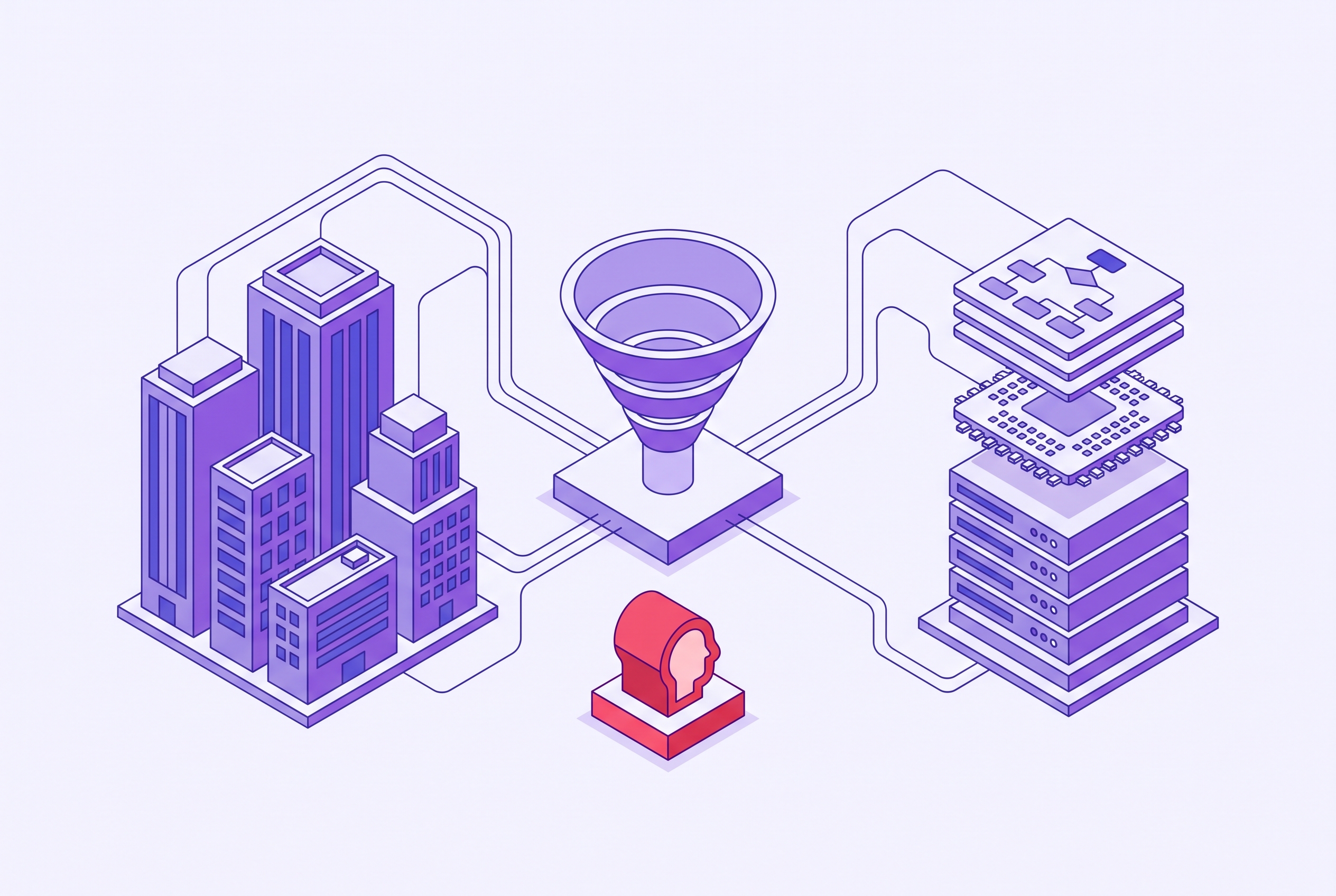
- Written by
- Tariq Benhamida
- Published
- October 22, 2026
- Reading time
- 8 min read
- Sources cited
- 3 sources ↓
What this covers
Firmographic and technographic data perform distinct, sequential jobs in ideal customer profile definition. Firmographics establish which market segment to pursue, while technographics narrow that segment to accounts with a concrete fit and a relevant message. A targeting system needs both to work, then adds intent signals to tell which accounts fit and which show signs that they are ready to buy.
Why firmographics alone cannot complete an ICP
Marketing hands over companies that match the target industry, size, and revenue range, but follow-up stalls. Sales reps go after businesses too small to afford the price point or enterprises whose security and procurement requirements the product cannot meet. The dashboard records activity without momentum because the selection criteria describe attractive companies without establishing whether they can become customers.
The structural problem begins when a team labels a firmographic profile its finished ICP. Industry, headcount, and revenue can establish a broad resemblance to existing customers, but they cannot explain every difference between accounts that buy, expand, or renew and those that do not. A lookalike list inherits that weakness. It reproduces the shape of the customer base while leaving out technology and operational patterns that may distinguish the strongest customers.
An ICP also operates at a different level from a buyer persona. The ICP defines which organizations to go after, and the persona describes the people inside them. ZoomInfo’s sales ICP guide places account selection before persona development. Reversing that order can produce precise targeting of the right people at the wrong companies, where even relevant messaging cannot resolve a structural mismatch.
A stalled opportunity may belong to a company the targeting system should have ruled out before outreach began. Completing the ICP therefore requires more than describing the market in greater detail. It requires criteria that distinguish a plausible customer from a company that merely resembles one.
What firmographic data actually does in ICP construction
Firmographics set the bounds of the market before teams spend time on outreach. Industry and vertical identify relevant business contexts, with specific subsectors providing more useful distinctions than a broad category such as technology. Employee count and annual revenue establish scale, while geographic location and ownership type add service and organizational context. These are necessary filters. Their job is to screen out companies that are structurally outside the market the vendor can serve.
A subsidiary or holding company may have a structure that does not match the vendor’s sales model. Operational maturity affects whether the organization can set up and use the product, and its location may limit how it can be served or which compliance requirements it can meet. A company can therefore pass a broad industry-and-size filter while remaining unsuitable. A useful profile spells out those constraints so sales has them before qualification begins.
The boundary between organizational context and technology context is not absolute. ZoomInfo’s ICP definition identifies the tech stack as a signal of budget capacity, operational sophistication, and integration requirements. Revenue may establish a plausible commercial range, but it does not identify the systems with which the product must work.
For practitioners, the lesson is to treat the profile as a commitment to exclude accounts. Ambiguous thresholds inflate customer acquisition cost and stretch sales cycles because each campaign and qualification decision inherits the uncertainty. Those thresholds also need scheduled review. B2B data decays over time, especially in SaaS and technology segments where headcount, funding stage, and business model can shift within a quarter. Even a well-defined market boundary becomes unreliable when its underlying records are stale, and a current boundary still needs a second layer to establish technical fit.
What technographic data adds and how it is captured
Technographic data describes the technology an organization runs today. It reveals the infrastructure, integration surface, and operational context that a product may require. ZoomInfo’s guide identifies CRM platforms, marketing automation, sales engagement tools, and data and analytics as key technographic signals in a B2B ICP. An installed platform does not establish what the company is researching or whether it plans to buy anything.
That distinction does not diminish the value of the installed base. An integration vendor targeting a specific CRM can exclude accounts running incompatible platforms before the first touchpoint. A displacement campaign can target companies that use a competing solution and build outreach around what is known about their technology. Sales and marketing then have a defensible entry point. They can lead with an integration, a migration path, or a displacement argument rather than a generic pitch to every company in the same industry.
The collection method determines how much confidence that entry point deserves. BuiltWith uses web crawling to detect technologies that leave recognizable fingerprints on public-facing sites. Wappalyzer primarily fingerprints pages through a browser extension. Frontend technology is easier to detect accurately because it is out in public. Back-office systems, including CRM, ERP, HRIS, and data warehouses, are much less reliably identified through crawl data alone.
Job-posting inference extends coverage into backend and internal tools by parsing hiring signals. However, those signals can lag reality by weeks or months. A hiring reference is not the same kind of evidence as a detectable technology on a live public page. As a result, a provider’s overall coverage cannot substitute for understanding how a particular field was captured.
Freshness creates a separate constraint on otherwise useful data. A company can replace its marketing automation platform within a quarter, making outreach about the former tool worse than no personalization at all. Many of the best providers update technographic data every week or more often. HG Insights operates on quarterly refresh cycles, illustrating the variation between providers. Updates made each month can miss important changes, and records updated each quarter may show what a stack used to be rather than what it is now when campaigns depend on a stack that is changing.
How the two layers combine into a working targeting system
Firmographics establish the outer boundary of the addressable market, and technographics narrow that boundary to accounts with a specific reason to engage. Reversing the sequence risks selecting technically compatible companies that remain commercially or operationally unsuitable. A compatible stack cannot resolve every mismatch. Company scale, service constraints, and the ability to implement still govern whether the opportunity belongs in the target market.
A firmographic filter might return a large group of companies in the chosen subsector, employee range, revenue range, and geography. Adding a required CRM integration or target platform reduces that group to a fraction of the original list. The smaller list has a stronger basis for outreach. Each retained account has passed the market filter and presents a technology context that the message can address.
A company may fall outside the commercial range, run an incompatible stack, or have a structure that leaves it unable to implement the product. These are different reasons to stop pursuit. Keeping them distinct makes the anti-ICP more useful than a general label of poor fit, because the rejection follows from a defined condition.
The output is a prioritized account universe. Timing remains a separate question. ZoomInfo’s framework describes higher conversion for ICP-fit accounts with active intent signals than for cold outreach, a comparison that includes both fit and buying signals.
Shared criteria also align the teams acting on that universe. Marketing can build campaigns around the same technology segment that sales has selected, so a handoff does not silently change the definition of a qualified account. When teams use different criteria, each can follow a filter that looks sound to them and still disagree on which companies to go after.
Where the firmographic-plus-technographic model reaches its limit
Two companies can share the same firmographic and technographic profile while occupying very different positions in a buying process. One may have available budget, an active evaluation, and a clear decision timeline. The other may lack an internal champion and have no near-term purchase plans. The two-layer model treats them as equivalent fits. It cannot, on its own, explain why one warrants attention now and the other does not.
Intent signals help fill this timing gap with evidence of what an account is doing. Topic surges and content engagement can show that research is underway, and leadership changes, funding rounds, and technology migrations are trigger events that may change an account’s situation. ZoomInfo’s guide describes intent and triggers as the layer identifying “who is ready to buy now”. Their role is to prioritize within the fit universe. They do not replace the commercial and technical conditions that made an account worth pursuing.
The interpretation still requires restraint because activity is not a guaranteed purchase. AI-scored intent can be opaque, and false positives consume SDR time on accounts flagged as in-market that are not actually buying. Historical training data creates another limitation. When a new product launch or market repositioning changes the ICP or buying pattern, the model may lag until retraining reflects that shift.
There is also a limit to visibility itself. No data provider can observe all the conversations in dark social or private communities where buyers conduct early evaluations. Intent data captures only the observable part of research behavior, so it cannot offer a complete view of readiness. The two-layer ICP identifies suitable accounts, while intent improves timing without removing uncertainty about the buying decision.
What a multi-signal ICP looks like in practice and how teams maintain it
A multi-signal ICP combines a firmographic foundation, a technographic precision layer, and behavioral evidence that informs timing. In practice, those inputs form decision rules rather than a static description of the target market. The rules are validated against closed-won data and reviewed on a regular cadence. Ownership spans sales, marketing, customer success, and product. This gives the profile an organizational home beyond the team that first drafted it.
Maintenance applies to both the records and the definition. Updating company attributes and installed technologies keeps the data from going stale, while reviewing the profile keeps it in step with changes in the product, market position, and buying pattern. These are separate tasks. A current record can still be scored against an outdated definition, just as a sound definition can produce poor targeting when applied to stale records. Scheduled review therefore needs to consider the selection criteria as well as the data used to enforce them.
Breeze Intelligence by HubSpot provides one example of infrastructure supporting that process. It enriches contact and company records with firmographic and technographic data directly inside the CRM. That placement supports a current enrichment layer without requiring a separate data workflow. It does not replace cross-functional ownership or the behavioral layer. Its relevance is in making company and technology context available where the operating rules can be applied.
The practical test is enforceability at the front line. Marketing must be able to build list criteria from the profile, an SDR must be able to disqualify an account against it, and RevOps must be able to score and route on it. Documented exclusions turn broad preferences into usable boundaries. If a teammate cannot explain in one sentence why a company fits, the targeting remains too loose. The finished ICP must change a Tuesday-morning targeting decision.
Methodology & sources
- What is an Ideal Customer Profile (ICP) and why you need one - Firmable
Provided foundational explanation of ICP components including firmographic filters and the distinction between ICP and buyer persona.
- Technographic Data: What It Is, Examples & Providers [2026]
Provided details on technographic data collection methods including web crawling, browser fingerprinting, and job-posting inference, and noted provider refresh cycles.
- What Is Technographic Data?
Supplied context on how technographic data reveals infrastructure and integration surface relevant to ICP construction.