AI SDR Agents vs Human SDRs for Outbound Pipeline
AI SDRs send more volume but convert worse downstream than human reps.
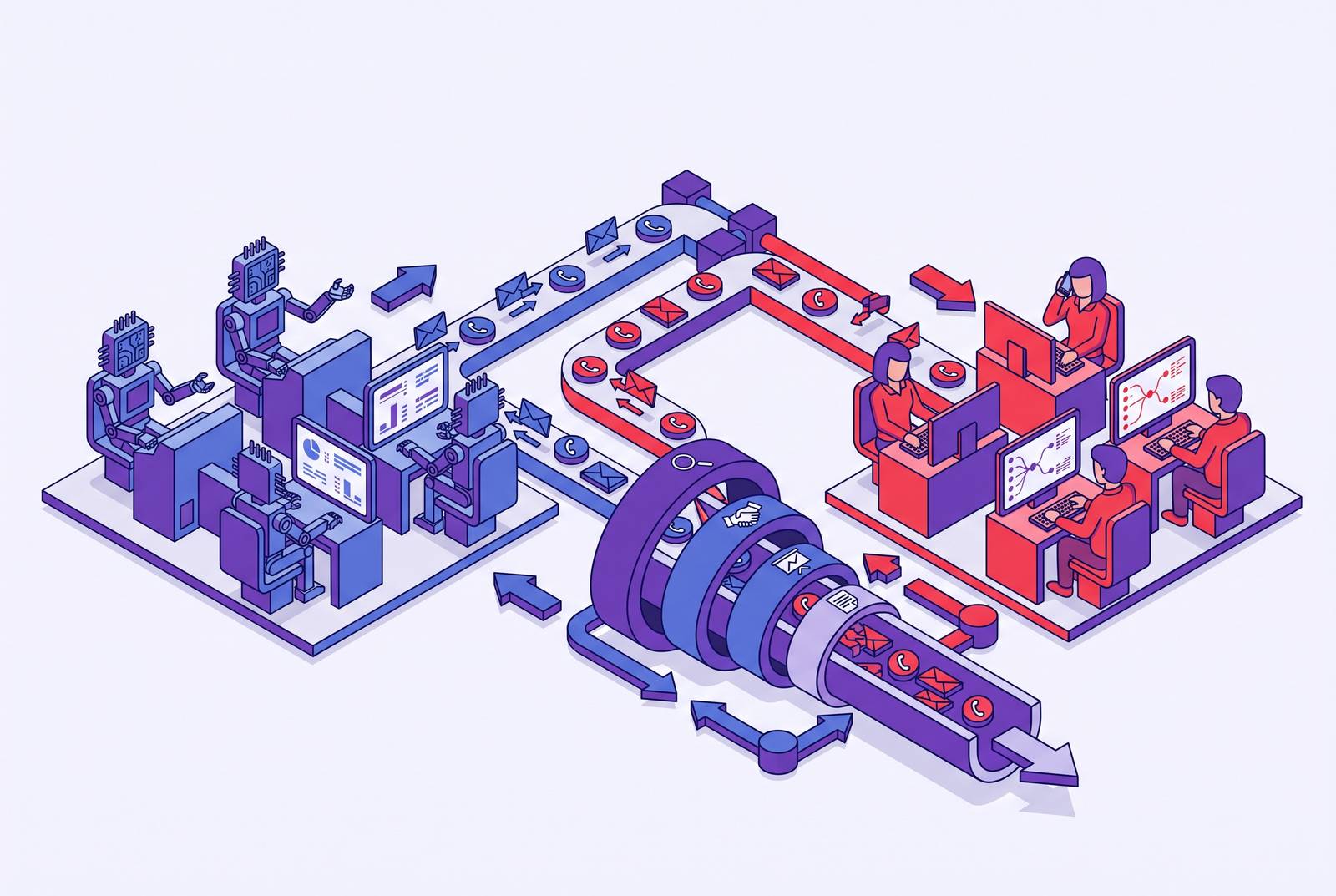
AI SDR software automates the prospecting work a human SDR would otherwise grind through by hand: building lists, researching accounts, writing outreach copy, running sequences, handling replies, booking meetings. That's the functional definition, and it matters because the market has stopped agreeing on it. Three very different pieces of software all get called "AI SDR" right now, and conflating them is the single most common mistake buyers make before they ever get on a vendor call.
The first category is the fully autonomous agent, sold as a digital worker that runs outbound start to finish with minimal human input. Vendors like 11x's Alice and Artisan's Ava fall here, and this is the category carrying the highest ambition and, as later sections show, the highest scrutiny. The second category is the copilot embedded inside an existing sales engagement platform, where AI augments a rep's workflow rather than replacing the rep. Apollo.io sits in this bucket, alongside platforms like Regie.ai that blend AI assistance into rep workflows. The third category is intelligence and enrichment infrastructure, tools built for research and orchestration rather than full-cycle SDR replacement, which get lumped into "AI SDR" roundups anyway despite doing a functionally different job.
Split further by motion, and you get inbound agents working high-intent website traffic, outbound agents cold-starting new lists, and orchestration layers feeding both. The category has grown fast enough to blur these distinctions further: it passed a multibillion-dollar mark in 2025, and industry research estimated that by early 2026, 42% of B2B companies were running some form of AI-assisted outbound. ZoomInfo's technographic data shows AI product usage up 893% since 2022 across nearly every industry it tracks. That number says something about the speed of adoption. It says nothing about whether the adoption is working.
What the volume-vs-quality data shows when AI and human SDRs run outbound head-to-head
On raw output, there's no contest. AI SDRs push 10 to 50 times the email and LinkedIn volume a human rep can manage, and a human maxes out somewhere around 50 to 100 emails a day before quality and personalization start to erode. AI doesn't get tired at email 60.
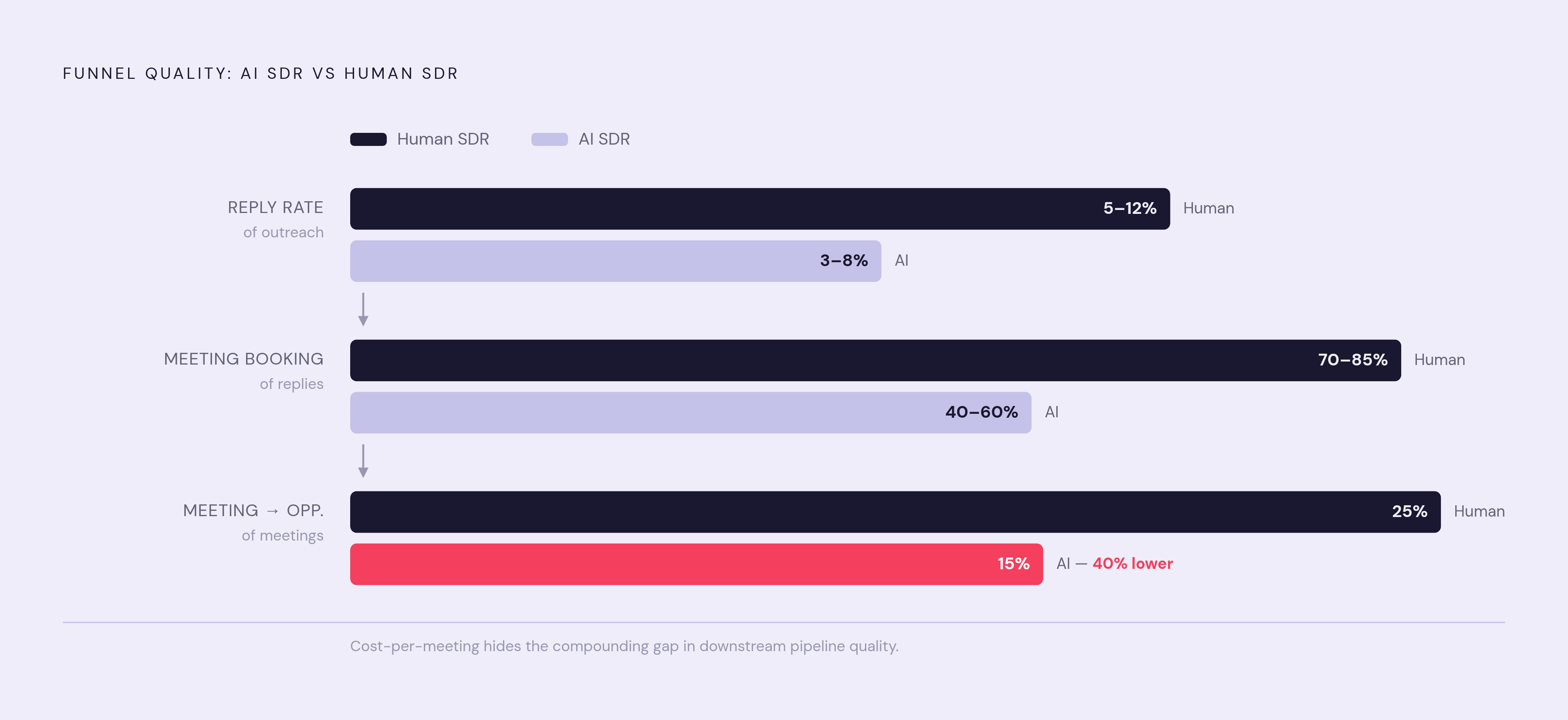
Reply rates tell a different story, and the gap is smaller than the volume numbers would suggest. AI SDRs land cold reply rates in the 3% to 8% range, while human SDRs run 5% to 12%. Real, but not the chasm you'd expect given how differently the two approaches scale. At 10 to 50 times the volume, even the lower AI reply rate can generate more total replies than a human rep produces, and that arithmetic is exactly what makes the category attractive to a VP of sales staring at a headcount budget.
The trouble appears downstream, in the meeting-booking data. AI-booked meetings convert at a 40% to 60% rate, compared to 70% to 85% for meetings a human SDR booked. It's a structural problem, not a tuning problem you fix with a better prompt. It's structural. And it compounds: meeting-to-qualified-opportunity conversion runs around 15% for AI SDRs versus 25% for humans, based on analysis of 2026 deployment data. A 40% drop in downstream pipeline quality does not appear on the activity dashboard that made the AI SDR look like a bargain in month one.
The mechanism is straightforward once you see it. AI optimizes for sends, because sends are the thing it can measure and iterate on cheaply. Buyers optimize for relevance, because their attention is the scarce resource. The dynamic resembles a machine gun versus a sniper: one method sprays volume and accepts a lower hit rate as the cost of scale, the other places fewer shots with far more precision. Both can work. They do not work the same way, and they do not produce the same downstream pipeline.
Cost comparisons usually stop at the wrong number. A fully loaded human SDR runs $75,000 to $120,000 a year and, after a three to four month ramp, books somewhere around 15 to 20 qualified meetings a month. AI SDR licensing costs a fraction of that salary. But cost-per-meeting is the vanity metric here; cost-per-qualified-opportunity is the one that actually maps to revenue, and it inverts the comparison more often than vendors advertise.
A controlled test cited in the Digital Applied buyer's guide makes the point concretely. A pure-AI outbound setup booked more total meetings, converting at 11%. A hybrid setup, mixing AI execution with human oversight, booked fewer meetings but converted at 38%. The hybrid setup generated several times more revenue with a smaller meeting count. Volume, in other words, is the number that feels good and means less than it looks like it means.
One more caveat before moving on: most vendor performance claims in this category have not survived independent scrutiny. The clearest example gets its own section next.
The 11x collapse and what it reveals about where autonomous AI SDRs break
11x.ai raised a substantial round from Andreessen Horowitz and Benchmark, making it the best-funded and most publicly hyped fully autonomous AI SDR vendor in the category. Within months of launch, it lost 70% to 80% of its customers.
A TechCrunch investigation found fabricated customer logos and inflated ARR figures behind the company's public claims. ZoomInfo confirmed running a one-month trial in which 11x performed significantly worse than its own SDR employees and chose not to renew, yet 11x kept listing ZoomInfo as a customer afterward. Airtable denied being a customer at all. Independent verification put the company's actual revenue at a fraction of what it had claimed publicly.
The pattern isn't unique to one vendor, even if 11x is the sharpest case study. Industry data puts the figures at 40% to 60% of autonomous AI SDR pilots shutting down within 90 days, and 50% to 70% of AI SDR tools churning within a year. Platform dependency adds a second layer of risk that has nothing to do with the AI itself: Artisan was banned from LinkedIn for roughly two weeks spanning late 2025 into early 2026, hitting both its company page and employee accounts. Teams whose outbound motion depended on LinkedIn automation through that platform lost that channel overnight, with no warning and no recourse.
The Digital Applied buyer's guide identifies the real bottleneck, and it's not the AI model. Success in this category runs 80% to 90% on data plumbing, routing logic, and guardrails, with prompts accounting for maybe 10% to 20% of the outcome. Vendors sell the AI engine because that's the exciting part of the pitch. The unglamorous data infrastructure underneath it is what actually determines whether the thing works, and most buyers underestimate it before signing.
Jason Lemkin's SaaStr experiment offers a more honest read of the technology's actual ceiling. Twenty AI agents sent 70,000 personalized emails against 7,000 from a human team, and the AI cohort performed on par with mid-tier reps. Lemkin's own conclusion was that the agents were "not better than top performers." Mid-pack, not exceptional, and that's from someone running the experiment in good faith rather than trying to sell the outcome.
None of this means autonomous AI SDRs are a failed idea. It means they're frequently a failed deployment, built without the data infrastructure or human checkpoints the category actually needs to function. The real question is where humans need to stay in the loop, and the next section answers that directly. It's where humans need to stay in the loop, and the next section answers that directly.
Where human SDRs remain irreplaceable, and what that work looks like
Some parts of SDR work resist automation no matter how well the tool is configured. Deep account research is one: AI personalizes from LinkedIn profiles and company boilerplate, but it misses the language buried in an earnings call, the hiring pattern that signals a new initiative, a competitor's recent move, the timing cue that tells a rep this account is worth a call this week and not next quarter.
Reading account readiness is another. One enterprise SaaS rep, quoted in industry research, put it bluntly: a meaningful share of accounts in any pipeline are "teenagers, not adults," prospects who simply won't buy this year no matter how well they're pitched. Judging that readiness is human work, and an AI system optimized purely for output doesn't skip that judgment call so much as never make it, burning meetings on accounts that were never going to close.
Multi-threaded relationship building sits outside AI's structural reach entirely. Enterprise selling runs on trust built across multiple stakeholders over months, and that kind of layered rapport doesn't compress into a sequence of automated touches. AI operates single-threaded by design. It can message five people at one account, but it can't hold the kind of evolving, cross-referenced relationship a human rep builds by remembering what the CFO said in March when talking to another stakeholder in June.
Objection handling shows the gap most visibly, because it's the moment AI SDRs most often embarrass themselves. When a prospect replies with real, nuanced pushback, agents frequently default to generic or slightly off-key responses that read as canned, and a canned response to a specific objection does more damage to a deal than silence would have. Channel strategy, too, needs judgment: deciding whether a specific account needs a warm intro, a cold call, a slow LinkedIn build, or a referral through an existing customer isn't a decision an algorithm makes well, because it depends on context no CRM field fully captures.
The deal-size threshold clarifies where this matters most. Human SDR time is easiest to justify when the ACV and sales cycle length make relationship equity and multi-threading genuinely necessary, the kind of enterprise account where one closed deal pays back months of SDR salary many times over. Below that threshold, the case weakens fast.
None of this is happening in a vacuum. Industry research shows roughly 36% of B2B companies cut SDR headcount over the past year, the steepest reduction of any sales role. That's real pressure, and it's exactly why the role needs to be defined precisely rather than defended in the abstract. Human SDRs aren't being replaced by AI so much as being stripped of the roughly 70% of their job that was research and administrative overhead, and held to a much higher standard on the 30% that was always the actual job: judgment, timing, and the conversation itself.
The hybrid model that outperforms both extremes
Teams pairing AI SDRs with human oversight report 2.8x more pipeline than teams running AI alone, per 2026 industry research. That figure, not the cost-per-license comparison, is the one that actually makes the case for hybrid structures.
The market has more or less already voted on this. Available research shows around 45% of sales teams are running some form of hybrid model today, while only 22% have fully replaced human SDR functions with AI. Full autonomy remains the minority position, and the data above explains why.
In practice, the division of labor looks fairly consistent across teams that have built this well. AI handles prospect identification against a defined ICP, contact enrichment, buying-signal monitoring, first-draft outreach copy, sequence execution, follow-up cadence, and meeting scheduling. A human reviews the draft before it goes out, the checkpoint that separates a copilot from what one industry framing calls a spam cannon, and owns the send decision on high-value accounts. The moment a prospect replies with anything requiring judgment, an objection, a nuance, interest that needs qualifying, a human takes the conversation over.
A lean structure documented in 2026 GTM engineering analysis illustrates how small this can be run. One GTM engineer, or a small agency filling that function, handles enrichment, signal detection, AI-assisted personalization, and sequencing, paired with one or two senior humans who take the phone and the complex accounts. Vercel's inbound motion, reportedly consolidated at a ten-to-one ratio and run by a part-time GTM engineer, is cited as a working example of just how lean this structure can get without losing quality.
Signal-driven outbound is what makes the hybrid model actually function rather than just sound good on a slide. Unify's data shows outreach built around real buying signals gets replied to 73% more often than cold outreach with no signal behind it, and reply rates roughly double when four or more signals stack on a single account. AI is well suited to watching for those signals continuously across a large book of accounts. Humans are better suited to deciding which signals are worth acting on right now, and how.
ZoomInfo's 2025 State of AI in Sales and Marketing report shows the time recovered by handing research and admin to AI is substantial: roughly 12 hours per week per rep, with AI lifting overall GTM team productivity by an average of 47%. That recovered time is the whole point of the hybrid model. It doesn't disappear into more automated sends. It gets redirected into the conversations only a human can run well.
Sequence structure in a well-run hybrid setup tends to follow a fairly consistent shape: a multi-touch cadence scaled to account tier, with lighter sequences for mid-market and longer, more intensive sequences for enterprise, mixing email, LinkedIn, and phone across the cycle. AI executes that cadence. Humans intervene the moment a reply or a high-signal account calls for it.
Combining email, phone, and LinkedIn meaningfully outperforms single-channel outreach, and LinkedIn DMs reply at a higher rate than cold email, so relying on a single channel caps response rates well below what a mixed approach achieves. Combining channels meaningfully outperforms any single-channel approachover single-channel outreach, and Expandi's 2026 figures show LinkedIn DMs reply at 10.3% compared to cold email's 5.1%, making LinkedIn the stronger first-touch channel in many motions. Any AI SDR tool that can't place a call and can't run LinkedIn natively is leaving a real coverage gap, and that gap is exactly where human reps close the loop.
How to decide which configuration fits your motion before you take a vendor call
Deal size and sales cycle length are the variables that should decide this before anything else does. High-volume SMB outbound, with deal sizes under roughly $25,000 ACV, a standardized pitch, and short cycles, is where AI SDRs deliver the strongest economics. The quality gap documented earlier matters less here, because volume compensates for it and a human follow-up step can catch what the AI missed. Mid-market is where hybrid should be the default assumption rather than a special case: AI for research and first touch, human for qualification and multi-threading. Enterprise is where human judgment on account strategy and readiness stops being optional. AI can support that motion. It should not be allowed to lead it.
A handful of secondary factors push the dial further toward human involvement regardless of deal size: buying committees complex enough to require real multi-threading, brand sensitivity high enough that AI-generated email at scale carries real reputational risk, LinkedIn-heavy motions where a platform ban like Artisan's is an unacceptable single point of failure, and long sales cycles where timing judgment, is this account ready now, determines whether a meeting is worth having at all.
Before any of that, there's a prerequisite most buyers skip. The Digital Applied buyer's guide shows AI SDR success runs 80% to 90% on data plumbing and only 10% to 20% on prompts, so ICP definition, signal sourcing, and CRM hygiene all need to be resolved before a tool evaluation even starts. A strong agent pointed at weak data doesn't fail quietly. It sends confident, irrelevant outreach at machine scale, and it does that fast.
List quality alone can move the needle more than any AI feature. Saleshive.com reports one client narrowed its ICP and moved reply rates from 2% to 11%, and separately, 43% of salespeople identify getting higher-quality data as their single biggest prospecting challenge. That's a targeting problem before it's a technology problem.
Segmentation compounds the same effect. Data cited by marketbetter.ai shows building at least three sequence variants, one per tier or persona, rather than one generic sequence for everyone, lifts reply rates by roughly 38%. A VP of Sales does not respond to the same message that lands with an SDR Manager, and treating them identically wastes the personalization AI is supposedly good at.
Inbound signal deserves its own routing logic entirely. Prospects who've visited the website are seven times more likely to take a meeting than a cold prospect, which means that traffic should route to the highest human-touch tier available, not get folded into the same AI sequence running against a cold list.
Before taking a vendor call, four questions settle most of the decision: Is there a clean, defined ICP already in place? Are signal sources, intent data, website visitors, job change alerts, actually connected to the outreach workflow, or sitting in a separate dashboard nobody checks? Is there a human review step before AI sends to high-value accounts? And can the tool slot into the existing CRM and engagement stack, rather than requiring a rebuild around it?
How the leading AI SDR platforms divide across the four categories
Sorting vendors by category, rather than treating them as one interchangeable list, is the only way this comparison holds up, because a fully autonomous agent and an embedded copilot are solving different problems with different risk profiles.
Fully autonomous agents carry the highest ambition and the highest scrutiny, and 11x's Alice is the case study the rest of the category now gets measured against, given the substantial funding raised, the 70% to 80% customer loss, and the customer logo and ARR misrepresentations documented above. Artisan's Ava operates in the same category as a plug-and-play autonomous AI SDR, and it carries a 3.8 rating on G2 according to industry roundups, alongside the LinkedIn platform risk already noted.
AI copilots embedded inside existing sales engagement platforms represent a fundamentally different bet: augmenting a human-run workflow rather than replacing the human running it. Apollo.io sits in this category, built into a platform that already handles prospecting data and sequencing rather than standing apart as a separate autonomous layer. Regie.ai has moved further into this space as well, now operating as a standalone AI-native sales engagement platform under the name RegieOne rather than as a bolt-on feature. The distinction that matters for a buyer: these tools assume a human stays in the loop by design, which lines up directly with what the data in the sections above says actually produces qualified pipeline rather than just qualified activity.
The intelligence and enrichment layer forms a third category entirely, infrastructure for research and orchestration that feeds AI SDR tools rather than replacing the SDR function itself. Whether a given platform in that category counts as an "AI SDR" in the full functional sense is a genuinely contested question in current buyer's guides, so that question needs to be resolved before comparing it against tools built for the whole outbound motion. The fourth axis, inbound versus outbound versus pure orchestration, cuts across all three categories rather than sitting apart from them, and applying that framework before comparing any two vendor names side by side matters because two tools wearing the same "AI SDR" label can be doing almost entirely different jobs.