Inbox Placement Rates vs Open Rates in Outbound Email Measurement
Inbox placement rate, not open rate, determines whether your emails actually reach readers.

- Written by
- Dayo Fashola
- Published
- October 10, 2026
- Reading time
- 10 min read
What this covers
You often see delivery rate and inbox placement rate treated as the same number wearing two names. They are not, and the gap between them is where most outbound email programs lose track of what's actually happening to their messages. Delivery rate measures whether the receiving mail server accepted the email: a handshake between sending infrastructure and the recipient's server that ends the moment the server says yes. As the MassMailer guide for Salesforce teams puts it, a delivered status confirms acceptance, but not inbox arrival. Everything that happens next, whether the message lands in the primary inbox, slides into a promotions tab, or gets routed straight to spam, sits entirely outside what delivery rate can see.
Inbox placement rate picks up where delivery rate stops. It measures the destination: primary inbox, promotions, social, spam, or junk, and only one of those destinations gives a message a real chance of being read. Open rate sits downstream of both. It only counts the fraction of already-placed emails that registered a tracked open event, and it has no way of describing what happened to the emails that never got placed in a visible location.
These three metrics can drift apart quietly. If delivery rate holds at a high rate of acceptance for months, placement can still erode underneath it as domain reputation slides, and nothing in the sending dashboard raises a flag. Two campaigns can post identical delivery rates and still produce wildly different open and reply rates, and when that happens, you can almost always trace the gap back to the placement layer, not to a weak subject line or sloppy copy. Relying on delivery rate as a proxy for health confirms only that the handshake happened and says nothing about whether a human ever had the chance to see what came through the door.
How inbox placement rate determines the open rate a sender can achieve
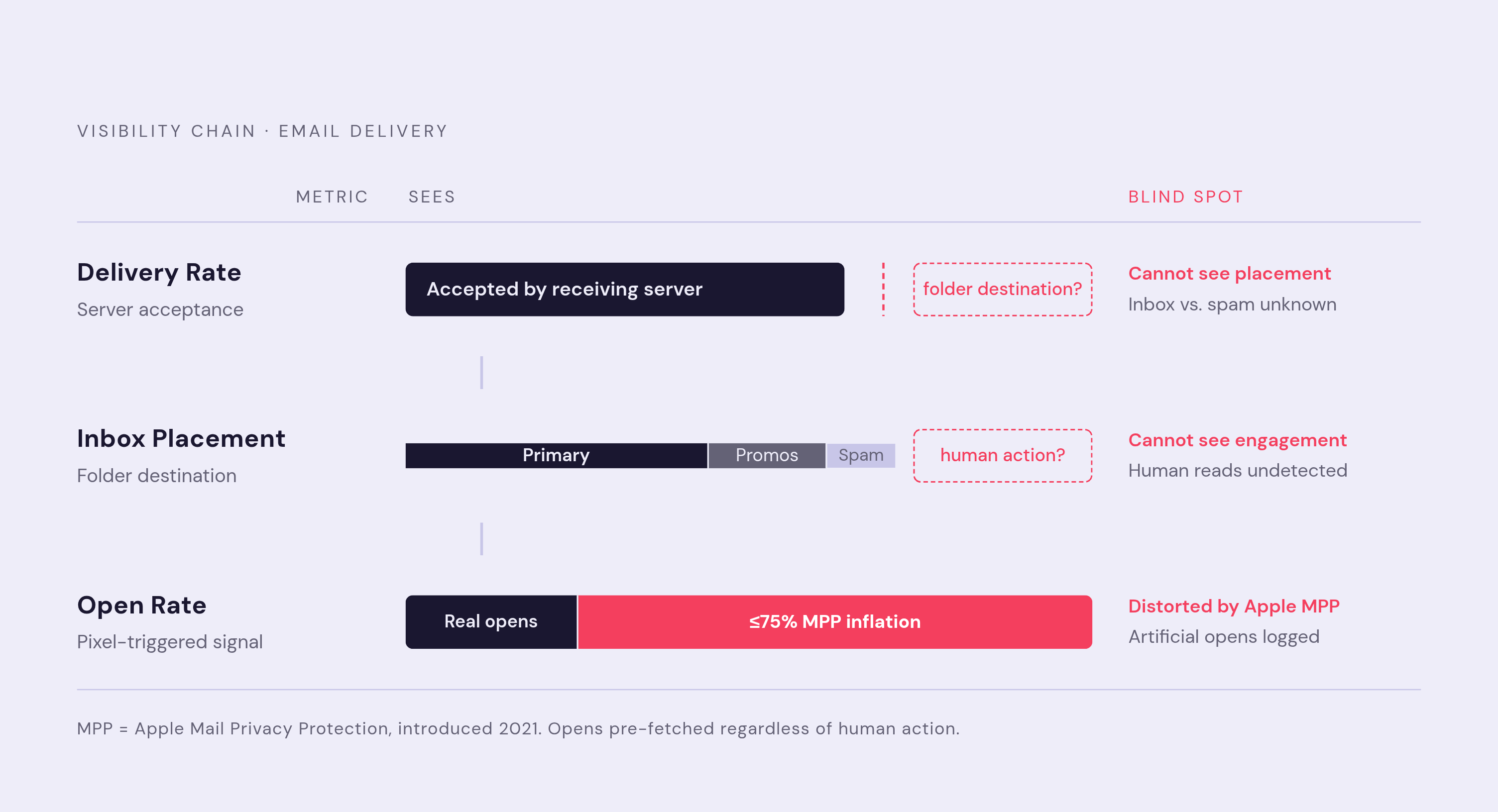
Inbox placement works as a ceiling on open rate, not a variable that moves alongside it. A message that lands in spam or in a promotions tab produces a lower open rate than one that lands in a primary inbox, no matter how sharp the subject line, how well-timed the send, or how warm the list. The causation runs one direction: placement happens first, and open rate is constrained by whatever placement allowed through.
This makes inbox placement rate the single most predictive variable for open rate performance, ahead of subject line quality, send timing, or list size. A spam folder placement counts as delivered. A promotions tab placement counts as delivered. If a message sits in a folder nobody checks, it still counts as delivered. All three suppress open rate while leaving delivery rate completely intact, so a sender can watch delivery hold steady while results quietly fall apart.
Gmail's Promotions and Social tabs are not spam; they are lower-engagement surfaces where many users check less often, or skim with less attention than they give the primary tab, so a sizable share of a Gmail audience landing in Promotions can drag open rate down with no actual change in how well a campaign was built.
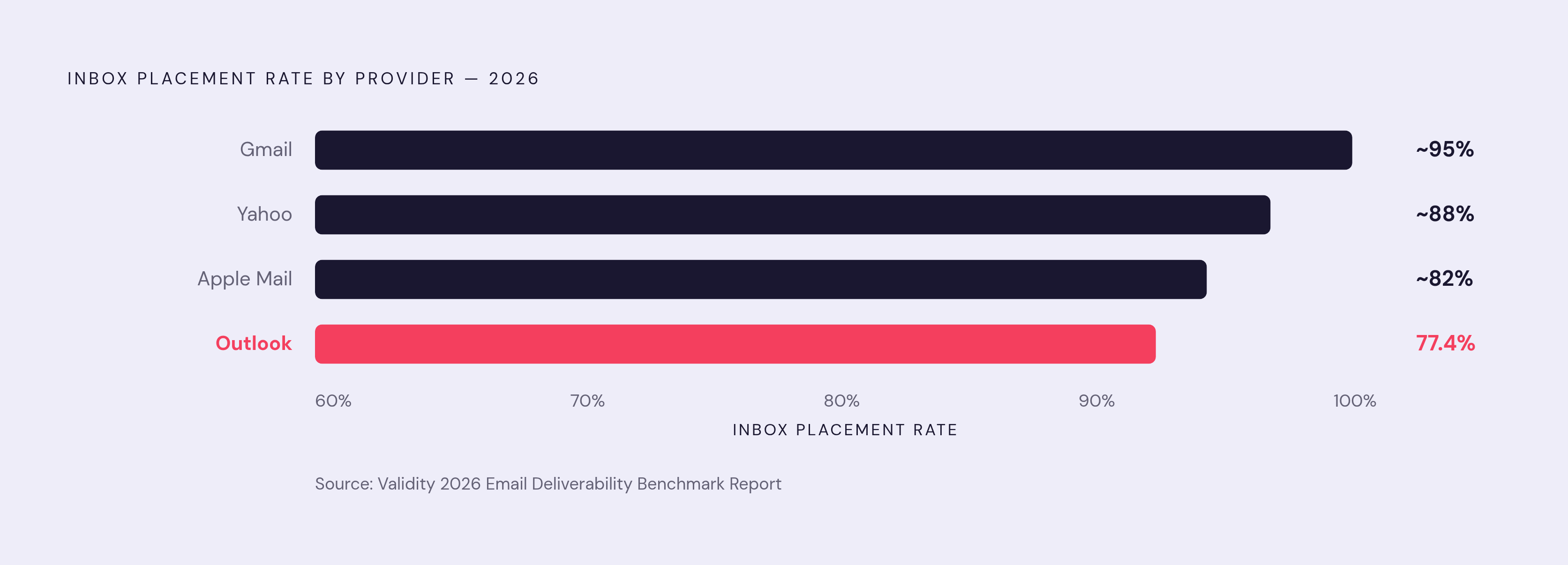
Provider-level differences widen the picture. Validity's 2026 Email Deliverability Benchmark Report shows Gmail producing the strongest inbox placement, with Yahoo behind it, Apple Mail after that, and Microsoft's Outlook and Hotmail trailing the group by a significant margin. A single blended open rate hides all of this. A sender looking at one aggregate number has no way to tell whether Gmail recipients are opening at a healthy clip while Outlook recipients never saw the message. Only placement data broken out by provider separates those two very different outcomes, and without it, a middling open rate could mean anything from a mild subject-line problem to a near-total failure to reach one entire segment of the list.
The practical risk here is a sender chasing the wrong fix. Rewriting subject lines to lift a sluggish open rate only optimizes the fraction of mail that made it to the inbox. It does nothing for the larger fraction that never had a chance to be read, because it was never actually there.
How Apple Mail Privacy Protection Inflates Open Rates
Even the open rate signal generated by emails that do reach the inbox is no longer trustworthy on its own terms. Apple Mail Privacy Protection introduces a systematic upward bias that has nothing to do with whether a recipient actually read or engaged with a message, and some segment analyses put the share of artificial opens as high as 75 percent. That bias severs what used to be a workable, if rough, proxy relationship between open rate and inbox placement.
MPP has been active since September 2021, and it works by pre-fetching email content automatically. Apple's systems fire the tracking pixel the moment they retrieve the message, not when a human opens it, so the sending platform logs that fetch as a genuine open even if no one ever looked at the email. Brevo's 2026 Marketing Orchestration Benchmark reports two separate open rate figures throughout its data for this reason: one that excludes MPP-triggered opens and one that includes them. The gap between those two figures is wide enough that you can't really compare benchmarks across sources unless you know the methodology behind each number.
The failure compounds in the worst possible direction. An email sitting in a spam folder can still register as "opened" through MPP, which inflates the open count while leaving the placement failure that put it there completely invisible. iOS 18 added AI-generated previews and new inbox categories to Apple Mail on top of this, adding another layer of distortion between what a platform reports and what a prospect actually saw.
The old deliverability shortcut said a sharp drop in open rate signals spam placement, but that no longer holds in the direction senders need it to. MPP can sustain or even inflate a reported open rate while genuine engagement falls, because Apple's servers fire a pixel fetch no matter what folder the message landed in. Senders are now contending with two separate problems stacked on top of each other: placement suppresses how much of the list could ever have opened the message, and MPP inflates the reported rate on top of whatever did get placed. Neither problem is visible from the open rate number itself.
Why the HTML tracking pixel that generates open data worsens inbox placement
So the mechanism that produces open rate data also degrades the inbox placement it's supposed to help you diagnose. Open tracking works by embedding a remotely loaded image, an HTML tracking pixel, inside the body of the email. Spam filters treat HTML content, externally loaded images, and tracking infrastructure as signals strongly associated with bulk commercial mail. The very code that counts opens is also raising the odds that the message never reaches an inbox to be opened.
The conflict is sharpest in cold outbound, where sender reputation is thinner and spam filters apply more scrutiny from the first message onward. Removing the open-tracking pixel removes the HTML element that inflates spam-filter scores, and the deliverability gain from that removal appears in a metric that can't be faked: reply rate. If senders disable tracking to protect placement, they see that gain directly in how many prospects respond.
Keeping open tracking on and turning it off both carry real costs. A sender who keeps open tracking on to measure performance accepts a placement penalty for doing so. If a sender turns tracking off to protect placement, they lose the exact signal they were using to judge whether the campaign was working. Both costs are invisible in a standard delivery report. Most teams never realize they're paying one of them.
What authentication status does to inbox placement
Authentication status produces the largest single placement gap most senders will ever encounter; it can explain, on its own, whether a program reaches its audience or doesn't. So before you test a subject line or question a list source, confirm authentication first, because a gap here suppresses placement across every send regardless of how good the content is.
Missing or misconfigured SPF, DKIM, and DMARC records raise deliverability risk substantially. Mailbox providers weigh domain reputation, IP reputation, complaint rates, list hygiene, and sending consistency alongside authentication, but authentication functions as the foundation the rest of that evaluation sits on. Weak footing there undermines everything built on top of it.
The enforcement timeline turned this from a best practice into a requirement with teeth. Google and Yahoo announced in October 2023 that bulk senders would need DMARC in place by February 2024. Microsoft followed, rejecting non-compliant email from high-volume senders starting May 5, 2025. Validity's 2026 Email Deliverability Benchmark Report shows global inbox placement rising after the Gmail and Yahoo bulk-sender requirements took effect, with Microsoft's 2025 requirements contributing to the same industry-wide shift, even as Microsoft's own placement rates lagged behind, with Outlook recorded at a 77.4 percent inbox placement rate, described by Validity as the toughest major provider to send to. The cascade rewarded compliant senders and penalized the rest in a way visible at the industry level.
Compliance has a specific weak point. It isn't DMARC itself, it's the RFC 8058 one-click unsubscribe header, which a large share of bulk senders still haven't implemented. A sender can have SPF and DKIM configured correctly and still fall short of full compliance because of that single missing piece. Authentication problems also tend to compound rather than sit still: weak authentication drags domain reputation down, poor list quality drags engagement down, and falling engagement erodes reputation further. One weak factor pulls the others down with it. Placement failures rarely trace back to a single clean cause once they've had time to settle in.
How open-rate errors corrupt downstream workflows, not just dashboards
Most email platforms use open events to trigger automated follow-up logic, so MPP-inflated opens and placement-suppressed non-opens do more than produce a misleading number on a dashboard. They feed bad decisions into workflows that then make the underlying problem worse.
The clearest example is the resend-to-non-openers workflow, a common automation that identifies recipients who haven't opened a message and sends them a follow-up. Apple Mail users now show as having opened nearly every message they receive because of MPP, so they get excluded from that resend even when they never actually saw the original email. The failure runs in the opposite direction too: false opens triggered by MPP can activate follow-up sequences for recipients who never engaged at all, producing extra sends to contacts who were never paying attention, and eventually contributing to the complaint rates that damage sender reputation.
Artificial opens suppress resends to the people who actually needed them, inflate sends to people who didn't, raise unsubscribes and complaints, erode domain reputation, and worsen placement for the next campaign, which absorbs all of that damage without the dashboard ever explaining why. A lower open rate following a platform migration can reflect a stricter measurement methodology rather than a real decline in performance: platforms that filter out MPP prefetches report meaningfully lower open rates than platforms that count them, so switching tools can look like a performance drop when it's actually a correction in how the number was being calculated all along.
The operational conclusion follows directly from this. Any workflow built to branch on open or non-open events inherits the noise from both MPP inflation and placement suppression at once, so you can't trust it to route the right recipients into follow-up until you fix the measurement feeding it.
What to measure instead
No single metric steps in to replace open rate across everything it used to be asked to do. The more defensible approach separates the deliverability-signal role from the engagement-signal role and assigns each a metric actually built to carry it.
For deliverability health, the role open rate once served as a rough proxy, the more reliable signals are spam complaint rate, hard bounce rate, unsubscribe rate, and inbox placement rate measured directly through seed testing. But if open rate drops suddenly and sharply, you should still treat that as a possible warning sign. A slow, gradual decline is harder to read on its own and calls for placement data before any conclusion gets drawn from it.
For genuine engagement, the thing open rate was never reliably measuring in the first place, the stronger signals are reply rate, click-through rate, conversion rate, and revenue per email. These are harder to fake because each one requires an actual human action that no prefetching server or security scanner performs on a recipient's behalf.
Reply rate carries the most weight for cold outbound specifically. It can't be inflated by MPP, it isn't suppressed by image-blocking the way pixel-based open tracking is, and it reflects the one outcome a sender is actually trying to produce: a prospect writing back. But none of this means you should discard open rate entirely as a data point. It means you treat it as a single, heavily compromised signal among several, not as the headline number a program's health gets judged by.