Consolidating a Six-Tool Sales Stack for Mid-Market Revenue Teams
Consolidating a sprawling tech stack eliminates wasted rep time and enables AI-powered workflows.
- Written by
- Tariq Benhamida
- Updated
- October 3, 2026
- Reading time
- 11 min read
What this covers
A mid-market sales stack rarely grows by design. It grows the way sediment builds: one tool at a time, each added to patch a gap nobody planned for, until a rep needs seven logins just to research and contact a single prospect. Consolidating that stack back down to a manageable core is not a cost-cutting exercise. You need to know which tool categories a revenue team cannot function without, which capabilities already live natively inside the platforms it keeps, and how to remove the rest without breaking active pipeline.
Why mid-market sales teams end up with six or more tools
The seven-login prospecting workflow is the lived reality for sales development reps at mid-market companies, who open a data provider to find a contact, a separate intent tool to check for buying signals, a sequencing platform to send the outreach, a professional networking tool to confirm the title is current, and a CRM to log all of it, when the logging happens. Each of those tools arrived at a different time, bought by a different person, solving a problem that felt urgent in isolation. Sales bought a sequencing tool because outreach wasn't happening consistently. Marketing added an intent data provider because leads felt cold. RevOps then inherited both tools, plus whatever the CRM vendor sold as an add-on, and nobody asked if the four systems actually talked to each other.
Mid-market revenue teams end up here because of how the tools get purchased, not because anyone chose poorly in isolation. Each point solution solves the problem in front of it, selected by whoever had the budget and the urgency, with no unified data strategy guiding the decision and no single owner responsible for how the pieces fit together.
Mid-market sits in a uniquely exposed position on this. Enterprise companies have dedicated RevOps headcount, whole teams whose job is to maintain integrations and keep data flowing between systems, so they absorb the complexity. Early-stage companies don't yet have enough tools for the gaps between them to matter. Mid-market teams carry enterprise-scale tool counts without enterprise-scale support staff to maintain them. The result, as Crono's 2026 mid-market guide frames it, is a patchwork rather than a stack. Patchworks leak. Data falls through the seams between tools that were never built to share it, and a missed deal or a rep calling a prospect who already said no twice is where the leak becomes visible.
Three compounding costs that make sprawl unsustainable, not just inconvenient
A bloated stack doesn't just annoy the people who have to use it. It produces three distinct and measurable failures, and the real danger is that none of them stay contained to their own corner of the business.
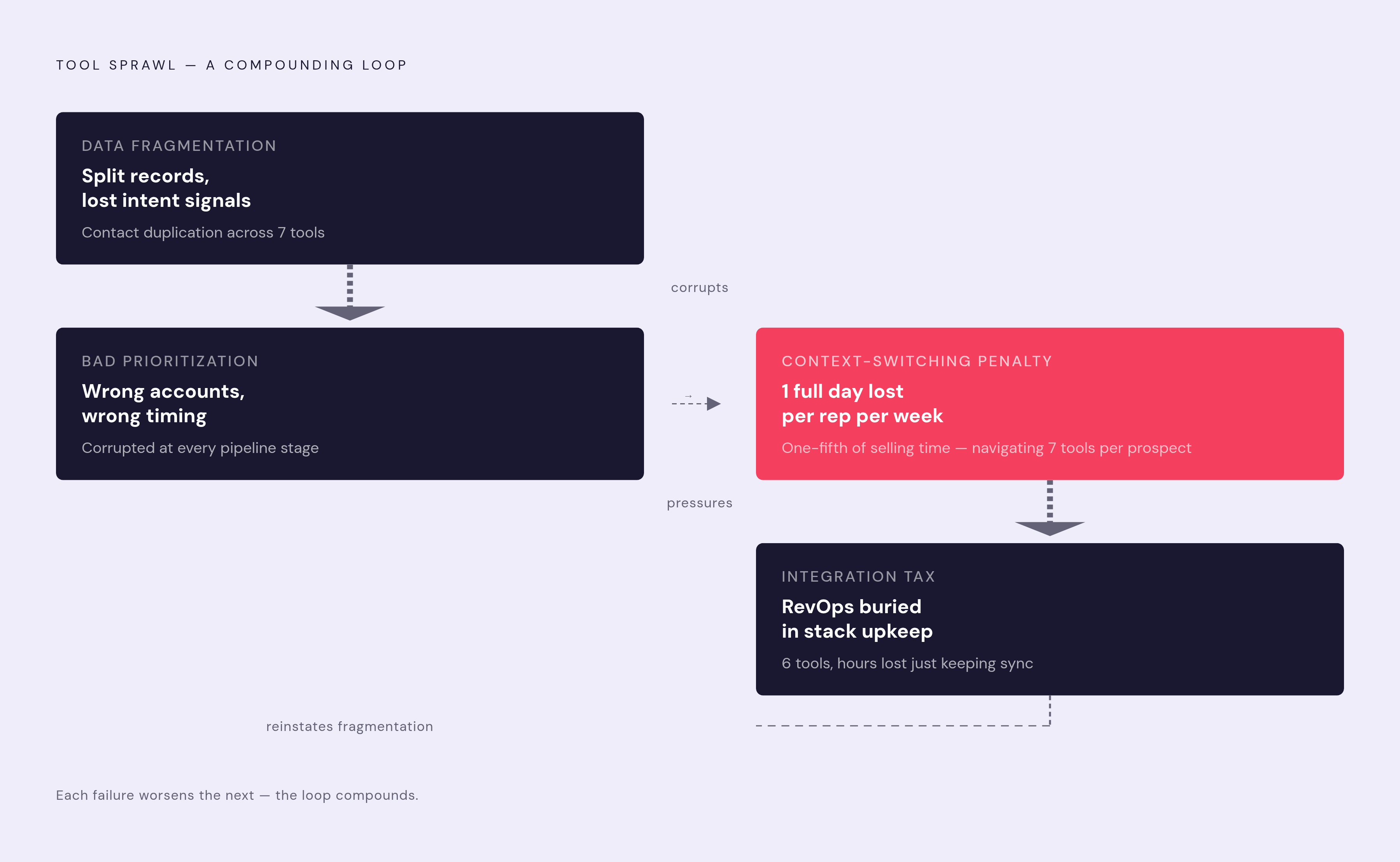
The first is an integration tax paid by RevOps. Every tool added to the stack creates its own maintenance burden: API connections that need monitoring, data mappings that drift and need updating, vendor security reviews, contracts that need renegotiating on their own cycle. Amplemarket's consolidation ROI breakdown describes a RevOps team managing six tools, and this team spends a significant share of its working hours just keeping the stack operational rather than improving how it performs. That's time not spent on reporting, forecasting accuracy, or the kind of process work that actually moves pipeline forward.
The second cost lands on reps, in the form of a context-switching penalty. Amplemarket notes that reps working across fragmented stacks spend a notable share of their day on tasks that would simply not exist if their tools were connected. Cleed's 2026 case study puts a concrete shape on this: an SDR switching between seven tools to research and contact one prospect loses an entire selling day each week just navigating software rather than talking to buyers. A full day a week is a fifth of a rep's working time converted from selling into administrative overhead, repeated across every rep on the team.
The third cost is data fragmentation, and it corrupts judgment at every level of the organization. When contact records sit in one tool, intent signals sit in another, and engagement history sits in a third, nobody has a single accurate view of the prospect. Apollo lays out what follows from that: sales leaders lose visibility into real pipeline health, SDRs re-contact prospects who already declined because the decline was logged somewhere nobody checks, and account executives walk into calls missing context a colleague captured in a tool they don't have open.
These three costs don't sit side by side. They compound. Fragmented data produces bad prioritization, which wastes selling time that context-switching has already eaten into, which piles more pressure onto a RevOps team already consumed by keeping six systems patched together. Each failure makes the next one worse, and the stack that was supposed to make the team more productive becomes the primary drag on its output.
Finance departments have started noticing. Cleed points out that CFOs now expect ROI per tool, per rep, per quarter, a standard of accountability most sprawling stacks were never built to meet. When a tool's contribution can't be isolated from the noise of five others doing adjacent things, it fails that test by default, regardless of whether it's actually useful.
Why AI-driven workflows make consolidation a technical requirement
Everything above makes consolidation a sound cost argument. A newer development makes it something closer to mandatory.
Agentic AI workflows, systems that run multi-step prospecting, qualification, and enrichment tasks without a human clicking through each step, depend entirely on clean, consistent data. Apollo's analysis states the mechanism directly: AI-driven GTM workflows require a consolidated data foundation, and fragmented stacks block agentic execution from end to end. If an AI agent makes sequencing decisions off a contact record that updated in one system but never synced to the CRM, it is acting on a version of reality that's already wrong, and every decision built on top of that record carries the error forward.
Agentic AI represents a real shift in what a sales platform can do, not an incremental feature update. Landbase's mid-market guide describes teams that can describe an ideal customer profile in plain language, so AI agents can handle targeting, qualification, enrichment, and prioritization as one continuous process. That kind of execution only works if the underlying data layer is unified. Fed instead by six tools that each hold a partial, slightly different version of the same prospect, the agent inherits all six disagreements and has no way to resolve them.
Amplemarket's framing of a consolidated platform captures what's structurally different: signal detection triggers outreach, which triggers follow-up, all inside one continuous flow, with none of the handoff failures that occur when data crosses from one system to another. Those handoffs are where lag, data loss, and formatting errors creep into a multi-tool stack, and agentic workflows cannot tolerate them.
For a mid-market team watching competitors adopt AI-driven prospecting and qualification, consolidation stops being a backend efficiency project. Consolidation becomes the precondition for running the same caliber of GTM motion.
Tool categories that are non-negotiable versus candidates for elimination
Reducing a stack starts with separating what a revenue team genuinely cannot operate without from what it has simply accumulated. Four categories belong in the first group.
Every other action depends on verified contact data and enrichment as its foundation. Stale or inaccurate records corrupt the output of whatever tool sits downstream, whether that's a sequencer, a scoring model, or an AI agent.
Sales engagement and sequencing is the layer where outreach actually happens. Without a reliable system here, even well-targeted messaging never reaches the prospect, and no amount of upstream data quality compensates for that.
Pipeline visibility and forecasting let revenue leaders see how healthy a deal really is. ZoomInfo's guide notes this is where coaching decisions get made, so weak or fragmented visibility here doesn't just blur reporting. So it misdirects management attention toward the wrong deals and the wrong reps.
A CRM record that every other tool can write back to rounds out the core. Everything else in a typical six-or-more-tool stack is a candidate for removal because that function now lives natively inside a broader platform.
Standalone enrichment tools fall into this category. Cleed notes that modern signal platforms now include enrichment as a built-in feature rather than a separate purchase. Separate intent data subscriptions belong here too: signal quality delivered inside a unified platform tends to beat signal quantity purchased from a disconnected point solution, because the unified version arrives already tied to the contact and account records a rep is working. LinkedIn-only research tools fall away once an AI-driven platform handles that research at scale as part of its core workflow, with no separate subscription required. Manual lead scoring systems, built on static rules that go stale within a quarter, give way to AI scoring built on real-time behavioral signals. Standalone AI writing and personalization tools get absorbed the same way, so they fold into engagement platforms that now generate personalized messaging natively.
The decision rule is simple to state even if the audit behind it takes real work: keep what no other tool in the stack already does, and treat everything else as a subscription paying twice for a capability already owned.
Where native integrations inside anchor platforms replace point solutions
The mechanism that makes consolidation possible, rather than just desirable, is the anchor platform: one or two systems chosen to cover multiple capability clusters at once, so that four tools a team used to pay for separately become four native features of a system it already owns.
The advantage isn't just fewer invoices. It's structural. Amplemarket describes what happens when contact data, engagement history, intent signals, and deliverability metrics all live inside the same platform: every outreach action is informed by every other data point automatically, because the platform already holds the full context rather than needing it imported from somewhere else. Compare that to a multi-tool stack, where every transfer between systems can introduce lag, data loss, or formatting errors. A consolidated platform removes the handoff itself, so that signal detection, outreach, and follow-up run as one unbroken sequence instead of three separate steps connected by brittle integrations.
The same logic applies to reporting. When engagement data is scattered across five systems, you end up guessing at attribution, stitching it together from exports that rarely agree with each other. A consolidated platform tracks every touchpoint, email, phone, social, inside a single view, so a rep's actual influence on a deal is visible rather than reconstructed after the fact.
Apollo is one concrete example of what an anchor platform looks like in practice: it combines prospecting, verified contact data, sequencing, and pipeline intelligence in a single system, a direct replacement for the data provider, the sequencer, and the intent tool that many mid-market teams currently run as three separate subscriptions. Apollo serves a large base of paying customers across sales, marketing, and revenue teams, and it positions itself as a single platform rather than one piece of a larger patchwork. Landbase represents a different flavor of the same shift: a team can describe its ideal customer profile in plain language, and AI agents handle targeting, qualification, and enrichment as one workflow rather than as separate tool-driven steps. Both illustrate the same underlying principle: the capability a team used to buy separately hasn't disappeared. It has relocated into a platform built to hold it alongside everything adjacent to it.
The test for any point solution still sitting in a stack is straightforward: does it do something the anchor platform genuinely cannot, or is it a separate invoice for a feature already included in a platform already being paid for?
How to sequence the reduction without breaking pipeline
Knowing what to cut is only half the problem. Cutting it in the wrong order can take live pipeline down with it, which is the strongest objection RevOps leaders raise against consolidation, and a legitimate one.
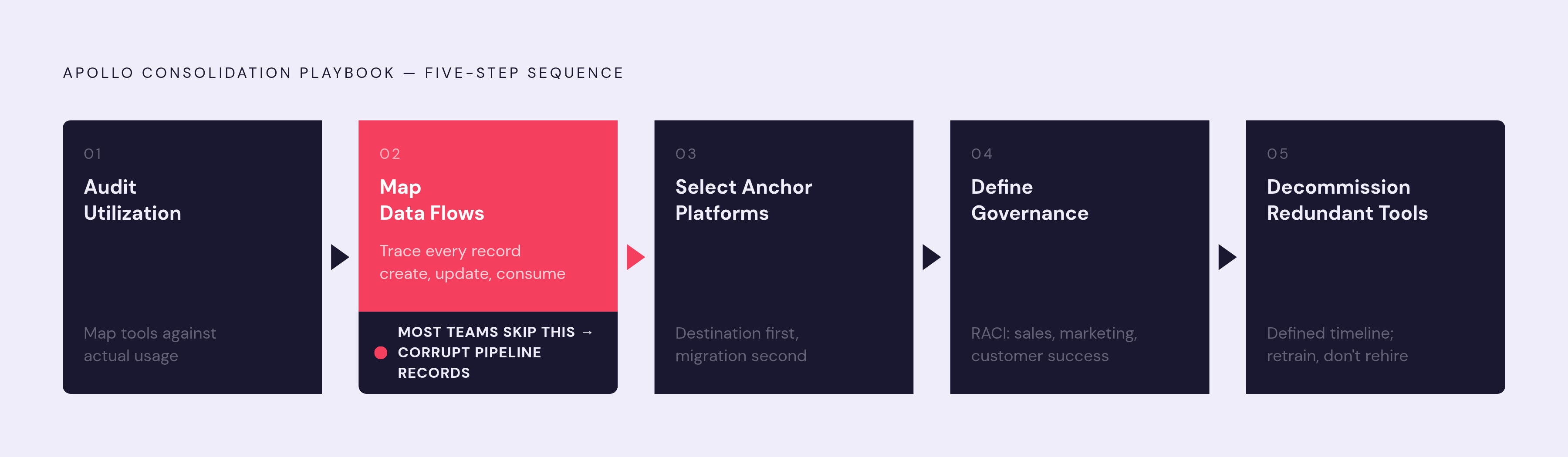
Apollo's five-step playbook addresses that risk directly by refusing to let any tool get removed before its dependencies are understood. The first step is an honest audit of utilization: mapping every active tool against how it's actually being used, surfacing the overlap and the dead weight before anything gets touched. The second step, mapping data flows, is the one most teams skip, and skipping it is why migrations end up corrupting pipeline records. This step shows you where every record gets created, updated, and consumed, and it exposes where handoffs between systems are already breaking down quietly.
Only after that mapping is complete does the third step make sense: selecting one or two anchor platforms to cover the highest-value capability clusters. That decision needs to happen before any conversation about sunsetting a tool begins, because choosing the destination before planning the move is how migrations turn into outages.
The fourth step, defining governance, assigns clear ownership, often using a RACI structure, for data hygiene, tool administration, and adoption tracking across sales, marketing, and customer success. Skip this step, and consolidated data decays as fast as the fragmented data it replaced, just inside a single system instead of six.
The fifth step is disciplined decommissioning: sunsetting redundant tools on a defined timeline, and retraining teams on the consolidated workflow rather than hiring new specialists to manage what remains.
The data flow map built in step two functions as the safety net for the entire sequence. It shows you exactly which active sequences, enrichment jobs, and pipeline records depend on the tool being removed, so you cut nothing until you confirm its replacement workflow is live and carrying the same load. Sequencing by risk follows naturally from the audit in step one: start with tools that are already underused. Cleed's example of a team running many tools with reps touching only a handful daily shows that a sizable portion of most stacks is shelf-ware already, carrying no live pipeline dependency and posing no real risk to remove first.
Bidirectional CRM sync should function as the baseline requirement for every tool that survives the audit. ZoomInfo's guide recommends making it a standard condition of every tool evaluation going forward: any system that cannot write its data back to the CRM is quietly recreating the same fragmentation the whole consolidation effort was meant to fix.