AI-Assisted Inbound Qualification for SDR Teams
AI absorbs lead overflow so SDRs can engage qualified buyers while intent is still high.
- Written by
- Mirela Ostrowski
- Published
- November 5, 2026
- Reading time
- 9 min read
What this covers
AI-assisted inbound qualification addresses a structural mismatch between the leads a business generates and the leads its SDR team can qualify in time. Its strongest use is not replacing SDRs, but absorbing overflow through immediate engagement, enrichment, scoring, and routing. The hybrid model succeeds when human SDRs receive qualified prospects while intent is still high, with enough context to begin a useful conversation.
Why inbound volume has outgrown the human SDR model
Leads arrive faster than the SDR team can touch them. Marketing scales a campaign, but each new inquiry still requires research, qualification, follow-up, and a CRM update. Those tasks impose a fixed daily limit on each rep, regardless of how much interest the campaign generates. For mid-market teams, the pressure is especially acute because they need enterprise-level responsiveness without multiplying headcount whenever inbound demand rises.
Administrative work makes that limit more restrictive. SDRs spend much of their day logging activities, researching companies, and updating records, leaving less time for discovery conversations. Qualification also includes rejecting leads that were never sales-ready, so a larger queue does not necessarily contain proportionately more opportunity. Reps must separate genuine intent from weak MQLs before they can advance the pipeline. That filtering consumes the same scarce time as engaging a promising buyer.
Coverage adds another constraint to daily workload. Overnight, weekend, and global inquiries arrive when the assigned team may not be available, even if its business-hours operation is well organized. Those leads enter a queue that must compete with fresh demand when work resumes. Effort alone cannot expand the qualification model’s available hours and processing capacity at the pace of inbound demand.
How slow response destroys conversion before the SDR ever dials
The cost of that queue is declining conversion probability. A lead waiting for qualification is also a buyer who can speak to another vendor. With a fast response, the SDR joins the evaluation early, while a slow response leaves the SDR entering after a competitor has shaped it. The first conversation gives that competitor an advantage.
Leads who do not hear back within the five-minute response threshold are far less likely to convert. Moving a lead from a 24-hour response window into a sub-five-minute window can roughly double the close rate without changing the offer, the rep, or the pitch. Better work at later stages cannot win back every opportunity lost before the first conversation.
A Friday evening form submission can wait until Monday while a competitor with automated engagement starts the relationship immediately. Even diligent business-hours coverage cannot bridge that interval through human effort alone. Initial engagement and qualification must begin when intent appears, independently of a rep’s availability.
What AI actually does in the inbound qualification workflow
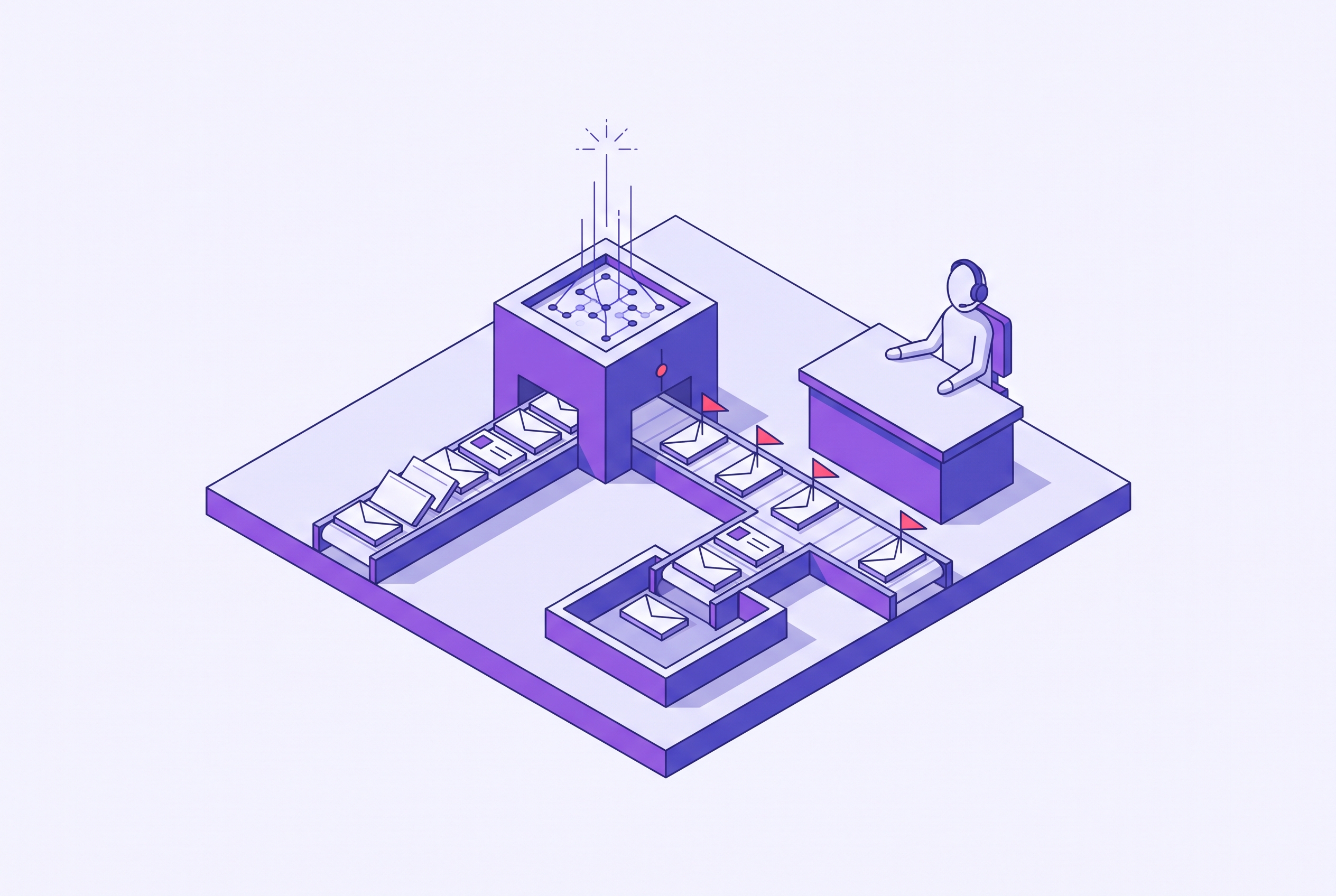
An AI qualification agent creates a parallel track for incoming demand. When a lead enters through a form, chat, or high-intent page visit, the agent engages immediately and asks about use case, budget, company size, and timeline. Modern agents can conduct multi-turn conversations that adapt to buyer responses, with flexibility beyond a fixed script. The exchange gathers information while interest is fresh. Those conversations also let prospects get answers to their questions without first filling out a form.
Enrichment runs during that conversation rather than becoming a separate research task for the SDR. Firmographic and technographic data populate the CRM record, while scoring compares the enriched profile with the team’s ideal customer profile criteria. Company size, industry, and prior engagement help decide which leads come first. Only leads that clear the defined threshold route to a human SDR. This absorbs both the research workload and the first layer of filtering that would otherwise compete for rep time.
Routing then assigns the qualified lead by territory, segment, or account ownership and can book a meeting. The conversation context travels with the handoff, including identified pain points and relevant company background. These rules also apply to inquiries arriving overnight or across time zones. The SDR’s work on the individual opportunity begins at the handoff, with a contextualized prospect rather than a raw record requiring qualification from scratch.
Where the hybrid model outperforms both full automation and human-only teams
The concern that AI can degrade qualification quality is valid. Faster engagement does not establish whether the agent is identifying opportunities worth a sales conversation. Pure AI campaigns can also experience declining reply rates and engagement quality as buyers become better at recognizing and filtering generated outreach. Automation does not make buyer attention unlimited. A system that produces activity without preserving opportunity quality has not solved the SDR team’s problem.
Human-only teams face the opposite constraint because judgment does not remove their limits on time and coverage. The hybrid model assigns immediate engagement, enrichment, scoring, routing, and repetitive follow-up to AI while reserving ambiguous qualification decisions and objection handling for people. That split matters even more at high ACVs. Buying committees, ties with executives, and politics within a company call for judgment that enrichment data alone cannot provide. Human SDRs remain responsible for navigating those conditions rather than treating every qualified record as equivalent.
Human judgment also governs the rules upstream. An agent can use the same qualification framework every time, but that will not fix a poor definition of fit. More leads routed by the wrong rule can make the pipeline worse. The appropriate division of work therefore includes human ownership of qualification policy as well as buyer relationships. The SDR role becomes more focused on judgment, exceptions, and multi-stakeholder conversations, rather than disappearing beneath a larger volume of automated activity.
How the leading inbound AI SDR platforms divide the work in practice
For teams choosing a platform, CRM fit and channel coverage are more useful starting points than conversation quality alone. The available systems differ in where they engage buyers, which records they use, and whether sales and support can share an agent. Those differences define the operational fit. A chat-only tool leaves some leads out when inbound demand also comes through email, social, or SMS. The comparison therefore begins with the workflow the platform must support.
Fin for Sales from Intercom handles inbound sales across chat, email, WhatsApp, social, and SMS. It uses the same AI engine as Fin AI Agent for customer service, trusted by over 12,000 businesses. Its Engage capability starts conversations based on the page a buyer is on and what they do there, while another capability uses product content and documentation to answer pricing questions, compare plans, and handle objections. Qualify runs the SDR playbook conversationally and enriches the exchange with CRM and external signals. Close books meetings through Calendly, Chili Piper, or HubSpot Meetings, routes buyers to sales or self-serve flows, initiates trials, and syncs conversation context to the CRM.
Fin’s distinctive capability is Customer Agent Orchestration. It can switch between sales and support within the same conversation without handing off the buyer or losing context. Its AI-generated qualification playbook also uses documentation the team already has, with no need to build flows by hand. That makes the documentation and qualification logic important inputs. The platform’s breadth does not remove the need to define what counts as a qualified lead.
Piper from Qualified is a premium inbound-only specialist that engages website visitors through chat, qualifies them using live Salesforce data, and books meetings in real time. Salesforce’s SEC filing states that its acquisition of Qualified closed on April 1, 2026. Its deepest integrations are with Salesforce, which is its principal strength but remains optional. Qualified also supports HubSpot and Marketo. Its inbound specialization is the key scope constraint for teams comparing broader workflows.
Knock AI is designed for teams whose high-intent visitors leave before a form connects them with a rep. Its identify-qualify-engage-automate structure combines anonymous visitor identification, real-time intent scoring, enrichment, messaging, scheduling, outreach, and routing. By contrast, monday CRM’s native AI SDR capabilities categorize leads, extract qualification data, and detect sentiment inside the CRM without complex integrations. That native approach offers deployment in hours instead of weeks, but its central fit is for teams seeking qualification integrated within that CRM.
Drift also requires a clear qualification in this comparison. Its sunset means it is not a forward-looking platform choice. Across the remaining options, CRM architecture still comes first. The fields and routing rules available to the agent define what it can execute, while channel coverage determines how much inbound demand it can reach.
What to configure before the AI agent goes live
Before platform configuration begins, marketing and sales should agree on a written definition of a qualified lead and a committed response-time SLA. This is an operating agreement. If the teams use different definitions, automation sends SDRs more leads they disagree on at a faster pace and makes conversion metrics harder to read. The shared definition should specify the evidence needed to justify a handoff. Only then can the agent’s speed serve a common sales objective.
That definition must translate into criteria the system can evaluate. Company size bands, industry codes, job title patterns, and prior engagement signals are usable inputs, while a description such as “good fit” leaves the decision unresolved. Routing rules, CRM syncs, and calendar connections should then be mapped and tested. Each connection must pass the information needed by the next stage.
The handoff needs an equally explicit standard. The rep should receive the full conversation transcript, identified pain points, an enriched firmographic record, and the booked meeting context. When information is missing, the SDR must research the lead or qualify it again, using up the time the agent saved. Buyer transparency also belongs in the deployment plan. Disclosure or a clearly branded AI persona is operationally safer than presenting generated outreach as the work of a named human who is not involved.
Measurement must be designed before launch as well. Response time, conversion rates, and pipeline velocity should make it possible to see where leads stall alongside counts of completed interactions. That visibility connects a weak result to the part of the workflow requiring adjustment. Without it, a team cannot distinguish a routing problem from a qualification problem. The ability to improve that distinction separates a pilot that can be refined from one that gets shut down without a clear diagnosis.
How to measure whether the AI layer is actually closing the gap
Speed-to-lead and volume handled are insufficient measures of success. Both can improve while meeting-to-opportunity conversion deteriorates, leaving SDRs with a fuller calendar but weaker pipeline. Response time establishes whether the agent is consistently meeting the five-minute threshold. Conversion rates then show what share of AI-qualified leads reach a booked meeting and what share of those meetings become opportunities.
Meeting-to-opportunity conversion is the decisive mid-funnel quality gate. If AI-booked meetings convert at a significantly lower rate than human-booked meetings, the qualification criteria need tightening before throughput increases. A pilot that books fewer meetings than expected should still get a chance if those meetings lead to stronger opportunities. Pipeline velocity adds the next test. Qualified pipeline should accumulate faster, rather than activity merely moving faster through the earliest stages.
Coverage and SDR time allocation show whether the system is absorbing the intended work. The percentage of inbound leads answered within five minutes should be broken down by time of day and channel so gaps remain visible. Reps should also be spending less time on research and CRM entry and more time on discovery and closing conversations. These are practical signs of work shifting. They connect the agent’s output to the capacity available for human selling.
The original capacity mismatch is resolved only when throughput rises without sacrificing conversion quality. That combination shows that overflow is being absorbed and human SDRs can engage prospects while intent remains high, without additional headcount. Teams that achieve it are redefining what an SDR team can do.