Inbound Lead Routing Logic for Multi-Rep Sales Teams
Establish rule order so account ownership and territory take precedence over fairness.

- Written by
- Soo-Jin Pak
- Published
- November 3, 2026
- Reading time
- 9 min read
What this covers
Inbound lead routing for multi-rep sales teams works when rules run in a defined order. Account ownership, territory, specialization, and workload each answer a different assignment question. Stacking those rules from most specific to broadest gives each lead a clear destination without letting distribution fairness override an existing relationship or market responsibility.
Why inbound lead routing breaks down as sales teams grow
A lead matches both a territory rule and a product-specialization rule. One rep owns the region, and another knows the product. Without an explicit order, the platform’s default tiebreaker decides who receives the lead. It is a platform behavior, rarely documented and almost never audited, resolving a conflict the team should have settled.
As teams grow, those conflicts become harder to see. Territories change, reps come and go, and CRM fields fall out of date while routing still uses the old rules for who owns what. Duplicate outreach, high-value leads assigned to junior reps, and unassigned records are visible symptoms. The underlying misassignments do not throw an error. So the routing layer can look healthy even as reps call the same leads, RevOps reassigns them by hand, and buyers hear conflicting messages.
Fast assignment is useful only when ownership is correct. Sending a lead immediately to the wrong rep creates work. The team therefore needs to establish which rule takes precedence when several conditions apply.
What routing is actually doing before a rule hierarchy can work
Qualification and scoring must happen before assignment. Qualification evaluates fit through attributes such as job title, company size, and industry. Scoring then evaluates fit and urgency using signals including content downloads, pricing page visits, email engagement, pages visited, and time spent. Whether a lead merits senior-rep attention or belongs in nurture should be decided before routing selects its destination.
The routing layer matches lead attributes against rep attributes. monday.com describes territory, industry, product interest, and account ownership as inputs matched against specialization, capacity, and territory coverage. A useful match requires quality data. Vendilli, a marketing and communications agency, reached a high rate of CRM data completion only after deploying structured field automation. That completeness made accurate routing possible, while blank fields would have pushed records toward defaults regardless of how carefully the rules were written.
The five routing models and the conditions that make each one the right or wrong choice
Round-robin assigns leads sequentially among available reps to maintain even distribution. It suits small to mid-sized teams with broadly equivalent skills, low to moderate inbound volume, and a stronger need for fairness than specialized fit. Its limit is variation in rep expertise. When some enterprise deals are much more complex than others, an equal split of leads can still send a deal to the wrong rep.
Territory-based routing assigns leads by geographic region or market segment. It suits teams with clear rules for who covers each region and reps who can serve buyers better because they know the local market. Cisco groups territories by industry, country, and other criteria, then assigns enriched leads within that structure. Stale territory data defeats that logic immediately. Rigid boundaries also constrain expansion into new regions or situations where lead source is more relevant than location.
Account-based routing keeps contacts from the same company with the account’s assigned owner. It fits sales motions in which several contacts independently submit forms or visit the site. Without account matching, those contacts can scatter across reps and fragment the relationship. Continuity can also create uneven workloads, however. Accounts that generate much more inbound activity than others require a rebalancing plan rather than an assumption that ownership alone distributes work fairly.
Skill- or vertical-based routing matches leads to industry knowledge, product specialization, or language proficiency. A healthcare buyer interested in compliance features, for example, belongs with a rep who understands healthcare and its regulatory requirements. LeadAngel supports automatic matching without manual assignment work. The constraint is clean, consistently populated specialization data. Missing fields can produce mismatches that look like successful assignments.
Priority- or score-based routing sends high-fit, high-intent leads to senior or top-performing reps, while leads with lower scores go into slower queues or nurture. Pricing-page activity, time spent, and existing account presence can inform the score that determines the tier. Its accuracy depends on the scoring model’s quality and recency. A stale model prioritizes the wrong signals. None of these models replaces the others, because each governs a different part of the assignment decision.
How to stack routing rules in the right order: the waterfall hierarchy
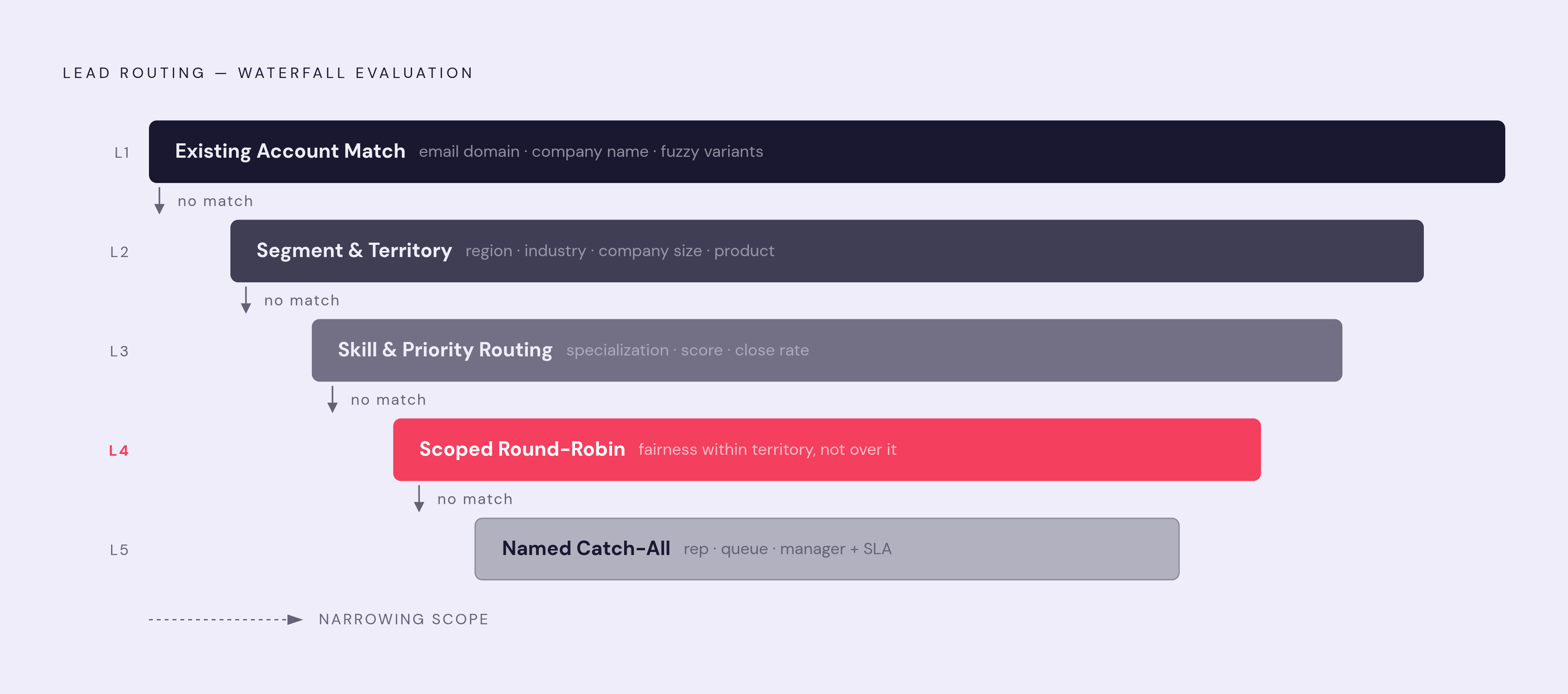
Layer 1. Existing account match. First, check whether the lead belongs to an account with an assigned owner. Match on email domain, company name, and fuzzy name variants such as “Zoom Inc.” and “Zoom Video Communications.” The existing relationship takes precedence over other assignment signals. Sending that contact to someone else splits up what the team knows about the account and causes conflicts among SDRs, AEs, and account teams. Duplicate leads and contacts can break matching in Salesforce environments, so deduplication is a prerequisite.
Layer 2. Segment and territory rules. If there is no existing account match, evaluate the attributes that define market ownership, including region, industry vertical, company size tier, and product interest. This establishes the eligible rep pool before workload distribution begins. Territory ownership is a business decision about accountability. Letting a broad round-robin rule override it would sever assignment from that responsibility. The layer fails silently when its territory table still names a departed rep as the owner.
Layer 3. Skill or priority routing within the matched pool. Once the segment establishes eligibility, use specialization or score to distinguish among eligible reps. High-score leads can route to matching vertical expertise or the highest close rate against that lead profile. Fit is evaluated inside the ownership boundary. Lower-score leads that remain eligible for sales assignment enter the pool’s standard round-robin within territory rules. Availability and tie-breaking rules also belong here, including backup assignment when a rep is out of office.
Layer 4. Round-robin fallback within the eligible pool. When skill or priority gives no rep an edge, split leads evenly among the reps who can receive them. The scope is the critical constraint. Round-robin must operate within the identified territory or segment pool. Otherwise, a fairness mechanism undoes the ownership decision made above it.
Layer 5. Named catch-all. Every configuration must terminate in a specific rep, queue, or manager. Without that destination, a lead can fall through without an alert, follow-up trigger, or visibility. The catch-all carries temporary responsibility for review. Its owner must have the lead reviewed and rerouted within a defined SLA.
Each layer is more specific than the one below it. Account match beats territory, territory beats pool round-robin, and pool round-robin beats catch-all, with evaluation proceeding top to bottom and stopping at the first applicable assignment rule.
Where this hierarchy breaks down in practice and how to catch it before it costs pipeline
A correctly designed hierarchy still degrades as its inputs change. Reps who have left still appear in territory tables, duplicate records break account matching, and enrichment providers return blank fields that make leads skip specific rules. Manual overrides can hide these faults by correcting individual assignments without repairing the underlying rule. The workaround eventually becomes part of daily operations. Because an assignment still occurs, the system can report success while ownership is wrong.
Maintenance must therefore follow a defined operating cadence. monday.com recommends monthly metric reviews and quarterly rule audits as teams grow. Weekly checks should examine territory mismatches, duplicate record sets, distribution skew, enrichment failures, and manual override patterns. Monthly checks should cover rule version history, pool membership, territory tables, and synchronization between the routing tool and CRM. Quarterly, or after a major territory change, the full logic should be rerun with sales-management sign-off against the current go-to-market structure.
If one rep receives a disproportionate share of a round-robin pool’s leads, the likely cause is a rule above that layer passing too many leads through. A rising catch-all share similarly points toward failures in the more specific rules or their data.
To make those checks actionable, track time-to-first-contact by rep and tier, assignment accuracy, and catch-all volume as a percentage of total leads. Assignment accuracy shows how often the rep who first gets the lead still owns it when the opportunity is created. LeadAngel identifies time-to-first-contact dashboards by rep and tier as a way to surface routing issues before they affect pipeline. Speed exposes delayed follow-up, while ownership retention and catch-all volume reveal whether the hierarchy is making useful decisions.
When to add AI routing on top of the rule hierarchy — and when not to
AI routing belongs above a stable rule hierarchy. Instead of relying only on fixed conditions, an AI engine can weigh lead source, intent score, geographic match, historical close rate, lead-to-buyer fit, and time of day against outcome patterns. That broadens the assignment signals available to the system. It does not repair inconsistent ownership policies or missing CRM fields. Standardized data, clear policies, and established fallbacks remain prerequisites.
The practical readiness test is whether clean disposition data exists. A team without that history faces a cold-start problem because the model lacks a dependable record of assignments and outcomes to learn from. The recommendation is to stabilize the five-layer hierarchy first. Run it long enough to accumulate clean dispositions, then evaluate AI as an optimization layer.
Once that foundation exists, AI can help interpret cases that fixed rules do not anticipate. Examples include a personal email address paired with a Fortune 500 LinkedIn profile, a partner referral that merits a bypass, or a returning customer seeking expansion. Conversational intake adds another kind of input. When an AI agent handles the first interaction, routing needs a structured intent payload from that conversation beyond a submitted field value.
Agentic models can also infer rules from outcome patterns, reducing the need for RevOps to write every condition manually. Those inferences still need the ownership boundaries and fallbacks established below them. An AI agent can itself be an assignment destination. Knock AI describes routing to the appropriate rep or AI agent, placing agent assignment within the hierarchy rather than treating it as a substitute for routing policy.
Lead routing software that supports multi-layer rule configuration
Knock AI combines Knock Routing with upstream enrichment and intent capabilities in an all-in-one B2B funnel platform. Knock Reveal identifies visitors, Knock Intent and Score score their intent, and Knock CRM and Knock Enrich help with CRM and data enrichment. Routing runs after those stages, so the fields are filled in before a lead is assigned. That arrangement is relevant to teams seeking to reduce data-quality failures through a single enrichment-to-routing pipeline. Knock Chat and Knock AI Agent also send structured conversational intent to routing for teams that use conversational engagement and AI qualification before they assign leads.
LeadAngel supports lead-to-account matching, deduplication, and real-time routing across round-robin, territory-based, and priority-based models. It can match leads based on location, lead score, and product interest. The combination is relevant to teams whose first routing layer depends on clean account records, particularly Salesforce environments where duplicates can disrupt ownership matching.
Distribution Engine supports Salesforce-native round-robin, weighted, capacity-aware, territory-based, and skills-based routing. It offers rule-based routing with AI-adjacent features and lacks fully predictive routing. Salesforce-native teams can evaluate it for fine-grained distribution and capacity weighting within eligible pools.
monday CRM combines centralized lead capture, qualification scoring, and assignment without requiring technical expertise for rule configuration. It supports assignment by territory, industry, product interest, and rep specialization, with alerts through email, Slack, in-app notifications, mobile push, or Microsoft Teams. Routing stays within the CRM workflow. That makes it relevant where teams prefer not to add a dedicated routing tool and technical configuration capacity is limited.
Across these options, evaluation should test the hierarchy itself. Can account matching use domains and fuzzy name variants, and can round-robin pools stay within a territory or segment? Does the catch-all have a named destination and an alert? The tool must also take in enriched fields or structured conversational intent before it assigns a lead. Finally, assignment logs must make weekly and monthly audits actionable, because configurable rules are useful only when the team can inspect how they are being applied.