AI Agent Memory and Feedback Loops in Sales Platforms
True sales agents need memory and feedback loops to avoid plateauing.
- Written by
- Tariq Benhamida
- Published
- October 13, 2026
- Reading time
- 9 min read
What this covers
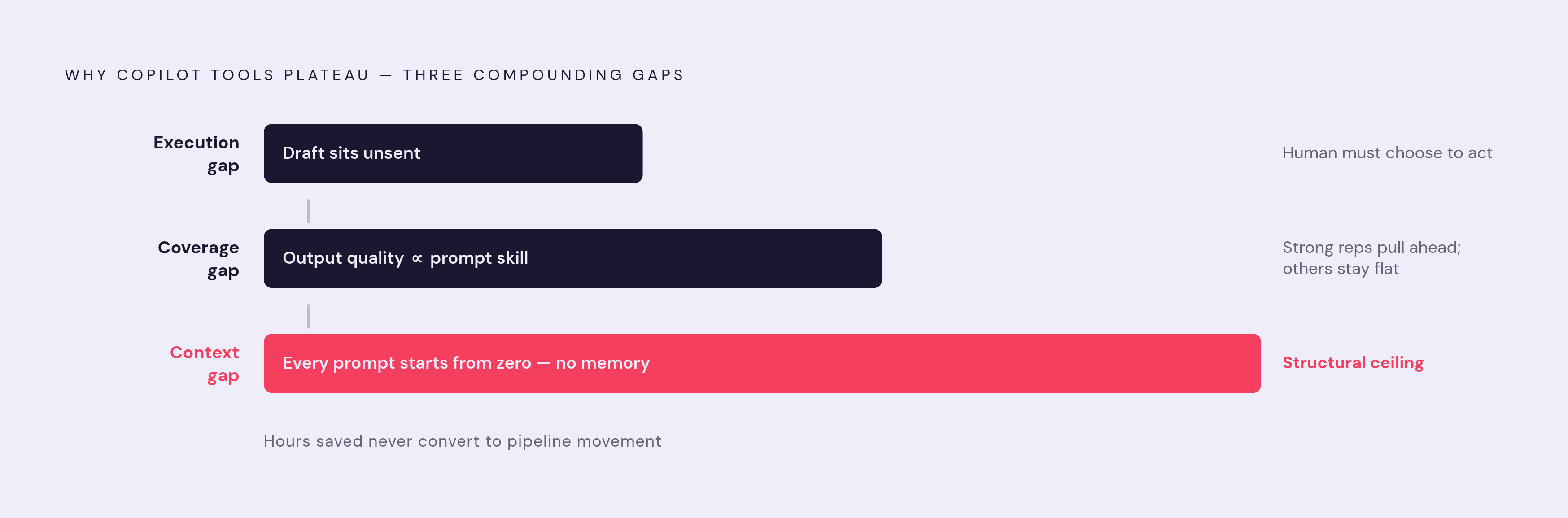
A revenue leader who rolled out AI copilots over the past two years has likely noticed a familiar pattern: reps save time drafting emails, summarizing calls, and filling in CRM fields, but pipeline doesn't move any faster, and the hours saved never seem to turn into new meetings or closed deals. Structurally, copilot-style AI plateaus because a human still has to act on every output before it's worth anything to the business, so the system scales with how much attention a rep has left in the day, not with how many opportunities sit in the pipeline. Prompt-based tools run into three gaps that compound on each other: an execution gap, where the drafted email or summary sits untouched until someone chooses to send it; a coverage gap, where the quality of the output depends on how well the rep writes the prompt, so the reps who were already strong pull further ahead while everyone else stays flat; and a context gap, where every new prompt starts from zero, with no memory of what was tried on that account last week or last quarter. The 2026 Agentic AI Sales Benchmark Report calls this a hard ceiling: in sales environments where opportunities can decay within minutes, a system that needs a human to kick off every step simply can't keep pace. The distinction that matters here, laid out in Mutiny's 2026 agent guide, is the one 2025 vendor relabeling blurred: a tool that auto-fills a CRM field from an email is automation, while a tool that reads a call transcript, picks out the top objection, researches the competitor the buyer mentioned, builds a tailored comparison, and sends it with a personal note is an agent. The Benchmark Report names the mechanism that actually closes that gap "closing the perception-action loop autonomously," built from continuous monitoring, contextual reasoning, autonomous execution, and defined points where the system hands off to a person, with no human required to start each cycle.
What persistent memory actually does inside a sales agent's observe-decide-act loop
An agent built to close that loop runs on a cycle: observe, decide, act. Memory runs through all three steps, and if it's missing, the loop resets every time it fires, so the agent is no sharper about a given account tomorrow than it was today. Cognee's 2026 sales intelligence analysis sorts this into four kinds of memory a sales agent needs, and each one is tied to something that breaks when it's gone. Outcome memory holds what actually led to progress, delay, loss, expansion, or a buyer going quiet; lose it, and the agent repeats a pitch that has already failed once. These four types only become useful once they interlock. This second layer of information is what memory holds onto, and it's the layer a sales agent needs to act well.
How feedback loops convert memory into an agent that improves over time
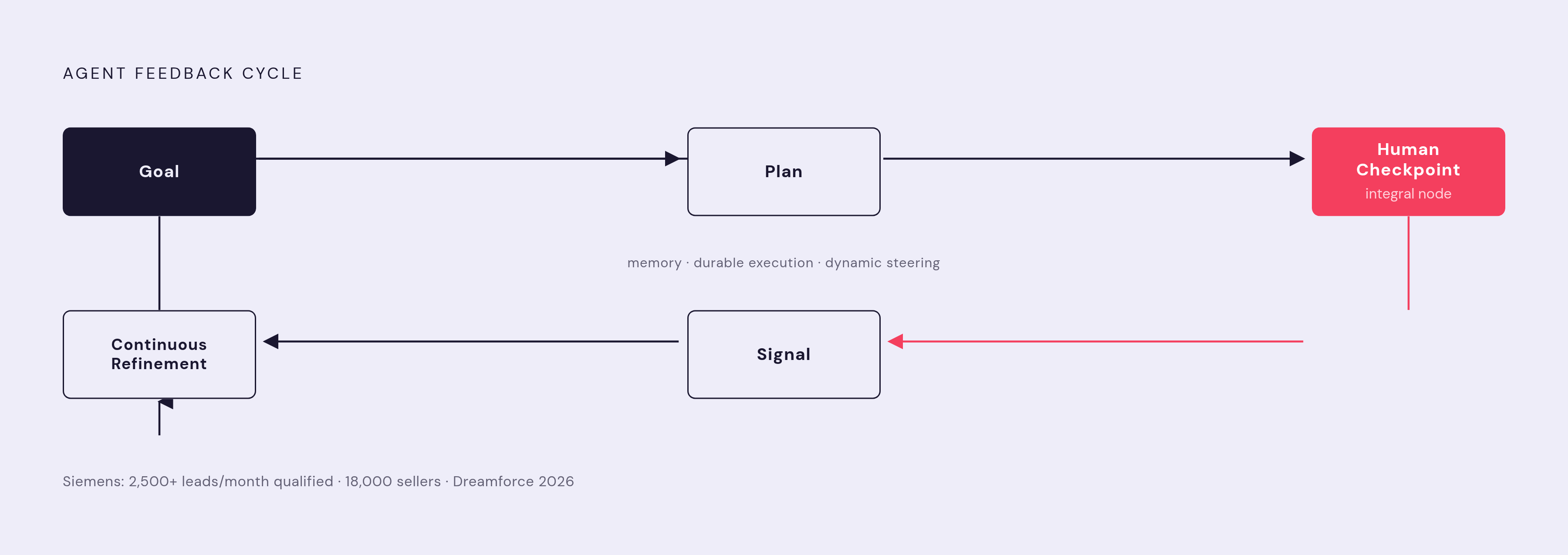
Memory on its own is just a record of what happened. A feedback loop is what ties an action back to its result and lets the agent adjust its next move accordingly, and that link is what separates a system that genuinely learns from one that's just a well-organized archive. The Benchmark Report describes three things that show up once a feedback loop is running: persistent context across every touchpoint on an account, which lets multi-step workflows adjust based on how the prospect actually behaves; a loop connecting actions to results, so the system learns which engagement patterns lead to booked meetings and which messages land with which kinds of buyers; and defined points where the system recognizes it needs a human's judgment and hands off. Over time, this compounds in a way a stateless tool can't match. Amplemarket's 2026 evidence-based assessment describes this directly in what it calls Wave 3 platforms: AI that learns from every rep interaction, improving with each approval and each dismissal a rep gives it. That approval or dismissal is the feedback signal, and it's what closes the loop between memory and improvement. The gap this produces between companies is not small or temporary. The Benchmark Report projects that by 2027, the difference in revenue productivity between agentic leaders and laggards will be substantial, and the gap keeps widening because feedback loops let early movers bank learning that late adopters can't easily catch up on just by switching tools later. None of this replaces human judgment; platforms that build this well treat the human as part of the feedback architecture, not a fallback for when the system fails. The loop runs from goal to plan to a human checkpoint to a signal back into the system to continuous refinement, built on memory, durable execution, and dynamic steering. Humans provide the clearest feedback signal the system gets, especially on the edge cases an agent can't yet resolve on its own.
The Three Implementation Camps on Memory Ownership
Once a revenue or sales leader accepts that memory and feedback loops are the real architecture question, the next decision is which layer of the stack owns the memory, because that choice decides whether an agent's understanding of an account survives a handoff between reps, a team reorg, or a switch to a different tool. Cognee's 2026 analysis sorts the market into three camps. The first is sales platforms that build memory directly into their own product: the memory is richest inside that platform's workflow, but it may not transfer if the company switches tools or needs that context to show up somewhere else in the stack. Cognee frames the decision around two questions to ask of any vendor: where does the agent's understanding of an account actually come from, and how much of it survives once the current task is finished? These questions matter because account context tends to break exactly at organizational seams: when an opportunity gets handed from SDR to AE, when a sales cycle runs long enough that priorities shift, when a rep leaves and someone else inherits the account. If one camp owns the memory, that context carries forward intact; if not, it resets to zero.
How leading platforms implement memory and feedback loops today
Nearly every major sales platform now ships some kind of agent or agent-building tool, but the depth of the underlying memory architecture, and the quality of the feedback loop behind it, differs sharply from one platform to the next, and that difference appears in what each one can do across sessions, beyond what it can do inside a single task.
Y Combinator's track record shows what a platform's compounding advantage can look like over time, so if you want to judge long-run outcomes, not just a single quarter, look there first. That pattern, repeated across DoorDash, Dropbox, Reddit, Instacart, GitLab, Kalshi, and Replit, reflects a compounding effect: each cohort's outcomes build on lessons from the ones before it, the same structural advantage that separates an agent with memory and feedback loops from one that resets every session.
Among sales platforms specifically, Salesforce has moved the furthest in public detail. Hunter, Salesforce's outbound sales agent, was announced September 11, 2026, just ahead of Dreamforce, and runs on what Salesforce describes as a long-horizon runtime built to preserve context, hold onto a plan, and adjust ongoing work across multiple sessions each time. Salesforce attributes this to three capabilities working together: memory, durable execution, and dynamic steering. In October 2026, Salesforce's Agent Optimizer reached general availability, a meta-agent that works alongside teams through the agent's whole lifecycle, helping build and refine agents, test how they perform, and read through session traces to find what needs fixing, making Salesforce one of the first CRM platforms to ship a dedicated tool for managing feedback loop quality. Siemens says it now qualifies more than 2,500 inbound leads a month for 18,000 sellers using two agents working together. Salesforce presented this at Dreamforce 2026 as a cycle: goal, plan, human checkpoint, signal, continuous refinement, with memory, durable execution, and dynamic steering keeping a human explicitly in the loop.
Microsoft launched real-time voice agents in Copilot Studio in April 2026, alongside new agents for Dynamics 365 Contact Center, Sales, and Customer Insights.
Below these larger suites sits a layer of point-solution agents, including Outreach, Apollo, Clay, Clari, 11x's Alice, Default, and Regie.ai, each automating one distinct piece of the sales workflow, whether that's prospecting, data enrichment, pipeline forecasting, multi-channel outreach, or autonomous SDR work. Amplemarket's 2026 assessment tracked a wider field over 18 months of product releases and customer outcomes, including Amplemarket, ZoomInfo, Outreach, Apollo, Salesloft, Clay, Lemlist, Cognism, Lusha, Artisan, 11x.ai, and Regie.ai. CRM software has been priced per seat, per month for more than two decades, but that logic breaks down once an agent is resolving thousands of tasks with no seat attached to any of them, and vendors across this list are now testing outcome-based pricing as an alternative.
Testing Whether a Vendor's Memory and Feedback Loop Claims Are Real
Because nearly every sales software vendor relabeled existing features as agents in 2025, you now have to check those claims yourself before you sign anything. Mutiny's four-part evaluation framework gives you a concrete way to do that, and each test maps onto one of the architectural requirements laid out above. The reasoning test asks whether the agent adjusts its behavior based on context or runs the same steps no matter what it's given: hand the vendor two accounts with genuinely different characteristics and ask it to handle both, and if it takes identical action on each, you have a script wearing an AI label, not a reasoning system. The tool-use test asks whether the agent reaches into multiple systems, CRM, email, outside data providers, content tools, to gather what it needs and act on it; an agent confined to its own platform is limited, and the strongest agents work across the rest of the tech stack. The memory test asks whether the agent's performance improves based on past outcomes, and whether it learns what actually works for the buyer's ideal customer profile, messaging, and sales cycle length. An agent without memory repeats the same plays whether or not they worked last time. A vendor's agent that fails two or more of these tests is a feature, not an agent, and should be priced and evaluated as one; that doesn't make it worthless, only smaller than its marketing suggests. None of this works, though, if the data feeding it is bad. That gap is visible in adoption numbers too: only a minority of B2B suppliers currently run true agentic AI, the autonomous, workflow-driving kind, even though a much larger share say they intend to, and the distance between those two figures is mostly a data problem.
The Compounding Risk of Persistent Memory
The strongest case against persistent memory is that it can work too well in the wrong direction: an agent that stores a hallucinated or injected fact treats that fact with the same confidence as something verified, and in a multi-agent stack, every downstream agent that queries that memory inherits the same error. Governance layers need to address three specific risks here. Reasoning quality makes this worse, not better, as memory grows. A 2026 study on large language model reasoning found that accuracy drops sharply as irrelevant context piles up, a pattern that held across all six models tested, and that this noise hurt both which reasoning path the model chose and the arithmetic it carried out. If you don't filter memory at the point of retrieval, it isn't a knowledge base; it's noise the agent has to work around just to reach a sound decision. Most organizations running AI agents in 2026 have built a memory layer, some kind of vector database, conversation store, or retrieval system, without building a governance layer to sit alongside it, and that gap is exactly where memory poisoning, stale context, access violations, and regulatory exposure build up over time. The field is converging on two responses to this. Going forward, any agent architecture has to show that longer memory produces demonstrably better outcomes, not just longer chains of mistakes nobody caught in time. The platforms that build toward that standard, with real access controls at the point of retrieval, a session trace that records what the agent knew when it acted, and a way to correct or retire stale memory instead of only adding to it, are the ones that will earn the trust enterprise buyers are still deciding whether to extend.